Engineering Hub: get this sized for your plant
Describe your goal, effluent limit or sludge volume and receive a technology shortlist plus a sizing proposal – by email, no phone call required.
<p>Equipment failures in wastewater treatment plants create immediate operational challenges. When a dewatering unit goes offline, sludge accumulates quickly, storage capacity fills, and regulatory compliance becomes threatened. Rental equipment offers a proven bridging solution, but successful deployment depends on thorough preparation and clear communication with your supplier.</p>
<h2>Understanding the urgency of dewatering outages</h2>
<p>A non-functional dewatering system disrupts the entire treatment process. Sludge storage tanks reach capacity within days, forcing operators to make difficult decisions about process adjustments or emergency disposal. The financial impact extends beyond rental costs to include potential regulatory fines, emergency hauling fees, and operational inefficiencies. Rapid deployment of rental equipment minimizes these risks, but only when site conditions and process parameters are clearly defined from the outset.</p>
Key Facts
- Typical rental deployment time
- 24-72 hours after order confirmation
- Common rental duration
- 2 weeks to 6 months
- Mobile unit footprint
- 6-12 m² depending on capacity
<h2>Rent sludge dewatering unit short term: key considerations</h2>
<p>Short-term rental arrangements require precise matching between equipment capabilities and site requirements. Screw press technology offers particular advantages for emergency deployments due to its compact footprint, low maintenance requirements, and ability to handle variable sludge characteristics. Unlike belt presses or centrifuges, screw presses operate effectively with minimal operator intervention, making them ideal for bridging scenarios where staff may already be managing increased workloads due to the primary equipment failure.</p>
<h2>Mobile sludge dewatering container rental specifications</h2>
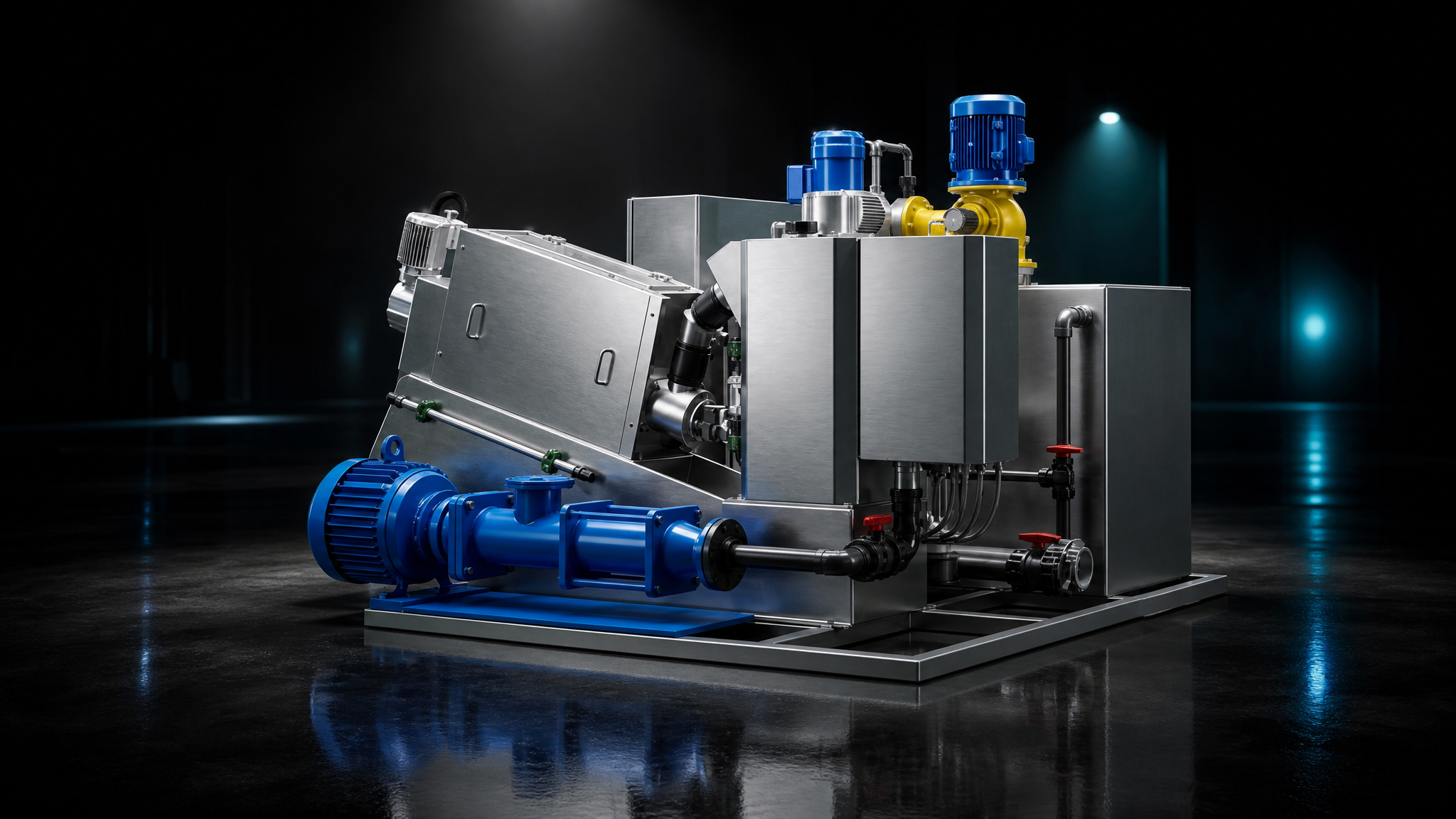
<p>Containerized dewatering units provide plug-and-play functionality for emergency situations. These systems integrate the screw press, polymer dosing equipment, control panels, and ancillary components within a weather-protected enclosure. Site preparation requirements are minimal—typically a level concrete pad, electrical connection, and sludge feed piping. The self-contained design accelerates commissioning and reduces the technical complexity of temporary installations.</p>
| Parameter | What to Clarify |
|---|---|
| Sludge type | Municipal / industrial / mixed |
| Dry solids content | Percentage before and target after dewatering |
| Flow rate | m³/h peak and average |
| Polymer | Supplied by rental company or self-provided |
| Power supply | Available voltage and amperage at connection point |
| Site access | Gate width, overhead clearance, ground bearing capacity |
Before You Call
Before contacting a rental supplier, gather data on your sludge characteristics, available utilities, and site constraints. Having flow rates, solids content, and electrical specifications ready accelerates the quotation process and ensures the proposed equipment matches your actual needs. Delays in providing this information directly extend the time before equipment arrives on site.
<h2>Emergency wastewater treatment equipment hire: the technical match</h2>
<p>Successful rental deployments depend on accurate equipment sizing. Undersized units create bottlenecks that merely shift the problem rather than solving it. Oversized equipment may exceed available power supply or require modifications to site infrastructure. Experienced rental suppliers use your process data to recommend appropriate capacity, accounting for peak flows and the need to work through accumulated sludge backlogs while maintaining ongoing treatment.</p>
<h2>Rental screw press skid mounted: installation requirements</h2>
<p>Skid-mounted configurations offer maximum flexibility for temporary installations. The entire dewatering system mounts on a structural frame, allowing forklift or crane placement without permanent foundations. Connection requirements include sludge feed piping, polymer supply lines, electrical power, and dewatered cake discharge arrangements. Most installations complete within 4-8 hours once the equipment arrives, with commissioning and performance verification adding another 2-4 hours.</p>
Rental Process
- 1Step 1: Assess sludge volume and flow
- 2Measure current accumulation rate and storage capacity to determine urgency
- 3Step 2: Contact supplier with data
- 4Provide sludge characteristics, flow rates, and site specifications
- 5Step 3: Agree on polymer and utilities
- 6Confirm polymer supply arrangements and verify electrical capacity
- 7Step 4: Prepare site access and power
- 8Ensure clear delivery path and ready connection points
- 9Step 5: Commission on arrival
- 10Conduct performance tests and train operators on temporary equipment
<h2>Customized solutions for complex situations</h2>
<p>Standard rental units suit most bridging applications, but some situations require modifications. Industrial sludges with unusual characteristics, limited site access, or integration with existing control systems may need customized solutions. Reputable rental suppliers maintain engineering capabilities to adapt equipment configurations, modify control logic, or provide specialized polymer dosing systems that address site-specific challenges.</p>
How quickly can a rental sludge dewatering unit be delivered?+
Delivery timeframes typically range from 24 to 72 hours after order confirmation, depending on equipment availability and transport distance. Expedited service may be available for critical situations, though this often incurs additional costs. Providing complete technical specifications during initial contact accelerates the entire process.
What information does a rental supplier need before delivery?+
Suppliers require sludge characteristics (type, solids content, flow rate), available utilities (electrical voltage and amperage, water supply), site access details (gate dimensions, surface conditions), and target performance parameters. Polymer compatibility and dosing rates are also essential. Complete data enables accurate equipment selection and prevents deployment delays.
Can a rental screw press handle industrial sludge as well as municipal sludge?+
Modern screw press designs effectively dewater both municipal and many industrial sludge types, including those from food processing, chemical manufacturing, and pulp and paper operations. Performance depends on specific sludge characteristics such as particle size, organic content, and chemical composition. Providing a sludge sample or detailed analysis helps suppliers confirm compatibility and recommend appropriate polymer programs.