Engineering Hub: get this sized for your plant
Describe your goal, effluent limit or sludge volume and receive a technology shortlist plus a sizing proposal – by email, no phone call required.
Cutting sludge disposal cost: what one extra percent of dry solids is worth
For most municipal and industrial wastewater plants, sludge disposal is the dominant operating cost line. Disposal fees are charged per tonne of wet sludge, so every percentage point of dry solids (DS) content added before the truck leaves the gate directly reduces the number of loads – and the invoice.
Many plants accept the dewatering performance they have without calculating what improvement would be worth. This article sets out the arithmetic and the technology options that move the number.
Sludge Disposal – Key Cost Drivers
- Disposal fee basis
- Per tonne wet sludge (landfill, incineration or agricultural use)
- Typical DS range – belt press
- 18–22 % DS
- Typical DS range – screw press
- 20–28 % DS
- Typical DS range – decanter centrifuge
- 22–30 % DS
- Disposal cost sensitivity
- Each 1 % DS increase reduces wet sludge mass by 4–6 %
The arithmetic of dry solids content
The relationship between DS content and wet sludge mass is non-linear. If a plant produces 100 tonnes/d of sludge at 20 % DS, it contains 20 tonnes of dry matter. Increasing DS to 22 % means the same 20 tonnes of dry matter is now contained in 91 tonnes of wet sludge – a reduction of 9 tonnes per day. At a disposal cost of 80 €/t, that is 720 €/d saved, or roughly 260,000 €/year from a single two-percentage-point improvement.
The calculation scales with plant size and disposal cost. Where incineration is the only permitted route, disposal fees of 150–250 €/t are common, making each DS percentage point proportionally more valuable.
9 t/d
Wet sludge reduction when DS rises from 20 % to 22 % (100 t/d dry matter basis)
260,000 €
Estimated annual saving at 80 €/t disposal cost for the above example
4–6 %
Wet mass reduction per 1 % DS increase (typical operating range)
What limits DS content in practice
The achievable DS content depends on sludge type, conditioning and dewatering technology. Biological sludge from activated sludge processes is more difficult to dewater than primary sludge because of its high bound water content. Mixed sludge (primary plus secondary) typically dewaters more readily than secondary sludge alone.
Polymer conditioning is the primary lever for improving dewaterability. Correct polymer selection, make-up concentration and dosing rate can shift DS content by 2–4 percentage points before any equipment change. The optimum operating point balances polymer spend against disposal saving.
Polymer optimisation before equipment investment
Before committing to new dewatering equipment, verify that polymer conditioning is optimised. A jar test programme comparing polymer types and dosing rates often reveals 1–2 % DS improvement at no capital cost. Document the optimum dose and make-up concentration so operators can reproduce it consistently.
Screw press performance and DS targets
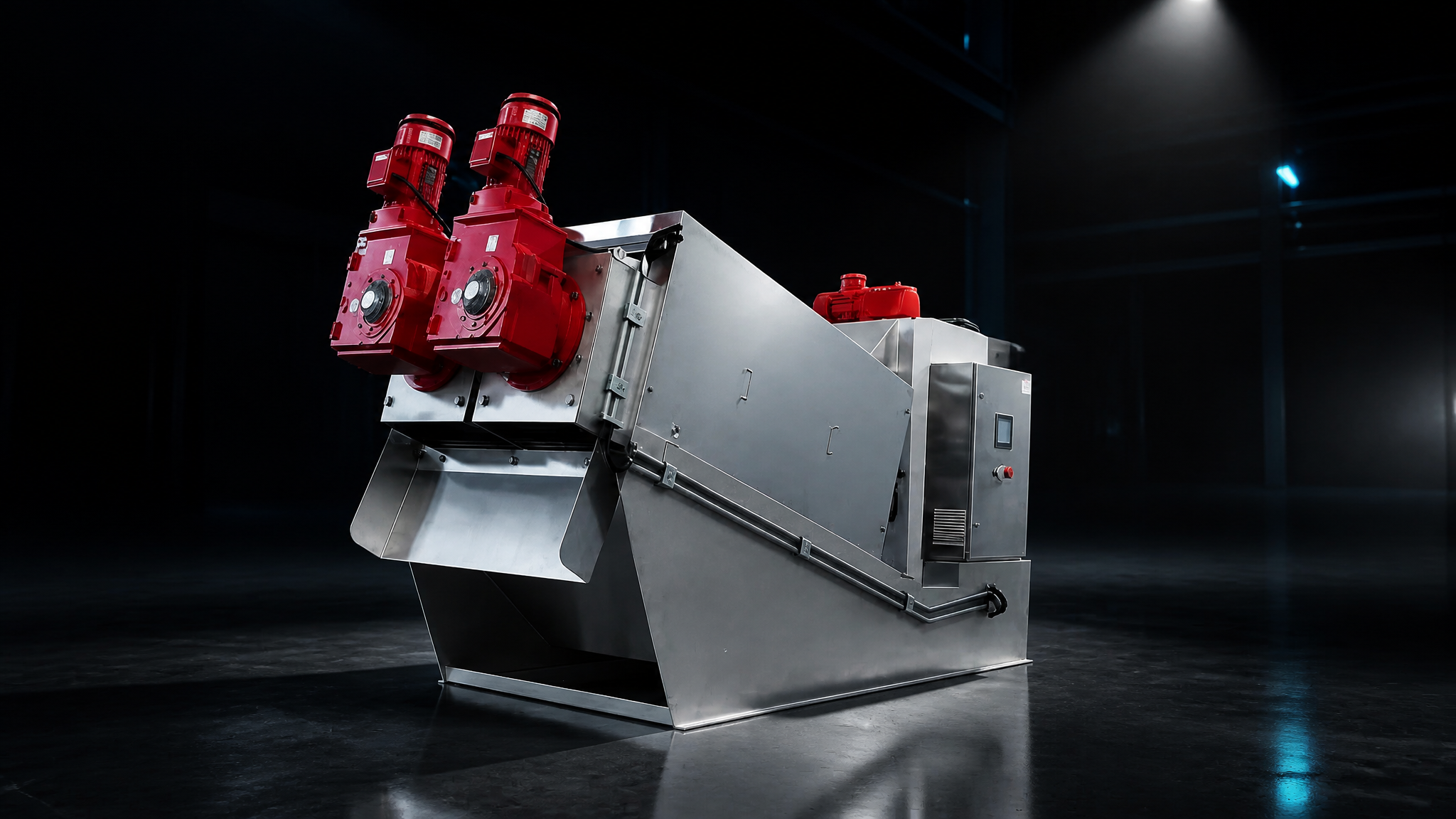
Screw presses are well suited to biological and mixed sludge applications where consistent, unattended operation is required. A modern multi-disc screw press operating on well-conditioned activated sludge typically achieves 20–26 % DS. On mixed sludge, 24–28 % DS is achievable with correct polymer conditioning.
The screw press operates at low rotational speed: low wear, low noise and low energy consumption – typically 0.01–0.04 kWh per kg DS processed. Continuous, self-regulating operation makes it suitable for unmanned night shifts, relevant for plants where labour cost is a significant component of operating expenditure.
| Technology | Typical DS Range | Energy (kWh/kg DS) | Operator Attention |
|---|---|---|---|
| Belt press | 18–22 % | 0.01–0.03 | High (belt washing, tensioning) |
| Screw press (multi-disc) | 20–28 % | 0.01–0.04 | Low (automated) |
| Decanter centrifuge | 22–30 % | 0.05–0.15 | Medium |
| Filter press | 30–45 % | 0.02–0.05 | High (batch cycle) |
Calculating the payback on a new screw press
A structured payback calculation requires four inputs: current DS content, target DS content, annual dry matter production and disposal cost per tonne wet sludge. The annual saving from improved dewatering can then be compared with the capital cost of new equipment.
For a plant producing 5 tonnes DS/d at a current DS of 20 % and a disposal cost of 100 €/t, moving to 24 % DS saves approximately 830 €/d – around 300,000 €/year. A screw press installation in this size range typically costs 150,000–350,000 € installed, giving a simple payback of six months to two years depending on the DS improvement achieved.
Payback Calculation Inputs
- Current average DS content (% from dewatering press reports)
- Target DS content (from equipment supplier performance data or pilot trial)
- Annual dry matter production (tonnes DS/year from sludge balance)
- Disposal cost per tonne wet sludge (current contract rate)
- Polymer cost per tonne DS processed (current consumption and price)
- Capital cost of new equipment including installation and commissioning
Reducing truck movements and their hidden costs
Disposal fees are the most visible cost, but truck movements carry additional costs: driver time, vehicle maintenance, road wear charges and scheduling overhead. Reducing wet sludge volume by 15–25 % through better dewatering can eliminate one or two truck movements per week at a medium-sized plant.
For plants in urban locations, fewer truck movements also reduce community impact and the risk of permit conditions being tightened on traffic grounds.
How do I calculate the financial value of increasing DS content at my plant?+
Start with your annual dry matter production in tonnes DS/year. Divide by your current DS fraction to get current wet sludge tonnes/year. Divide the same dry matter by the target DS fraction to get target wet sludge tonnes/year. Multiply the difference by your disposal cost per tonne. This gives the gross annual saving before polymer cost changes.
What DS content can a screw press realistically achieve on our activated sludge?+
On well-conditioned activated sludge with optimised polymer dosing, a modern multi-disc screw press typically achieves 20–26 % DS. On mixed sludge (primary plus secondary), 24–28 % DS is achievable. A pilot trial on your specific sludge is the most reliable way to confirm the achievable range before committing to capital expenditure.
Is it worth running a pilot trial before purchasing a screw press?+
Yes, particularly when disposal costs are high or the sludge composition is unusual. A pilot trial on site confirms achievable DS content, polymer consumption and throughput capacity under real operating conditions. The data from a trial also strengthens the business case for internal approval and reduces the risk of underperformance after installation.
Equipment we supply for this
Engineering Hub: get this sized for your plant
Describe your goal, effluent limit or sludge volume and receive a technology shortlist plus a sizing proposal – by email, no phone call required.