Engineering Hub: get this sized for your plant
Describe your goal, effluent limit or sludge volume and receive a technology shortlist plus a sizing proposal – by email, no phone call required.
The Role of Polymers
Polymers (flocculation aids) are long-chain molecules that aggregate suspended solids in wastewater into larger flocs. They are a critical component in almost every wastewater treatment plant.
Types of Polymers
- Cationic polymers: Neutralise negative surface charges, ideal for organic sludges
- Anionic polymers: Form bridges between particles, typically used for inorganic sludges
- Non-ionic polymers: Universally applicable, less dependent on particle charge
Preparation and Concentration
Correct make-up concentration is crucial:
- Powdered polymer: 0.1–0.3% make-up concentration
- Emulsion polymer: 0.3–0.5% make-up concentration
- Maturation time: 30–60 minutes for full activation
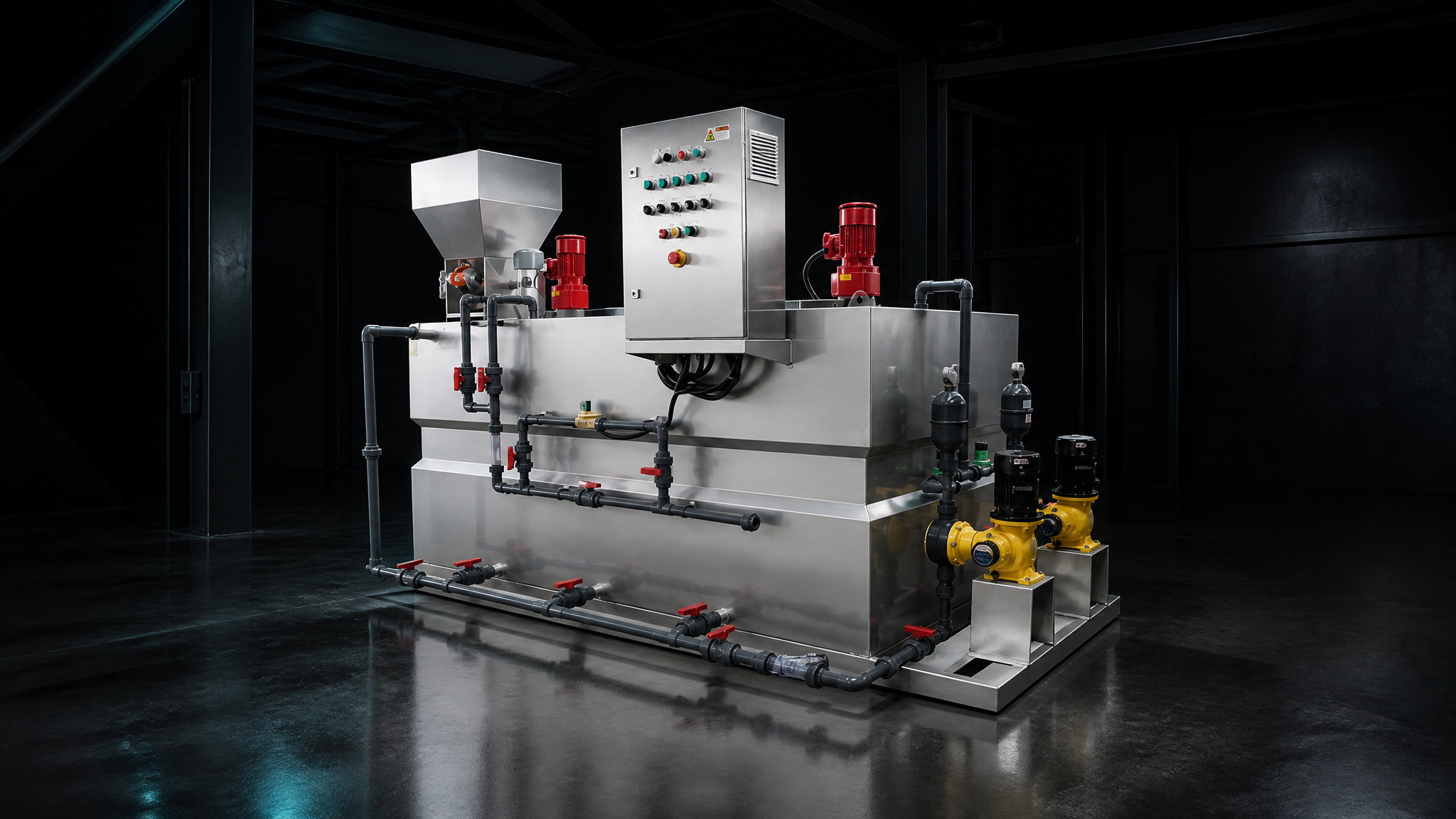
Automatic Dosing Stations
Modern polymer make-up units such as the R+F Polymer Preparation Series offer:
- Fully automated make-up and dosing
- Three-chamber system for continuous availability
- Integrated concentration monitoring
- Demand-based dosing control