Flotation & separation
Dissolved air flotation (DAF)
Dissolved air flotation separates by making solids float rather than settle. Fine air bubbles attach to flocculated particles and lift them to the surface, where they are skimmed off as a thickened float. It is the technology of choice wherever the material to remove is lighter than water or refuses to settle — fats, oils, grease and low-density flocs.
DAF earns its place in three roles: as pre-treatment that protects a downstream biological stage from load peaks, as the step that removes fats and oils to avoid discharge surcharges, and as an efficient sludge thickener.
In brief
Dissolved air flotation is a separation process in which micro-bubbles attach to suspended particles and float them to the surface for removal, used for fats, oils, grease, low-density solids and sludge thickening.
The challenges this solves
Fats, oils and grease surcharges
Food and process industries face steep surcharges when fat and oil loads exceed the sewer limit. DAF removes them at source and turns a recurring surcharge into a controlled process cost.
Protecting the biological stage
Industrial load peaks can overwhelm a biological stage. A DAF ahead of it evens out the load and removes the fraction that would otherwise upset the biology.
Removing solids that will not settle
Low-density flocs, emulsions and phosphorus precipitates settle poorly. Flotation removes exactly the fraction that a settling tank leaves behind.
Technologies we apply
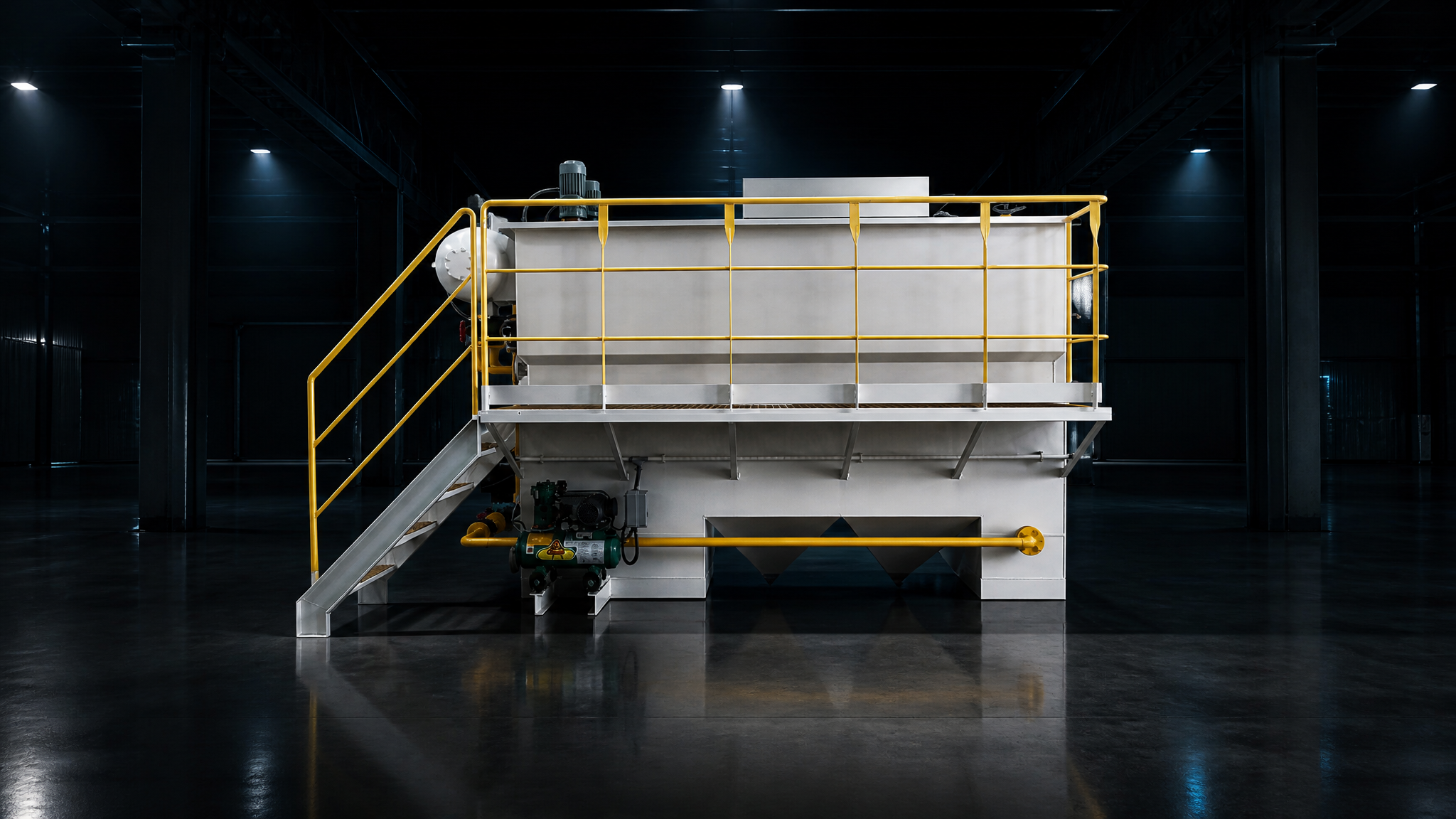
DAF unit
The core flotation system: a saturation and recycle loop generates micro-bubbles that lift flocculated solids to a skimmed surface. Compact, robust and effective on fats, oils and low-density solids.
View equipmentChemical pre-conditioning
Coagulant and flocculant dosing ahead of the DAF builds the flocs that the bubbles can attach to — the chemistry is as important as the flotation itself.
View equipmentLamella-assisted clarification
Where a portion of the load is dense enough to settle, combining flotation with plate settling can reduce the required footprint. We choose by particle density, not by habit.
View equipmentWhat is achievable
The ranges below are typical for industrial DAF duties. Actual removal depends on the pollutant, the coagulation chemistry and the hydraulic load, and is confirmed by jar tests and a pilot.
| Parameter | Typical range |
|---|---|
| Fats, oils & grease removal | typically ~90–98 % |
| Suspended solids removal | typically ~90–95 % |
| Total phosphorus (with precipitation) | to low single-digit mg/l |
| Surface loading rate | ~5–12 m/h (application-dependent) |
| Float solids | ~3–5 % DS |
How we size it
A DAF is sized on hydraulic and solids/oil load together with the required removal. The inputs we need are:
Key sizing inputs
- Average and peak flow
- Inlet concentrations (FOG, TSS, phosphorus)
- Required effluent quality or sewer limit
- Temperature and pH of the wastewater
- Whether the float is for disposal or thickening
Rent or pilot first
A mobile DAF lets you verify coagulation chemistry and removal on your own wastewater before you specify a permanent unit, and can cover a temporary or seasonal load in the meantime.
Rent or pilot firstRelated reading
Frequently asked questions
When is DAF better than settling?
Whenever the material is lighter than water or settles poorly — fats, oils, emulsions and low-density flocs. For dense, fast-settling solids a lamella settler is often the better fit.
Can DAF remove phosphorus?
Yes, in combination with precipitation: the phosphorus is converted to particles that the flotation then removes, reaching low single-digit values.
How much fat and oil can it remove?
With correct coagulation, a high fraction of the fats, oils and grease load — typically enough to move a site back under its sewer surcharge limit.
Does it need chemicals?
Almost always. Coagulant and flocculant build the flocs the bubbles attach to; the chemistry is optimised in jar tests before start-up.
Engineering Hub: get this sized for your plant
Describe your goal, effluent limit or sludge volume and receive a technology shortlist plus a sizing proposal – by email, no phone call required.