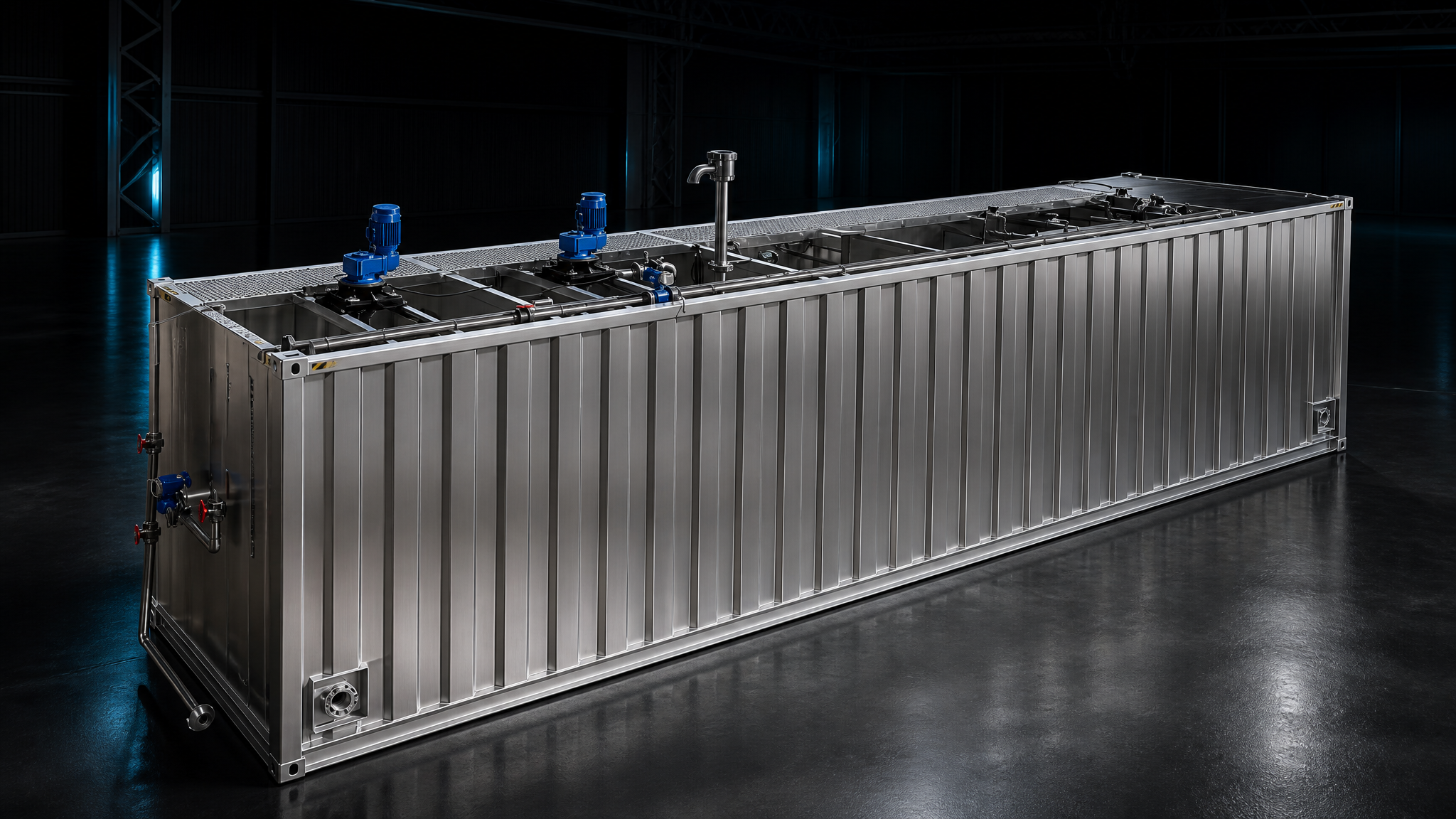
Production growth often reaches the limits of an existing aeration tank before a plant is ready to build new basins. In that situation, the best option is often to increase biological capacity inside the same tank volume by converting part of the suspended-growth volume into attached-growth treatment. For engineers, the real value of MBBR is not only more biomass, but a more compact and controllable loading response.
Engineering Hub: get this sized for your plant
Describe your goal, effluent limit or sludge volume and receive a technology shortlist plus a sizing proposal – by email, no phone call required.
increase biological capacity existing aeration tank
The first question is usually whether the tank can accept more load without losing effluent stability. In many industrial applications, MBBR can increase nitrification or organic removal capacity by about 30 to 70 percent, depending on influent characteristics, oxygen demand, and available mixing energy. The actual gain depends on how much active surface area is added and whether oxygen transfer remains sufficient at the higher biomass concentration.
MBBR carrier filling ratio design
Carrier fill ratio is the main capacity lever. Typical industrial designs use about 30 to 50 percent media fill for robust carbon removal, while nitrification-focused systems often operate around 40 to 60 percent if the tank geometry and aeration pattern support it. Higher fill can increase available biofilm area, but it also raises mixing demand, limits bubble contact, and can reduce effective mass transfer if the tank is not designed carefully.
MBBR vs activated sludge footprint
Compared with conventional activated sludge, MBBR usually delivers more biological capacity in the same footprint because the biofilm retains biomass even under load swings. That makes it attractive where the basin area is fixed and process intensification is needed. The trade-off is that the system becomes more sensitive to aeration layout, carrier retention, and hydraulic short-circuiting.
The oxygen side of the design is often the limiting factor, not the carrier surface itself. For nitrifying MBBR systems, practical oxygen transfer demand often falls in the range of 1.0 to 2.5 kg O2 per kg of ammonium oxidized, depending on temperature, alkalinity, and side reactions. Fine-bubble aeration can improve transfer efficiency, but carrier movement must remain uniform across the basin so biofilm does not starve in dead zones.
moving bed biofilm reactor industrial wastewater
Industrial wastewater brings variable COD, toxicity, temperature shifts, and intermittent peaks. An MBBR can absorb these variations better than many suspended-growth systems, but only if hydraulic design avoids excessive shear and preserves enough contact time for the target reactions. For high-strength streams, a staged tank arrangement often works better than pushing one basin to a very high fill ratio.
Hydraulic design should be checked at the same time as oxygen transfer. Recommended design targets often include a detention time that supports the slowest biological step, circulation that prevents carrier settling, and a velocity field that keeps media moving without excessive abrasion. In practice, this means balancing mixer power, diffuser placement, and compartment shape rather than assuming more air alone will solve the capacity problem.
[Engineering priorities]
- Label
- Value
- Carrier fill ratio
- Commonly 30 to 60 percent, depending on treatment goal
- Oxygen transfer efficiency
- Often improved by fine-bubble aeration and optimized diffuser layout
- Hydraulic objective
- No dead zones, no carrier washout, no short-circuiting
70 percent
Potential increase in biological capacity in optimized retrofit cases
50 percent
Typical upper range for many industrial carrier fill designs
2.5 kg O2/kg NH4-N
Practical oxygen demand range for nitrifying operation
[Avoid overfilling the basin]
More carriers do not automatically mean more capacity. If fill ratio is pushed too high, oxygen transfer efficiency, mixing quality, and solids separation can all decline at the same time. The tank should be checked as a coupled biological-hydraulic system, not as a media container.
[How to optimize MBBR capacity]
- 1Step 1: Calculate the limiting load, then confirm whether carbon removal, nitrification, or hydraulic residence time is the bottleneck
- 2Step 2: Select a carrier fill ratio that matches the target reaction and available aeration power, typically in the 30 to 60 percent range
- 3Step 3: Verify oxygen transfer with the selected diffuser grid, basin depth, and air demand under peak load conditions
- 4Step 4: Check carrier retention, mixing pattern, and compartment geometry to avoid dead zones and short-circuiting
How does MBBR carrier fill ratio affect biological capacity?+
A higher fill ratio increases the available protected surface area for biofilm growth, which usually raises biological capacity. However, beyond a practical range, extra media can reduce oxygen transfer and mixing quality, so the net gain may flatten or even decline.
What oxygen transfer rate is needed for MBBR nitrification?+
For nitrification, the design must supply enough oxygen for the ammonia load plus process losses, and practical demand often falls around 1.0 to 2.5 kg O2 per kg of ammonium oxidized. The exact target depends on temperature, influent quality, and how efficiently the aeration system transfers oxygen into the water.
How to increase biological capacity without building a new aeration tank?+
The most effective approach is to convert the existing basin to MBBR operation and optimize the carrier fill ratio, aeration system, and hydraulic flow pattern. In many cases, that adds capacity in the same tank volume while avoiding civil construction, provided the tank can support the added oxygen and mixing demand.
Equipment we supply for this
Engineering Hub: get this sized for your plant
Describe your goal, effluent limit or sludge volume and receive a technology shortlist plus a sizing proposal – by email, no phone call required.