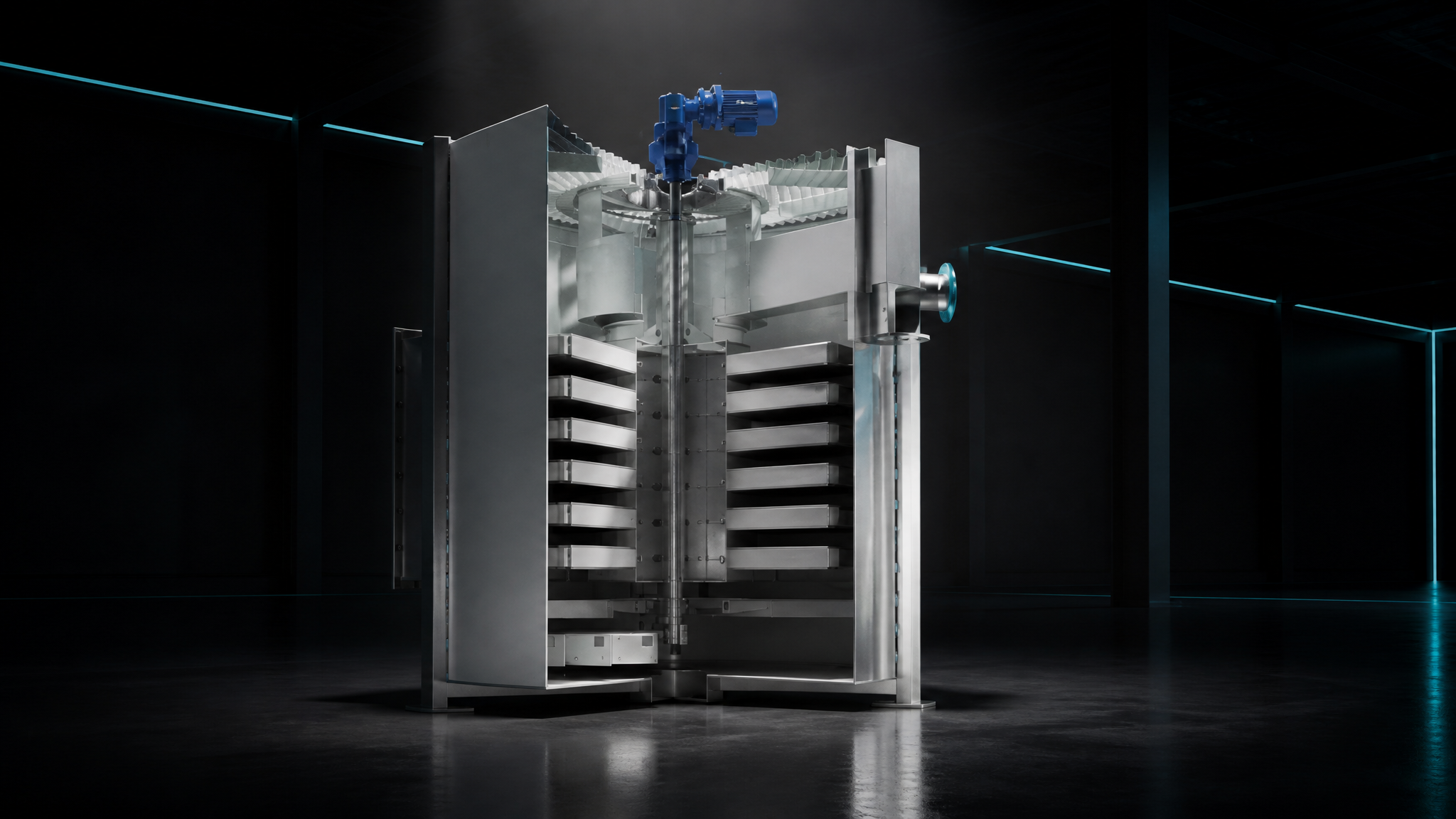
Cloth filtration and sand filtration are both widely used for tertiary treatment in municipal and industrial wastewater plants. When space is limited or retrofitting into existing structures is required, the differences between these two filtration technologies become particularly significant.
Pile cloth media filtration uses a synthetic pile fabric as the filter medium, while sand filtration relies on a bed of granular material. Both methods are effective for removing suspended solids and reducing effluent turbidity, but their design and operational characteristics diverge in ways that directly impact plant footprint, hydraulic profile, and ease of integration into tight spaces.
Engineering Hub: get this sized for your plant
Describe your goal, effluent limit or sludge volume and receive a technology shortlist plus a sizing proposal – by email, no phone call required.
Footprint and Space Requirements
One of the most critical factors in tertiary filter selection for space-limited sites is the required footprint. Pile cloth media filters are typically designed as compact, modular units that can be installed in a vertical or horizontal configuration. In contrast, sand filters—whether gravity or pressure types—require a larger surface area to achieve comparable filtration rates.
Footprint Comparison
- Label
- Value
- Cloth filter hydraulic loading rate
- 4–10 m³/(m²·h)
- Sand filter hydraulic loading rate
- 3–6 m³/(m²·h)
- Typical cloth filter depth
- 0.5–1.5 m
- Typical sand filter depth
- 1.0–2.0 m
A higher hydraulic loading rate and lower bed depth for pile cloth media filters translate to a smaller overall footprint for the same treatment capacity. This advantage is especially pronounced in retrofit scenarios, where available area is often fixed by existing civil structures.
Head Requirement and Hydraulic Profile
Headloss across the filter is another important consideration, especially when integrating into existing gravity flows. Pile cloth media filters are engineered for low headloss operation, often less than 0.5–1.0 m in clean conditions. Sand filters, depending on media depth and degree of fouling, typically require a higher minimum head—often 1.0–2.5 m or more.
This difference can be decisive for retrofit filtration projects, where additional pumping or structural changes to increase available head may be impractical.
Backwash Water Demand and Solids Handling
Both filter types require periodic cleaning to remove accumulated solids. Sand filters are usually backwashed with filtered water at relatively high rates, resulting in significant backwash water volumes—commonly 2–6% of the treated flow. Pile cloth media filters use a combination of suction and low-pressure water for cleaning, with backwash water demand often in the range of 0.5–2% of the treated flow.
| Parameter | Cloth Filtration | Sand Filtration |
|---|---|---|
| Backwash water demand (% of flow) | 0.5–2 | 2–6 |
| Backwash frequency | 1–6/h | 1–4/d |
| Solids concentration in backwash | 1–4% | 0.2–1.5% |
Pile cloth media filters also tend to produce a more concentrated backwash stream, which can ease solids handling and downstream dewatering. Sand filter backwash is more dilute and may require additional treatment.
Filtrate Quality and Performance
Both technologies can achieve high levels of suspended solids removal and low effluent turbidity. Typical filtrate quality for both systems is <5 mg/L TSS and <1–2 NTU turbidity under normal conditions. Pile cloth media filtration can be fitted with finer pile heights for enhanced particle retention if needed.
Energy Consumption and Civil Works
Energy demand for both systems is generally low, but pile cloth media filters may have a slight advantage due to less frequent or lower-intensity backwash cycles. Sand filters require pumps capable of delivering higher backwash flows and may also need additional pumping if significant head is required.
Civil works for pile cloth media filters are often less extensive, given the smaller footprint and lower structural loads. Sand filters, particularly in gravity configurations, require deep basins and larger reinforced concrete structures.
Summary Table: Cloth Filtration vs Sand Filtration
| Aspect | Pile Cloth Media Filtration | Sand Filtration |
|---|---|---|
| Footprint | Compact | Larger |
| Hydraulic loading rate (m³/(m²·h)) | 4–10 | 3–6 |
| Typical headloss (m) | 0.3–1.0 | 1.0–2.5 |
| Backwash water (% of flow) | 0.5–2 | 2–6 |
| Backwash solids (%) | 1–4 | 0.2–1.5 |
| Filtrate quality (TSS, mg/L) | <5 | <5 |
| Civil works | Minimal | Extensive |
| Retrofit suitability | High | Moderate–Low |
Selection Guidance by Situation
When selecting a tertiary filtration technology for an upgrade or a new build with space constraints, consider the following:
- Pile cloth media filtration is generally better suited for compact installations, upgrades within existing tanks, or sites with limited available head.
- Sand filtration remains a robust option where space and head are available, and where operators are familiar with granular media systems.
- Backwash water availability and solids handling capacity should be factored in, especially if the site has limited capacity for handling dilute backwash streams.
- For retrofits, the ability to install a filter within existing tanks or channels can significantly reduce project cost and complexity.
Can pile cloth media filters be retrofitted into existing sand filter basins?+
In many cases, yes. The modular design and low headloss allow installation within existing structures, subject to hydraulic and structural review.
How often do cloth media filters require backwashing?+
Typical backwash frequency ranges from 1 to 6 times per hour, depending on solids loading and filter design.
Are there differences in maintenance requirements?+
Cloth media filters generally require less frequent maintenance, but both systems need periodic inspection and cleaning of moving parts and valves.
What is the typical lifespan of the filter media?+
Pile cloth media can last 5–10 years or more, depending on operating conditions and cleaning frequency. Sand media may need periodic topping up or replacement.
How do the systems handle hydraulic surges?+
Both systems can accommodate moderate hydraulic fluctuations, but pile cloth media filters typically respond faster to changing loads due to their modular operation.