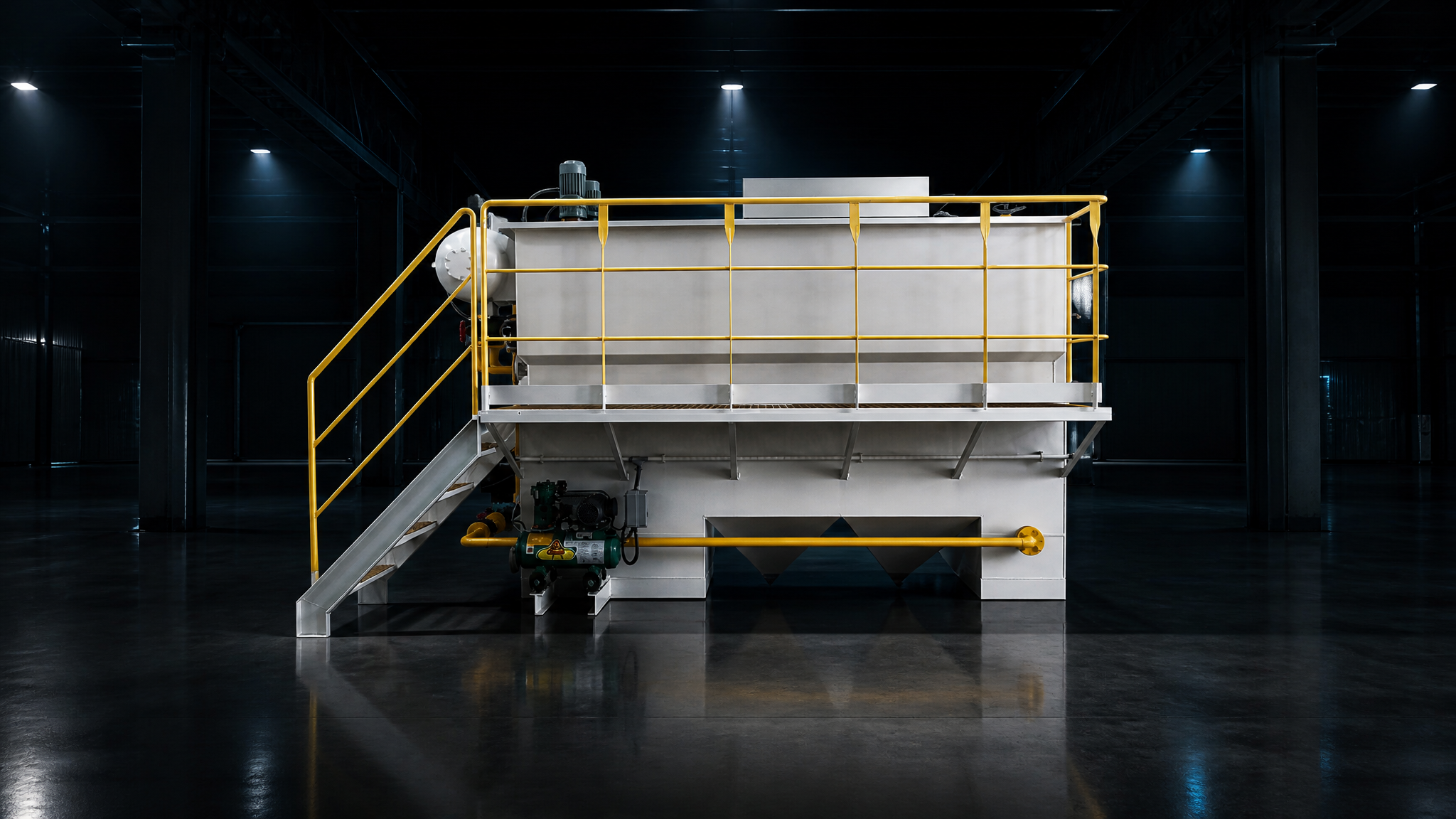
Food processors typically do not pay sewer surcharges because of one single parameter. The invoice usually reflects a combination of fats, oils and grease, suspended solids, and elevated COD, often amplified by short production peaks and hot cleaning cycles.
[DAF design basis for food wastewater]
- Parameter
- Typical engineering range
- FOG in raw wastewater
- 200 to 3,000 mg/L, sometimes higher during cleaning events
- Temperature at discharge
- 20 to 45 °C, with cooler streams behaving differently in flotation
- Peak flow factor
- 1.5 to 3.0 times average flow, depending on batch production and washdown
- Hydraulic loading rate
- About 5 to 15 m³/m²·h for food-industry DAF units
- Recycle ratio
- Roughly 10 to 40% of influent flow
- Air-to-solids ratio
- Commonly 0.02 to 0.06 kg air/kg removed solids
- Expected removal focus
- FOG, suspended solids, and a meaningful share of COD-bound particulate load
| Parameter | Typical Range |
|---|---|
| Hydraulic loading rate | 3–8 m³/(m²·h) |
| Air-to-solids ratio (A/S) | 0.005–0.060 g air/g solids |
| Recycle ratio | 25–50 % of influent flow |
| Coagulant dose (FeCl₃) | 20–80 mg/l |
| FOG removal efficiency | 85–98 % |
Engineering Hub: get this sized for your plant
Describe your goal, effluent limit or sludge volume and receive a technology shortlist plus a sizing proposal – by email, no phone call required.
DAF for food processing wastewater fats and oils
A DAF unit is most effective when fats and oils are present as free or emulsified droplets attached to suspended solids. In many food plants, the wastewater contains a mixture of wash water, product losses, rinse water, and cleaning chemicals.
Start with three characterisation layers:
- Mass balance by source: separate process drains, floor washdown, equipment cleaning, and utility water. This helps identify which streams should be routed to the DAF.
Temperature is especially important. Warm wastewater can reduce viscosity and improve rise rates, but it may also increase oil solubility or destabilise emulsions.
Dissolved air flotation sizing guidelines
Sizing a food-industry DAF is a balance between contact time, surface loading, recycle saturation, and sludge handling. The following ranges are typical engineering starting points, not guarantees:
- Hydraulic loading rate: 5 to 15 m³/m²·h for food wastewater. Higher values may work for low-solids streams, but FOG-heavy effluents generally benefit from conservative loading. - Recycle ratio: 10 to 40% of influent flow.
In practice, DAF sizing is usually based on the peak design flow, not the average daily flow. For a food plant with batch production, the DAF should handle the worst expected hydraulic event while maintaining a stable separation zone.
Worked example
Assume a food plant discharges:
- Average wastewater flow: 18 m³/h
- Peak flow during washdown: 32 m³/h
- Raw FOG: 1,200 mg/L
- Raw TSS: 700 mg/L
- Influent COD: 3,500 mg/L
- Target after DAF: FOG below 200 to 300 mg/L, TSS reduced substantially, and COD lowered enough to mitigate surcharge exposure
A reasonable preliminary design might use:
- Design flow: 32 m³/h
- Hydraulic loading rate: 8 m³/m²·h
- Required flotation surface area: 4.0 m²
If the selected unit includes a safety margin and process flexibility, the actual design area may be somewhat larger, for example 5 to 6 m². At a recycle ratio of 25%, recycle flow would be about 8 m³/h.
This example shows why DAF sizing cannot be reduced to a simple catalog selection. The best design comes from actual samples, peak flow data, and an understanding of the plant’s cleaning cycle.
Reduce COD surcharge industrial discharge
Municipal surcharge reduction is usually demonstrated with a combination of influent and effluent data over a representative operating period. The municipality may use COD, FOG, TSS, and sometimes flow-based load calculations.
To build a credible case, document:
- baseline wastewater composition over several production days
- the range of cleaning events and batch peaks
- DAF operating settings, including recycle, pressure, and chemical dose
- sampled effluent results from stable operation
- sludge production and disposal route
If COD is mainly associated with emulsified fats and suspended organics, flotation can materially reduce the surcharge basis. If a large portion of COD is dissolved, DAF alone may not be sufficient and should be paired with process segregation, equalisation, or downstream biological treatment.
[Engineering note]
A DAF should be sized for the wastewater you actually discharge, not the wastewater you hope to discharge. Plants that only sample during quiet production periods often under-design the unit and then struggle during washdown or high-fat runs.
Grease removal before municipal sewer
Before final sewer discharge, the most important design objective is stable grease removal. That requires three things: enough residence time for bubble-particle contact, enough air release to lift the floc, and enough sludge collection capacity to avoid carryover.
A practical implementation sequence is:
- Characterise raw wastewater across shifts.
A well engineered DAF can turn an unpredictable surcharge problem into a manageable operating condition. The key is disciplined sizing, not oversized hardware alone.
[What to confirm before final DAF sizing]
- Measure FOG, COD, TSS, pH, temperature, and peak flow
- Identify washdown and cleaning chemicals that affect flotation
- Establish the true design flow, not only average flow
- Confirm whether equalisation is needed upstream
- Perform jar testing for coagulant and polymer selection
- Define sludge disposal and maintenance access
How do I size a DAF for food processing wastewater fats and oils?+
Use peak hydraulic flow, FOG/TSS data, and jar test results as the starting point. Then check hydraulic loading rate, recycle ratio, and air-to-solids ratio against the expected load profile.
Can a DAF reduce COD surcharge industrial discharge charges?+
It can reduce the particulate and grease-associated portion of COD, which often helps lower surcharge exposure. Dissolved COD may require equalisation, source control, or biological treatment.
What are practical dissolved air flotation sizing guidelines?+
For food wastewater, a conservative starting range is 5 to 15 m³/m²·h hydraulic loading, 10 to 40% recycle, and 0.02 to 0.06 kg air/kg removed solids, with final values confirmed by testing.
Equipment we supply for this
Engineering Hub: get this sized for your plant
Describe your goal, effluent limit or sludge volume and receive a technology shortlist plus a sizing proposal – by email, no phone call required.