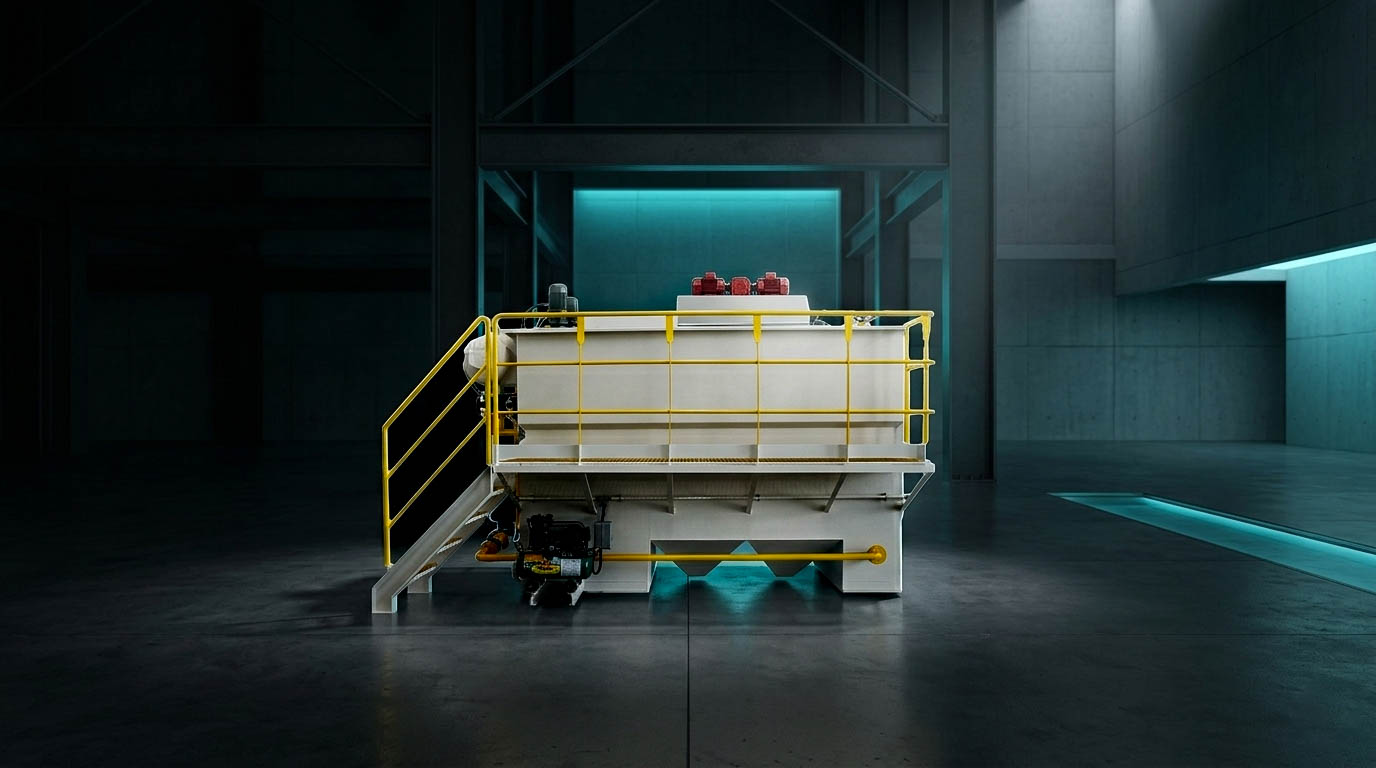
When production is batch-based, cleaning cycles overlap, or raw material use varies by shift, the biological stage often sees the consequences first. Short hydraulic and organic peaks can wash out performance, raise sludge production, and trigger process instability. The engineering task is not only to treat wastewater, but to attenuate the peak so the biology receives a more predictable feed.
Engineering Hub: get this sized for your plant
Describe your goal, effluent limit or sludge volume and receive a technology shortlist plus a sizing proposal – by email, no phone call required.
Engineering decision process
1) Quantify the load peaks
Start by converting the production schedule into pollutant and flow scenarios. Combine batch discharge timing, cleaning-in-place events, and process changeovers with measured wastewater data. At minimum, define:
- average daily flow and peak hourly flow
- COD, BOD, FOG, TSS, and conductivity ranges
- duration of each peak event
- frequency per day or week
- temperature and pH fluctuations
A useful design basis is the contrast between average load and maximum short-term load. If the peak lasts 30 to 90 minutes, the DAF system can be engineered as an attenuation step rather than as a full replacement for equalization. For highly variable production, a buffer tank upstream is often necessary to decouple discharge timing from DAF feed stability.
2) Translate peaks into design targets
The goal is to lower the amplitude of the shock before the biological reactor. Typical design targets are expressed as reduction of peak TSS, emulsified fats, and part of the particulate COD. In practice, the DAF stage is sized to achieve stable hydraulic loading, reliable floc formation, and repeatable sludge removal at the worst credible influent condition.
:::keyfacts DAF design basis
Parameter | Typical engineering range
Influent flow rate | 1.0 to 3.0 times average flow
Hydraulic retention in flotation zone | 10 to 25 minutes
Recycle ratio | 15% to 50%
Saturation pressure | 4 to 6 bar
Target pH window | 6.0 to 8.5, process dependent
Coagulant dosage | Jar-test validated, site specific
Flocculant dosage | Low-dose polishing, site specific
:::
:::solution dissolved-air-flotation
Dissolved-air flotation removes dispersed solids, fats, and part of the colloidal fraction by attaching microbubbles to flocculated particles and floating them into a sludge layer. For peak attenuation, the unit should be configured to tolerate sudden increases in solids and surfactants without losing bubble generation or sludge removal stability.
How to size the unit
Size the DAF on the worst operational case, not the average day. The key checks are:
- peak flow through the contact and separation zones
- solids loading to the surface
- recycle saturation capacity
- skimmer and sludge handling capacity
- chemical mixing time before flotation
If the plant has discrete batch releases, consider a feed tank or balance tank to smooth the influent to the DAF. If the peaks are mainly concentration-driven rather than flow-driven, the flotation unit must be designed for higher chemical demand and longer floc maturation.
Operational parameters that protect biology
To keep the biological stage stable, the DAF should deliver a predictable effluent quality and sludge consistency. Important settings include:
- pH control to maintain effective coagulation
- rapid mix energy high enough to disperse coagulant, but not destroy floc
- flocculation energy that supports large, buoyant flocs
- recycle flow and pressure stable enough to create fine bubbles
- sludge removal intervals that avoid blanket overload
A commissioning program should test chemical dose steps, recycle pressure, sludge discharge frequency, and the effect of production peaks on effluent variability. The best setting is not the one with the lowest chemical consumption, but the one that keeps the downstream biology within its comfort zone.
:::table Peak attenuation and operating focus
Topic | Engineering focus
Equalization | Smooth batch releases and reduce hydraulic shock
Coagulation | Destabilize emulsions and colloids under peak conditions
Flotation | Separate the concentrated solids fraction reliably
Sludge handling | Prevent carryover during high-solids periods
Biology protection | Maintain steady COD and TSS to the reactor
:::
:::info Commissioning priorities
During startup, document the wastewater profile under real production conditions. Do not rely only on lab samples from quiet periods. A week of mixed-shift monitoring often reveals whether the critical problem is flow surges, surfactant spikes, or a hidden high-COD batch stream.
If the biological stage still experiences instability after DAF installation, review three items first: peak timing versus tank volume, chemical response time, and sludge blanket control. In many cases, the flotation unit is correctly built, but the upstream feed pattern is still too erratic.
:::checklist What to verify before handover
- confirm peak scenarios from production planning
- validate jar tests across low, normal, and peak conditions
- confirm recycle pressure and air saturation stability
- check sludge pumping capacity during maximum solids load
- measure DAF effluent at multiple points in the production cycle
- compare biological inlet variability before and after startup
- document operator setpoints and alarm limits
:::
:::faq
Q: Is a DAF unit enough without equalization?
A: It can be enough for moderate peaks, but batch-heavy production usually benefits from upstream buffering. The decision depends on peak duration, frequency, and the sensitivity of the biology.
Q: Which pollutants does DAF remove best?
A: It is strongest on suspended solids, fats, oils, greases, and part of the particulate COD. Dissolved organic load is usually only reduced indirectly through associated solids removal.
Q: What is the most common commissioning mistake?
A: Setting chemical dosage based on average wastewater rather than peak conditions. The result is unstable floc formation and poor protection of the biological stage.
:::
:::products daf, mbbr
Consider a DAF system when the main task is load peak attenuation before biological treatment. For plants that still need a robust downstream reactor with process resilience, an MBBR can complement the pretreatment by handling variable organic loads more stably.
:::
:::cta
If you are defining a pretreatment concept for fluctuating production, start with measured peak data and a clear protection target for the biological stage. For engineering support and project discussion, contact [email protected].
:::