Engineering Hub: get this sized for your plant
Describe your goal, effluent limit or sludge volume and receive a technology shortlist plus a sizing proposal – by email, no phone call required.
- Topic
- Engineering focus
- Use case
- Buffering production-related load peaks before the biological stage
- Main objective
- Stabilise flow, COD/BOD shock loads, and solids carryover
- Sizing approach
- Derive peak factors from production schedules and batch discharges
- Key design variables
- Hydraulic retention, organic mass buffering, sludge handling, recycle ratio, clarification robustness
- Typical operating range
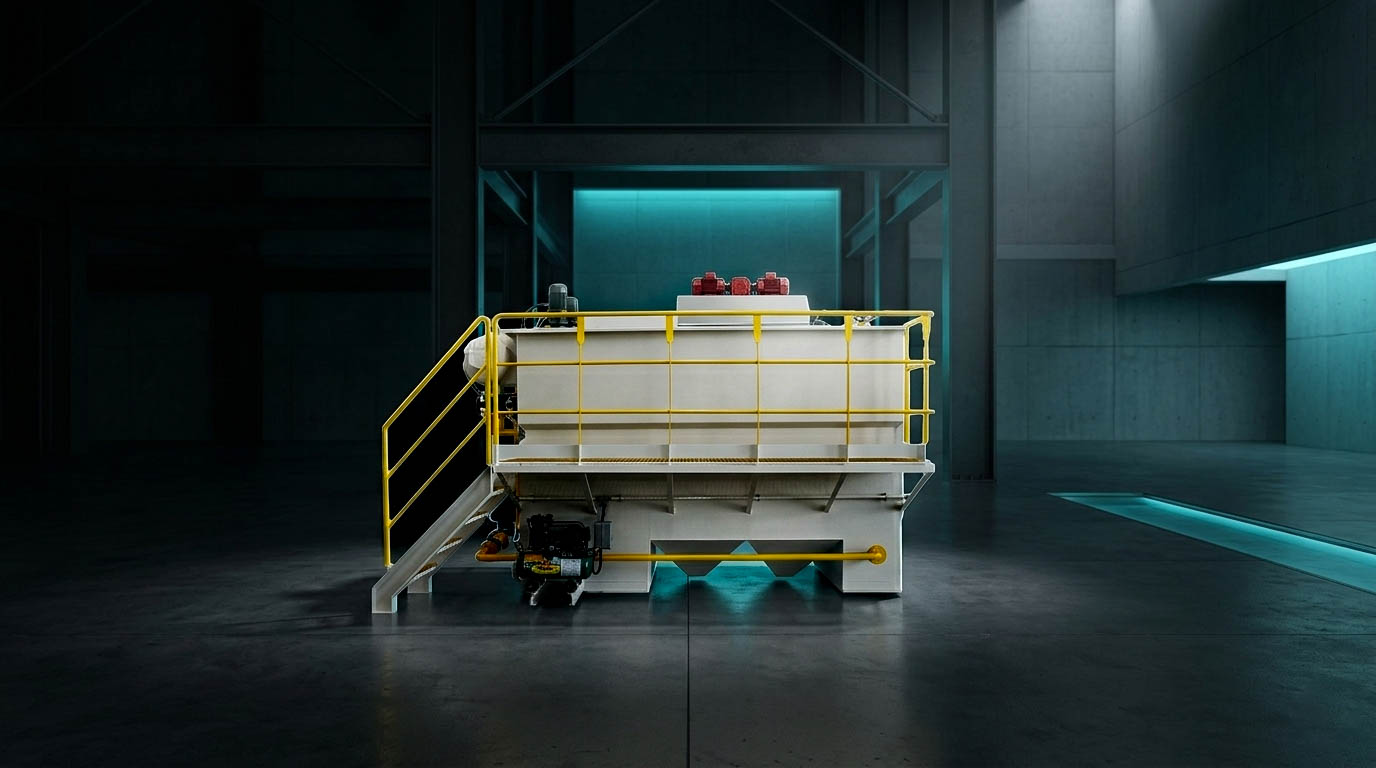
- Industrial DAF units are often designed for variable flows with short-term peak absorption in the range of 1.5 to 3.0 times average flow, depending on influent profile
- Integration concept
- DAF for physical-chemical load smoothing, MBBR for resilient biological polishing
| Design item | Engineering question |
|---|---|
| Peak flow profile | Which 15-minute and 1-hour peaks occur during cleaning or changeover? |
| Peak COD/BOD mass | How much organic load is released during the worst discharge window? |
| DAF separation duty | Which fraction of COD is particulate, colloidal, or floatable? |
| Upstream buffer volume | How much flow must be stored to prevent overload of the biology? |
| Recycle and saturation | Is enough dissolved air available to keep capture stable at peak flow? |
| Sludge handling | Can sludge withdrawal match the expected solids mass without backsliding? |
| MBBR tolerance | Can the downstream biology absorb the remaining variability without upset? |
A useful rule in design reviews is to separate what the DAF can remove from what the biological stage should never have to see. If the highest peaks are rich in suspended solids, fats, or emulsified organics, a DAF can convert an unstable shock into a manageable feed profile. If the peaks are mainly dissolved and non-separable, the equalisation volume becomes more important, and the downstream MBBR provides the resilience needed to finish treatment reliably.
- Collect time-stamped production and wastewater data for at least several representative weeks
- Identify batch events, cleaning cycles, and transfer losses that create the highest peaks
- Calculate peak flow, peak COD, peak BOD, and peak solids mass for each event
- Define the allowable inlet variability for the biological stage
- Estimate required equalisation volume and DAF hydraulic capacity together
- Verify sludge production, polymer demand, and recycle saturation at peak conditions
- Check whether an MBBR downstream can absorb the remaining fluctuation without process instability
Why is average daily load not enough for sizing a DAF upstream of biology?+
Because biological upset is usually caused by short, intense events, not by the daily average. A plant can meet average limits and still experience peak-hour overload, oxygen stress, or solids washout downstream.
Can a DAF replace an equalisation tank?+
Only partly. A DAF can remove a shock fraction of solids and colloidal organics, but it does not replace storage for dissolved peaks or very rapid batch discharges. In many cases, the best solution is a small buffer tank plus DAF.
Why combine DAF with an MBBR instead of using only one step?+
The DAF reduces the unstable physical-chemical load, while the MBBR provides a robust biological polishing stage that tolerates fluctuating influent better than more sensitive biological systems.
Equipment we supply for this
Engineering Hub: get this sized for your plant
Describe your goal, effluent limit or sludge volume and receive a technology shortlist plus a sizing proposal – by email, no phone call required.