Engineering Hub: get this sized for your plant
Describe your goal, effluent limit or sludge volume and receive a technology shortlist plus a sizing proposal – by email, no phone call required.
Replacing sand filters with pile cloth media: footprint, energy and backwash compared
Sand filtration has served as the workhorse of tertiary treatment for decades. Yet many operators find themselves trapped in a cycle of frequent backwash sequences, rising energy bills and a filter hall already at capacity. When a tighter discharge permit arrives or throughput grows, the question is no longer whether to upgrade but which technology to choose.
Pile cloth media disc filters have emerged as the most direct retrofit option for plants that need to replace sand filters without new civil works. This article compares the two technologies across the criteria that drive operating cost and plant availability.
Pile Cloth Media vs Sand Filter – Key Facts
- Filter medium
- Pile cloth (3–5 µm effective pore) vs quartz sand (10–30 µm typical)
- Hydraulic loading
- 8–15 m/h cloth filter vs 5–10 m/h rapid sand filter
- Backwash water
- 1–3 % of throughput (cloth) vs 3–8 % (sand)
- Footprint ratio
- Cloth disc filter typically 30–50 % of equivalent sand filter area
- Energy demand
- 0.02–0.05 kWh/m³ (cloth) vs 0.05–0.12 kWh/m³ (sand)
Why sand filters struggle at modern permit levels
Rapid sand filters were designed for TSS targets in the 10–20 mg/l range. As discharge limits tighten to 5–10 mg/l – or lower where phosphorus co-precipitation is required – sand filters must run at reduced loading rates, increasing backwash frequency and reducing net throughput. The backwash water itself, typically 3–8 % of total flow, returns to the head of the plant and adds to the hydraulic and organic load.
Energy consumption rises because pumps must overcome the increasing head loss of a loaded sand bed, and blower-assisted backwash sequences consume additional power. A sand filter hall at its design limit can account for 15–25 % of total plant energy use.
3–8 %
Backwash water as share of throughput – rapid sand filter
1–3 %
Backwash water as share of throughput – pile cloth media disc filter
50 %
Typical footprint reduction when replacing sand filters with disc filters
How pile cloth media disc filters work
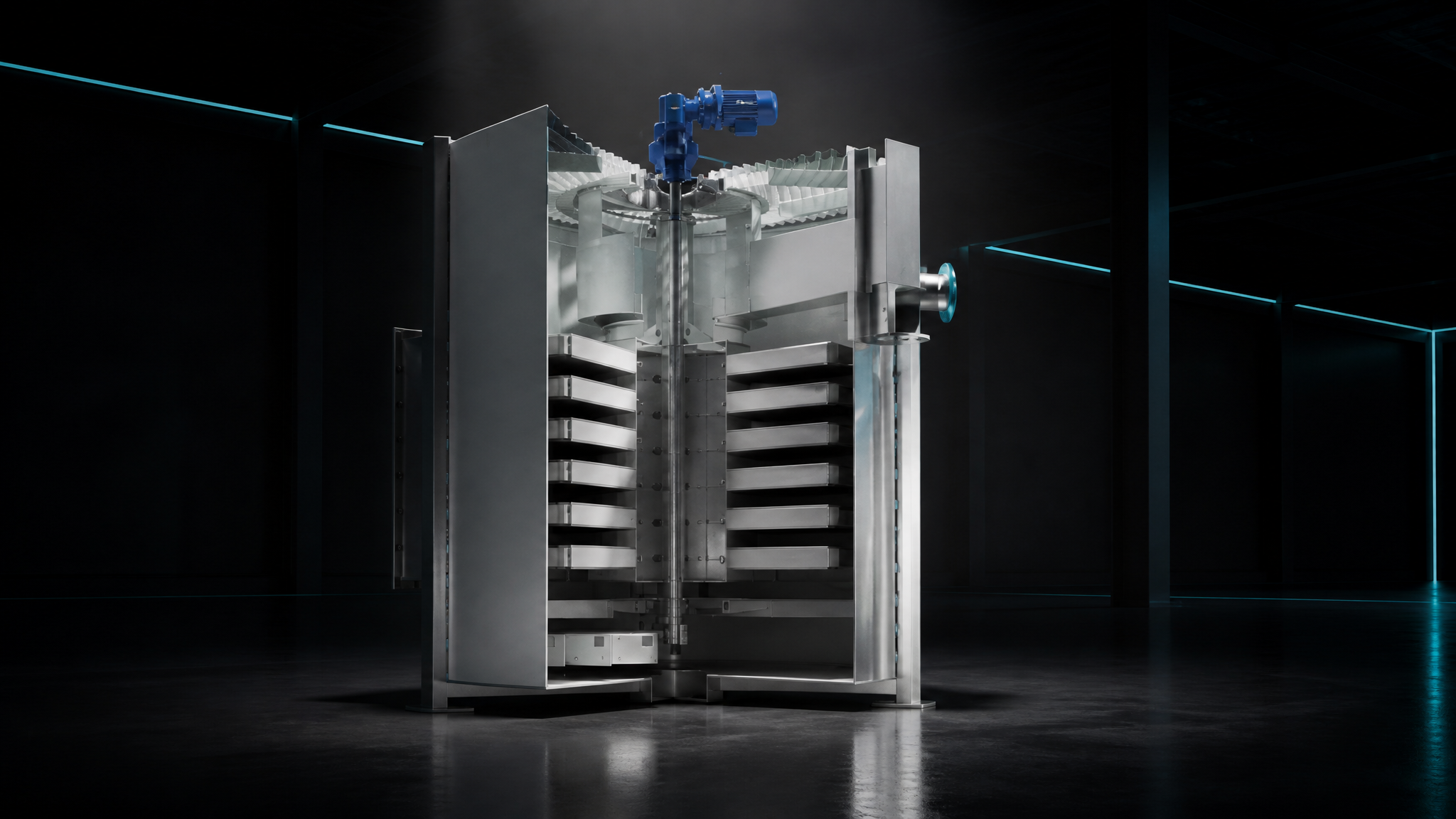
A pile cloth media disc filter consists of rotating discs covered with a three-dimensional pile fabric. Wastewater flows from the inside of the disc outward through the cloth. Solids accumulate on the inner surface and are removed by a low-pressure suction backwash that operates continuously during filtration – there is no offline backwash cycle. The backwash water volume is typically 1–3 % of throughput, and the suction head required is low, keeping pump energy minimal.
The pile structure creates a depth-filtration effect: particles are captured within the fibre matrix rather than only on the surface, extending cleaning intervals and maintaining stable effluent quality during load variations.
Continuous backwash advantage
Because suction backwash runs during normal filtration, pile cloth disc filters maintain full hydraulic capacity at all times. There is no need to take filter cells offline for regeneration, which simplifies hydraulic design and eliminates the flow surge that sand filter backwash sequences impose on upstream processes.
Footprint and civil works comparison
For a plant treating 10,000 m³/d, a conventional rapid sand filter installation typically requires 200–350 m² of filter area plus associated backwash water storage and pump rooms. An equivalent pile cloth media disc filter installation fits into 80–150 m², and the discs can often be installed inside an existing basin or tank, eliminating the need for new civil structures entirely.
This is the decisive advantage for plants where space is constrained. Disc filter modules are factory-assembled and arrive on site ready to install. Commissioning times of four to eight weeks are achievable, versus twelve to twenty-four months for a new sand filter hall.
| Parameter | Rapid Sand Filter | Pile Cloth Disc Filter |
|---|---|---|
| Filter area per 1,000 m³/d | 20–35 m² | 8–15 m² |
| Backwash storage required | Yes (separate tank) | Minimal (inline suction) |
| New civil works needed | Usually yes | Often no (in-basin install) |
| Commissioning time | 12–24 months | 4–8 weeks |
| Operator intervention | Daily backwash management | Low – automated |
Energy and chemical consumption
Pile cloth media disc filters operate at 0.02–0.05 kWh/m³ treated. Rapid sand filters, including backwash pump and blower energy, typically consume 0.05–0.12 kWh/m³. For a 10,000 m³/d plant, the difference amounts to 300–700 kWh/d – a meaningful reduction in both cost and carbon footprint.
Chemical consumption is comparable when coagulant dosing is applied upstream of both filter types. Because cloth filters achieve lower effluent TSS at the same coagulant dose, some plants reduce chemical addition after switching.
Retrofit Readiness Checklist
- Confirm available hydraulic head at the filter inlet (minimum 0.3–0.5 m)
- Measure peak flow rate and diurnal variation to size disc modules correctly
- Check existing basin dimensions for in-basin disc installation feasibility
- Review backwash water return capacity – cloth filter return flow is significantly lower
- Assess electrical supply for drive motors and control panel
- Verify effluent TSS and turbidity targets to select correct cloth grade
Effluent quality and permit compliance
Pile cloth media filters consistently achieve effluent TSS below 5 mg/l and turbidity below 1 NTU within design loading rates. This makes them suitable for direct reuse applications and compliance with stringent municipal discharge permits. Sand filters at equivalent loading rates typically deliver 8–15 mg/l TSS, with exceedances during backwash cycles.
Can pile cloth media disc filters be installed inside our existing sand filter basins?+
In many cases, yes. Disc filter modules are designed for in-basin installation and can be fitted into rectangular or circular tanks. The key parameters are available water depth (typically 2.5–4.5 m), basin width and inlet hydraulic head. A site survey will confirm feasibility before any commitment.
How does backwash water consumption affect our return load?+
Pile cloth media filters return 1–3 % of throughput as backwash water, compared with 3–8 % for rapid sand filters. For a 10,000 m³/d plant, this means returning 100–300 m³/d less to the head of the plant, reducing hydraulic and pollutant load on upstream processes.
What TSS and turbidity levels can we expect in the filtered effluent?+
Under normal operating conditions and within design loading rates, pile cloth media filters deliver effluent TSS in the range of 2–5 mg/l and turbidity below 1 NTU. Performance depends on influent quality, cloth grade and upstream coagulation. A pilot trial on your specific wastewater is the most reliable way to confirm achievable values.
Equipment we supply for this
Engineering Hub: get this sized for your plant
Describe your goal, effluent limit or sludge volume and receive a technology shortlist plus a sizing proposal – by email, no phone call required.