Engineering Hub: get this sized for your plant
Describe your goal, effluent limit or sludge volume and receive a technology shortlist plus a sizing proposal – by email, no phone call required.
Unattended 24/7 sludge dewatering: what has to be automated
Sludge does not stop accumulating when the last operator leaves the site. At many industrial plants and smaller municipal facilities, the dewatering unit runs only during day shifts — not because the process requires human presence, but because the automation was never designed for continuous unattended operation. The result is sludge storage tanks that overflow, polymer waste, and dewatered cake that sits in the press too long.
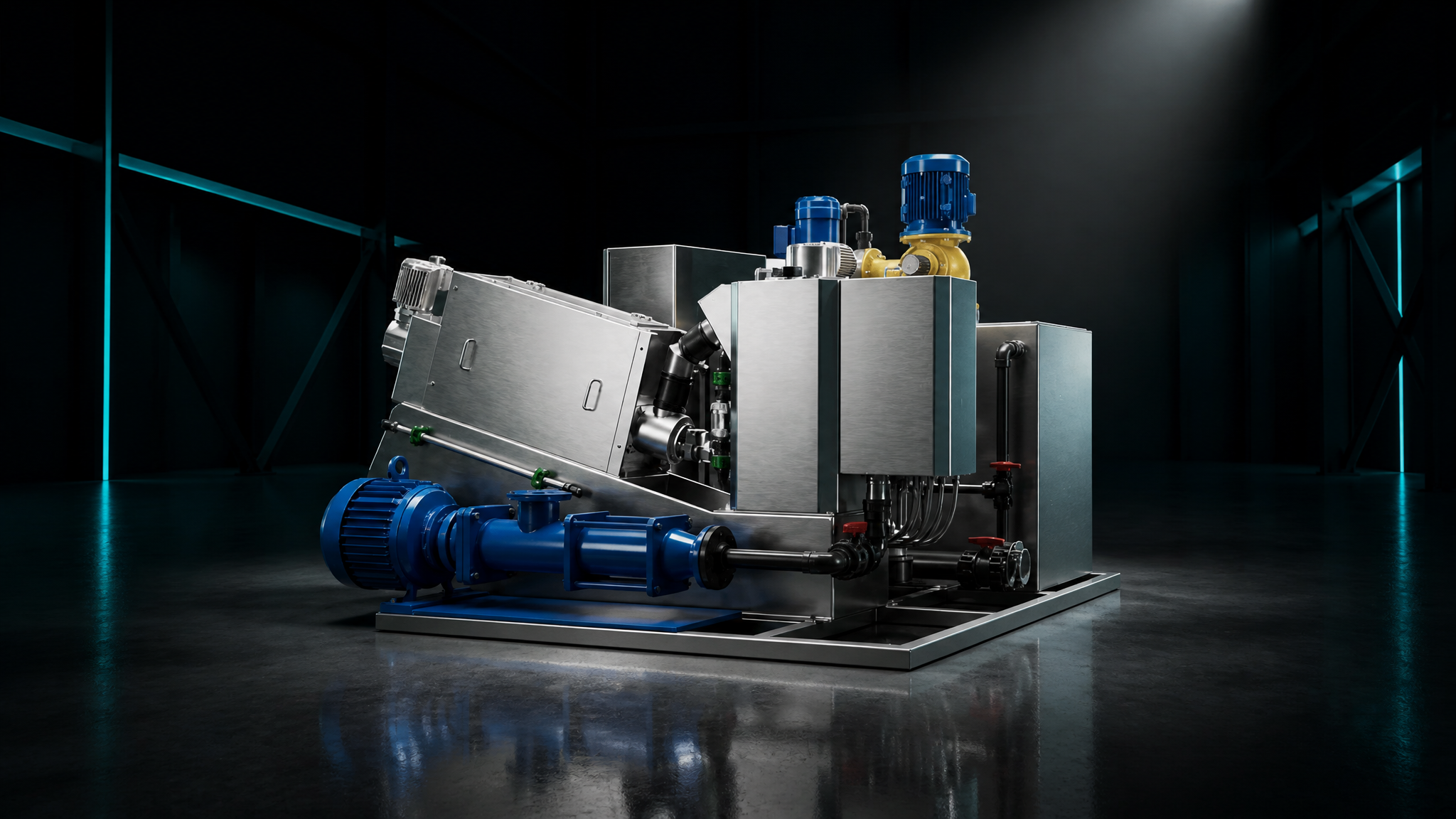
A properly configured screw press with an integrated polymer preparation unit can run for 20–22 hours per day with no operator on site, provided five specific process areas are automated correctly.
Unattended Dewatering at a Glance
- Typical operating hours per day
- 20–22 h without operator intervention
- Key automation areas
- Feed control, polymer dosing, cake discharge, fault response, remote monitoring
- Suitable equipment
- Screw press with variable speed drive; three-chamber polymer preparation unit
- Maintenance interval
- Weekly inspection; cloth cleaning monthly
- Remote access
- PLC with SCADA or cloud-based monitoring recommended
The five automation areas that matter
1. Feed sludge flow control
The screw press must receive a consistent feed rate to maintain stable dewatering performance. An inlet pump with a variable frequency drive (VFD), controlled by a level signal from the feed sludge tank, keeps the flow within the design range. Without this, the press alternates between starvation and overload — both of which degrade cake dryness and increase polymer consumption.
2. Polymer preparation and dosing
Polymer make-up quality is the single largest variable in dewatering performance. A three-chamber preparation unit — mixing, maturation, and dosing chambers in sequence — produces a consistent polymer solution regardless of when the batch was prepared. The dosing pump should be controlled by a ratio signal linked to the feed flow, with an upper limit on absolute dose rate to prevent overdosing during low-flow periods.
Polymer ageing time matters
Polymer solution that has matured for less than 30 minutes or more than 4 hours performs below its rated capacity. A three-chamber unit with a defined residence time in each chamber eliminates this variable automatically, without operator adjustment.
3. Cake discharge and conveyor management
Dewatered cake must leave the press continuously. A blocked discharge conveyor is the most common cause of unplanned shutdowns in unattended operation. The conveyor should be interlocked with the press drive: if the conveyor stops, the press stops within a defined delay. A torque sensor on the conveyor motor provides early warning of blockage before a hard stop occurs.
4. Fault detection and automatic restart
Not every fault requires operator intervention. A well-designed control system distinguishes between faults that are safe to clear automatically — such as a momentary high-torque event on the press screw — and faults that require human assessment, such as a bearing temperature alarm. The PLC should attempt one automatic restart after a recoverable fault, log the event, and send an alert. After a second consecutive fault of the same type, the system should hold and wait for operator acknowledgement.
Automation Checklist for Unattended Operation
- VFD-controlled feed pump with level-based setpoint
- Three-chamber polymer preparation unit with timed maturation
- Polymer dose ratio control linked to feed flow signal
- Conveyor torque monitoring with press interlock
- Automatic restart logic for recoverable faults (one attempt only)
- Remote alarm notification via SMS, email, or SCADA
- High-level alarm on dewatered cake storage with press shutdown
- Weekly maintenance schedule logged in PLC for operator review
5. Remote monitoring and alarm routing
Unattended does not mean unmonitored. A PLC with a remote access interface — whether a SCADA system, a cloud-based monitoring platform, or a simple GSM alarm module — allows the on-call operator to assess the situation without travelling to site. The alarm list should be prioritised: process alarms that affect cake quality are lower priority than safety alarms or alarms that will cause a tank overflow within the hour.
20–22 h
Typical daily runtime without operator presence
2–5 %
Polymer savings from ratio-controlled dosing vs. fixed-rate dosing
0.02–0.06 kWh/m³
Specific energy consumption of a screw press
What cannot be automated away
Even the most automated dewatering system requires periodic human attention. Cloth inspection and cleaning, bearing lubrication, and polymer bag or container changeover cannot be eliminated — but they can be scheduled. A weekly maintenance visit of 1–2 hours is realistic for a well-designed system. The PLC should log runtime hours and flag when maintenance intervals are due, so the visit is planned rather than reactive.
Do not automate around a process problem
If the feed sludge characteristics vary widely — for example, because the biological stage is unstable — automation will not compensate. Unattended operation requires a stable, predictable feed. Resolve upstream process variability before commissioning an unattended dewatering system.
Selecting equipment for unattended duty
Not all screw presses are equally suited to unattended operation. Key features to specify: a self-cleaning screw design that does not require manual screen clearing; a variable-pitch screw that adjusts compression automatically; and a control panel with a built-in data logger so performance trends are visible during the weekly maintenance visit.
Size the polymer preparation unit for at least 8 hours of autonomous operation between refills. Interlock polymer storage with the press: if the level drops below a minimum, the press reduces throughput rather than running without conditioning agent.
How long can a screw press run unattended before it needs attention?+
A well-configured screw press with automated feed control, polymer dosing, and fault management can run for 20–22 hours per day without operator presence. A weekly maintenance visit of 1–2 hours covers cloth inspection, lubrication, and polymer container changeover.
What happens if the polymer preparation unit runs out of polymer during unattended operation?+
The control system should detect low polymer level via a level sensor in the storage container and reduce the press feed rate proportionally. If the polymer level reaches a defined minimum, the press should stop automatically and send an alarm. Running a screw press without polymer conditioning leads to poor cake dryness and potential screen blinding.
Is remote monitoring of a dewatering plant technically complex to implement?+
Modern screw press control panels include a standard Ethernet or GSM interface. Connecting to a SCADA system or a cloud monitoring platform requires configuration of the PLC communication module and definition of the alarm list — typically a one-day commissioning task. Simpler GSM alarm modules that send text messages on fault conditions are available as a lower-cost alternative.
Equipment we supply for this
Engineering Hub: get this sized for your plant
Describe your goal, effluent limit or sludge volume and receive a technology shortlist plus a sizing proposal – by email, no phone call required.