Engineering Hub: get this sized for your plant
Describe your goal, effluent limit or sludge volume and receive a technology shortlist plus a sizing proposal – by email, no phone call required.
The problem: polymer consumption far above the design figure
A polymer preparation and dosing system is commissioned, the design dose is set, and within a few months the actual consumption is 30, 50, or even 80 % above the figure the supplier quoted. The instinct is to blame the polymer batch, the sludge characteristics, or the dewatering equipment. In most cases, the root cause is simpler: the polymer is not being prepared correctly before it reaches the dose point.
Polymer molecules are long-chain structures that must fully uncoil and hydrate before they can bridge particles and form flocs. If the make-up process is too fast, too concentrated, or too short, the polymer arrives at the dose point in a partially hydrated state. It still consumes chemical, but it does not perform at its rated capacity.
Polymer Make-Up Quality at a Glance
- Parameter
- Typical Optimum
- Make-up concentration (emulsion)
- 0.05–0.25 % w/w
- Make-up concentration (powder)
- 0.1–0.5 % w/w
- Minimum ageing time
- 30–60 min
- Dilution water temperature
- 10–25 °C
- Mixing energy (preparation chamber)
- Low shear — avoid high-speed impellers
How make-up quality drives polymer consumption
Three preparation parameters have the greatest influence on polymer efficiency:
Concentration. Dissolving polymer at too high a concentration produces a viscous gel that does not fully hydrate even with extended ageing. The individual polymer chains remain entangled and cannot extend to their full bridging length. Dissolving at too low a concentration wastes dilution water and increases the volume pumped to the dose point. The optimum concentration window is narrow — typically 0.05–0.25 % for emulsion polymers and 0.1–0.5 % for powder types.
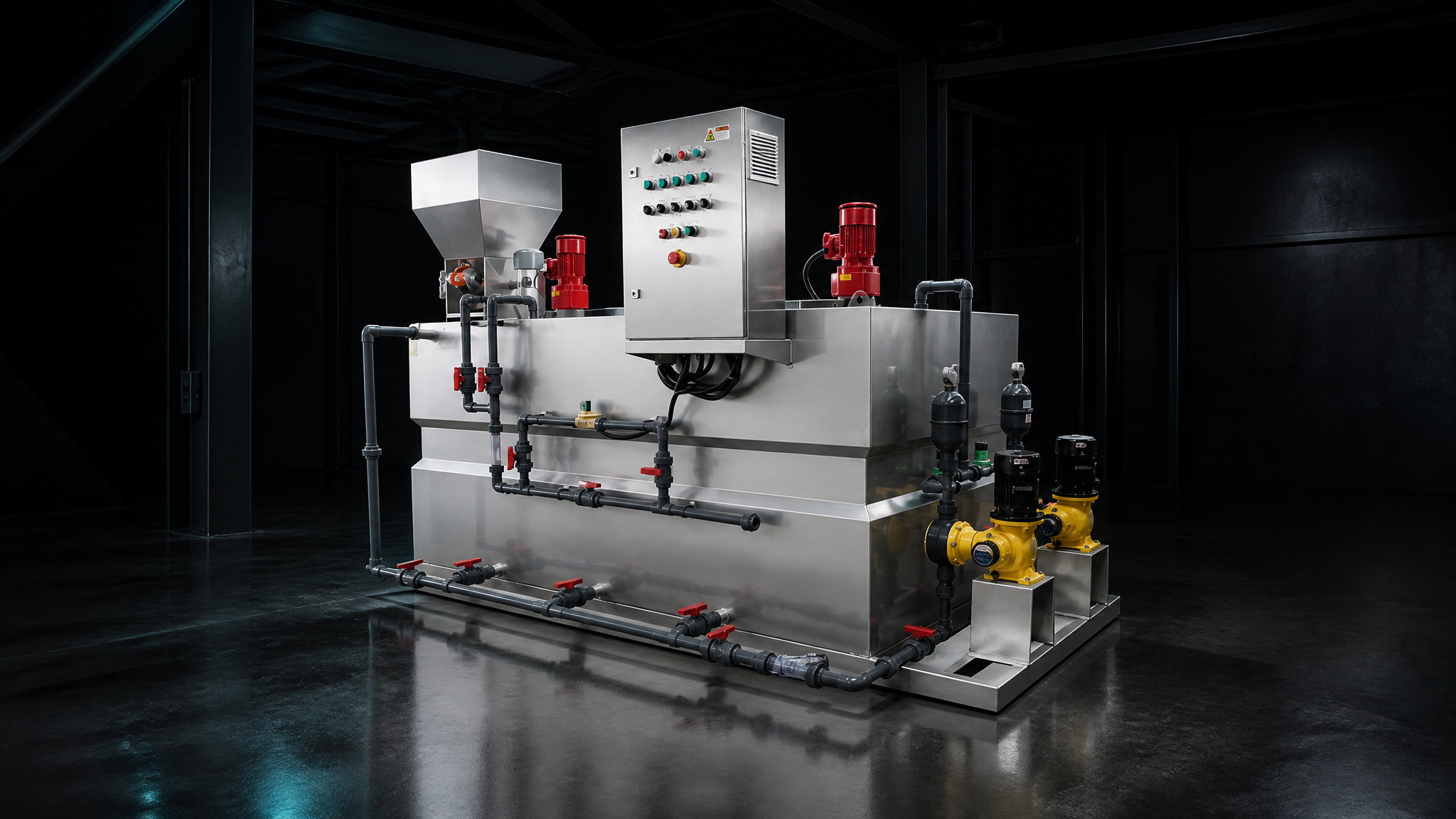
Ageing time. Freshly prepared polymer solution is not ready to use. The chains need time to uncoil and hydrate fully. Minimum ageing times of 30–60 minutes are standard for most polymer types; some high-molecular-weight powders require up to 90 minutes. A three-chamber preparation unit — dissolving, maturing, and dosing chambers in series — ensures that no under-aged solution reaches the dose point.
Mixing energy. High-shear mixing during preparation breaks the polymer chains and permanently reduces molecular weight. Once degraded, the polymer cannot be recovered by longer ageing. Low-shear, slow-speed mixing in the preparation chamber is essential.
20–40 %
Typical reduction in polymer consumption after optimising make-up quality
30–60 min
Minimum ageing time required for most emulsion and powder polymers
3
Number of chambers in a correctly designed polymer preparation unit
Why polymer consumption drifts over time
Even a correctly commissioned system can drift. The most common causes are:
- Dilution water flow variation — a worn flow control valve changes the make-up concentration without triggering an alarm
- Polymer batch variation — different batches of the same product can have different optimal concentrations; the system is not adjusted
- Ageing chamber bypass — a valve left open during maintenance is never fully closed again
- Temperature change — cold dilution water in winter slows hydration; the ageing time that worked in summer is no longer sufficient
- Sludge characteristic change — a change in upstream process chemistry alters the sludge charge; the polymer type or dose point needs review
Polymer solution shelf life
Prepared polymer solution degrades over time. Most emulsion-based solutions should be used within 8–12 hours of preparation; powder-based solutions within 24 hours. Running a preparation unit in batch mode with long hold times in the dosing chamber is a common cause of apparent under-performance that is misdiagnosed as insufficient dose.
Optimising polymer dosing: a systematic approach
Polymer Consumption Optimisation Checklist
- Verify make-up concentration with a refractometer or viscometer — do not rely on the flow meter alone
- Check ageing time by sampling from each chamber and comparing floc formation in a jar test
- Inspect dilution water flow control valve for wear and recalibrate if necessary
- Review polymer batch certificates — note any change in active content or charge density
- Measure dilution water temperature monthly and adjust ageing time seasonally
- Perform a jar test with fresh polymer at three concentrations to find the current optimum
- Log polymer consumption per tonne of dry solids weekly to detect drift early
Sizing a polymer preparation unit correctly
Undersized preparation units are a frequent cause of chronic over-consumption. The unit must be sized for the peak polymer demand, not the average, and must provide sufficient chamber volume to guarantee the minimum ageing time at peak flow. A unit that is hydraulically overloaded at peak dewatering rates shortens the effective ageing time and forces operators to increase the dose to compensate.
The three-chamber design — dissolving, maturing, dosing — is the industry standard for continuous dewatering applications. Each chamber should be sized for at least 20–30 minutes of residence time at peak flow, giving a total ageing time of 60–90 minutes.
How do I know if my polymer is being under-aged rather than under-dosed?+
Perform a simple jar test: take a sample of the prepared solution from the dosing chamber and compare its floc-forming performance with a freshly prepared solution aged for 60 minutes at the correct concentration. If the aged reference solution produces larger, denser flocs at the same dose, the operating solution is under-aged. Increasing the dose without fixing the preparation will not resolve the problem.
What is the correct make-up concentration for polymer dosing optimisation?+
The optimum concentration depends on the polymer type and the specific product. As a starting point, emulsion polymers are typically prepared at 0.05–0.25 % w/w and powder polymers at 0.1–0.5 % w/w. The supplier's technical data sheet gives the recommended range; a jar test at three concentrations within that range identifies the site-specific optimum. Concentration should be verified with a refractometer or viscometer, not estimated from flow meter readings alone.
How should a polymer preparation unit be sized for a dewatering application?+
Size the unit for peak polymer demand, not average demand. Each of the three chambers should provide at least 20–30 minutes of residence time at peak flow, giving a total ageing time of 60–90 minutes. The dilution water flow control must be accurate across the full operating range. If the existing unit is undersized, adding a second maturing chamber is often more cost-effective than replacing the entire unit.
Equipment we supply for this
Engineering Hub: get this sized for your plant
Describe your goal, effluent limit or sludge volume and receive a technology shortlist plus a sizing proposal – by email, no phone call required.