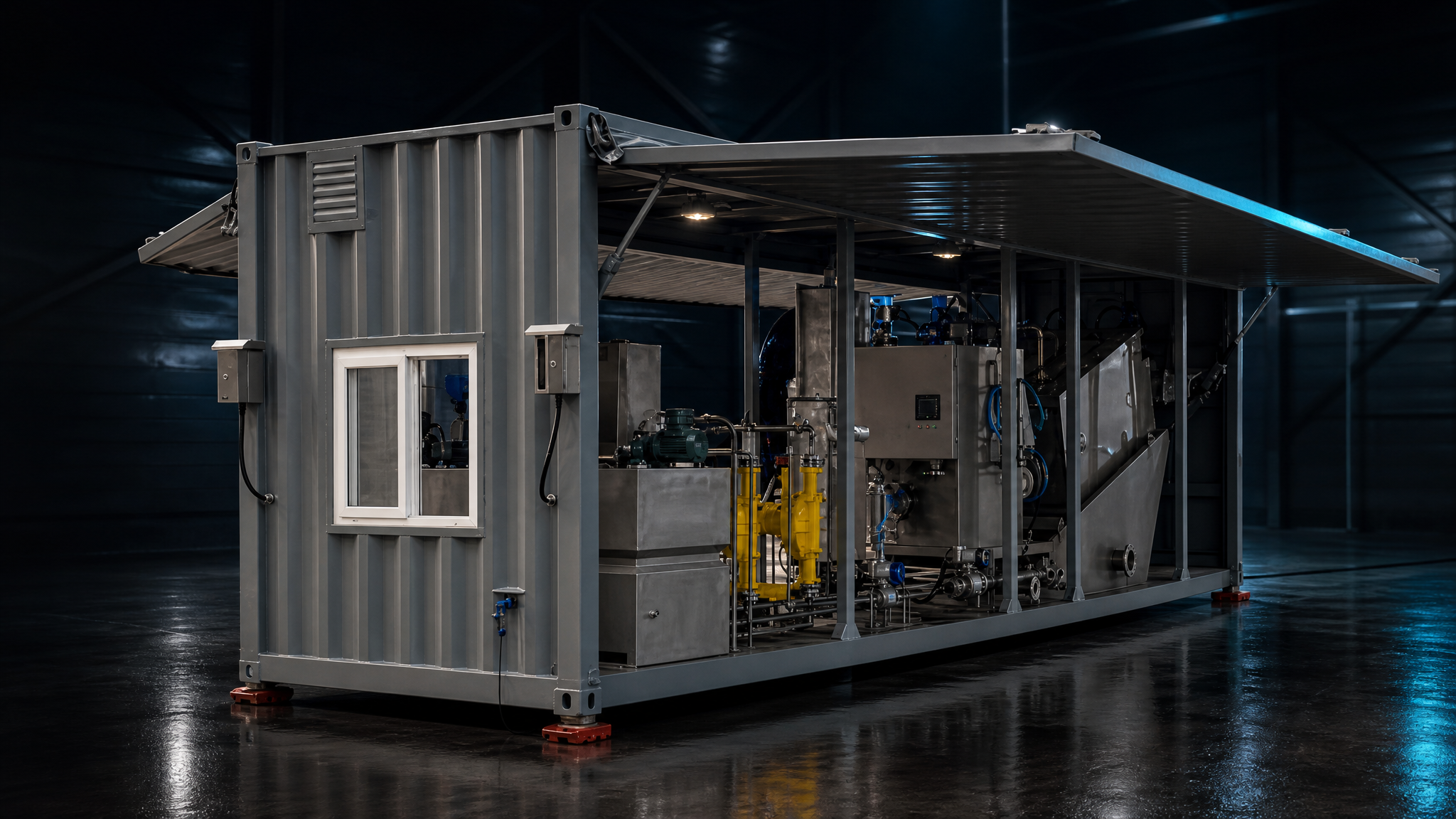
When a supplier asks for design data, the most common response is to pull the last annual discharge report and send it over. That document tells the supplier what the average looks like — but wastewater treatment equipment is sized for peaks, not averages. A single grab sample or a monthly average hides the variability that will determine whether the plant copes or fails.
A structured sampling programme, run over two to four weeks, is the minimum investment that produces numbers a supplier can actually use.
Sampling Programme Essentials
- Campaign duration
- 2–4 weeks minimum, covering at least one full production cycle
- Sampling type
- Flow-proportional composite samples (24 h) plus targeted grab samples at shift changes
- Key parameters
- Flow rate, TSS, COD, BOD₅, pH, temperature, fats/oils/grease (if relevant)
- Peak flow factor
- Daily maximum flow ÷ annual average daily flow — typically 1.5–3.0 for industrial sites
- Deliverable
- Signed design basis document handed to supplier before tendering
Engineering Hub: get this sized for your plant
Describe your goal, effluent limit or sludge volume and receive a technology shortlist plus a sizing proposal – by email, no phone call required.
Why averages mislead equipment suppliers
A tertiary filter, a dissolved air flotation unit or a screw press is not designed for the mean — it is designed for the worst credible hour of the worst credible day. If your sampling data does not capture that hour, the supplier will either guess conservatively (oversized, expensive) or optimistically (undersized, non-compliant).
The peak flow factor is the single most important number in the design basis. It is calculated as the maximum daily flow recorded during the campaign divided by the average daily flow over the same period. For most industrial sites this ratio falls between 1.5 and 3.0, but food processing, batch chemical and seasonal operations can reach 4.0 or higher.
| Parameter | Measurement interval | Instrument or method |
|---|---|---|
| Flow rate | Continuous (15-min logging) | Electromagnetic or ultrasonic flowmeter |
| TSS | 2-hourly composite | Gravimetric (EN 872) |
| COD | 24-h composite | Photometric or titrimetric |
| BOD₅ | 24-h composite | Dilution method (EN 1899) |
| pH | Continuous | In-line electrode |
| Temperature | Continuous | In-line probe |
| Fats, oils, grease | Grab at shift change | Solvent extraction |
Designing the campaign
Start by mapping your production calendar. Identify the longest repeating cycle — a weekly shift pattern, a monthly batch schedule, a seasonal peak. The campaign must cover at least one complete cycle, which is why two weeks is the practical minimum and four weeks is preferred for sites with monthly variation.
Flow-proportional composite sampling is the standard approach: a refrigerated autosampler draws a volume proportional to the instantaneous flow rate every 15–30 minutes and accumulates a 24-hour composite. This composite is then analysed for COD, BOD₅ and TSS. Grab samples at shift changes capture the short-duration peaks that composites can dilute away.
Do Not Rely on Grab Samples Alone
A single grab sample taken mid-shift on a quiet Tuesday will miss the cleaning-in-place discharge, the batch reactor dump and the morning start-up flush. Equipment sized on that sample will be undersized for real operating conditions. Always combine continuous flow logging with composite sampling.
Deriving the design basis document
Once the campaign is complete, the data should be processed into a design basis document — a single signed sheet that the supplier uses as the contractual reference for sizing. It should state:
- Average daily flow (m³/d) and peak hourly flow (m³/h)
- Peak flow factor (dimensionless)
- Average and 90th-percentile concentrations for each parameter
- Temperature range (minimum and maximum)
- pH range
- Any batch or shock-load events observed during the campaign
Design Basis Document Checklist
- Flow data: average daily, peak daily, peak hourly, peak flow factor
- TSS: average, 90th percentile, maximum observed
- COD and BOD₅: average and 90th percentile
- pH range: minimum and maximum recorded
- Temperature range: minimum and maximum recorded
- Fats/oils/grease: average and peak (if applicable)
- Production calendar note: shift pattern, batch cycles, seasonal peaks
- Sampling period: start date, end date, number of valid 24-h composites
- Signature and date of responsible engineer
How long should a wastewater sampling programme run before equipment selection?+
A minimum of two weeks is needed to capture at least one full production cycle. Four weeks is preferred for sites with monthly batch schedules or seasonal variation. Shorter campaigns risk missing peak loads that will determine whether the equipment is correctly sized.
What is a peak flow factor and how is it used in wastewater plant sizing?+
The peak flow factor is the ratio of the maximum daily flow recorded during the campaign to the average daily flow over the same period. Suppliers use it to size hydraulic components — pumps, pipes, filter surface area — so that the plant can handle the worst credible day without bypassing or overflowing. Typical industrial values range from 1.5 to 3.0.
Which parameters does a supplier really need to size a tertiary filter, DAF or screw press?+
For a tertiary filter: flow rate, TSS (average and peak), and turbidity. For a DAF: flow rate, fats/oils/grease, COD, and suspended solids. For a screw press: sludge volume, dry solids content, and polymer demand. All three units also need pH and temperature ranges. A complete design basis document covering all these parameters avoids costly change orders after contract award.
Equipment we supply for this
Engineering Hub: get this sized for your plant
Describe your goal, effluent limit or sludge volume and receive a technology shortlist plus a sizing proposal – by email, no phone call required.