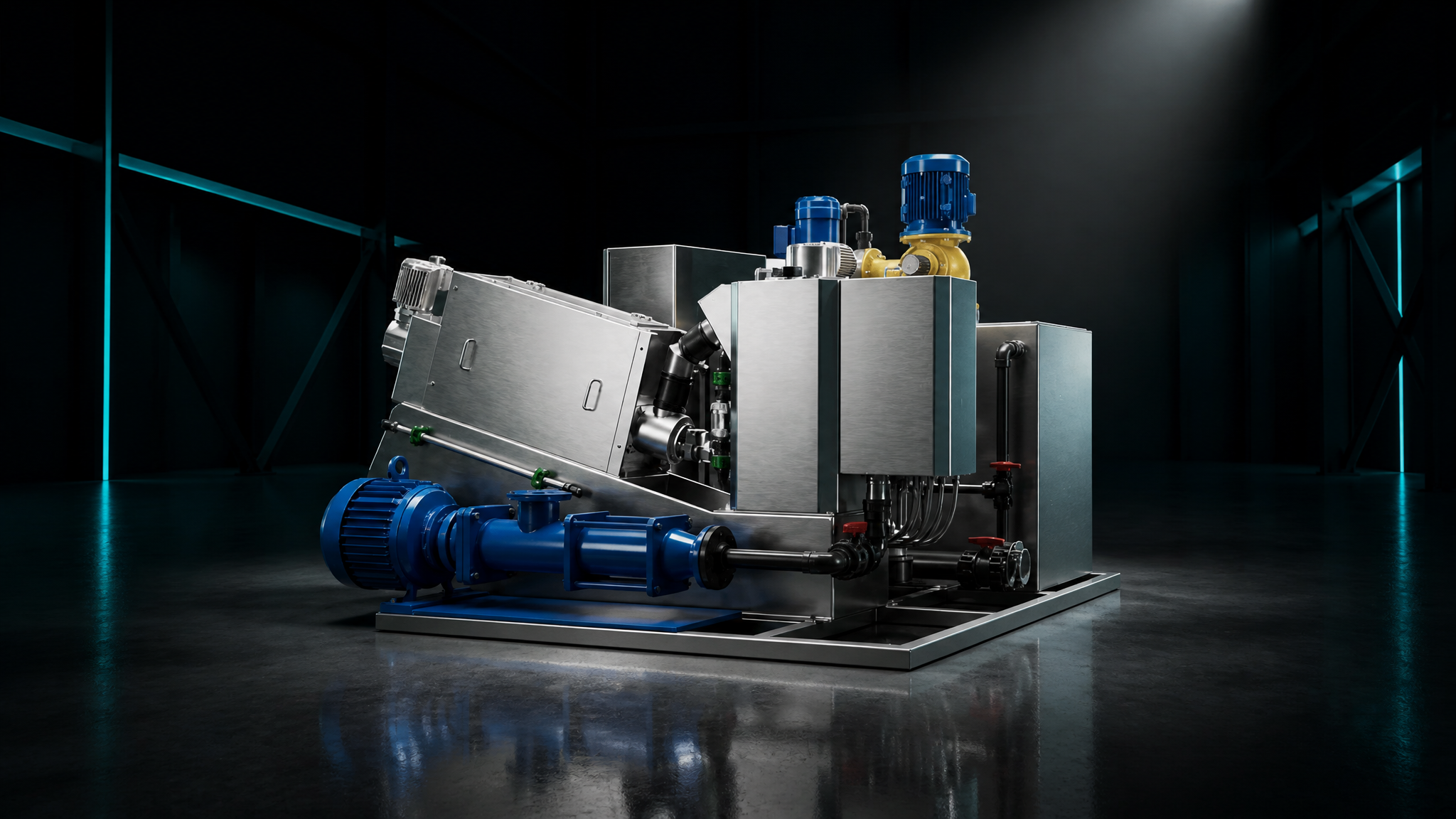
Engineering Hub: get this sized for your plant
Describe your goal, effluent limit or sludge volume and receive a technology shortlist plus a sizing proposal – by email, no phone call required.
Unattended 24/7 sludge dewatering: what has to be automated
- Label
- Value
- Operating mode
- Unattended, continuous, 24/7 sludge dewatering
- Core equipment
- Screw press, polymer preparation unit
- Main automation goal
- Stable cake dryness and safe operation without on-site personnel
- Typical inputs
- Sludge feed, polymer, wash water, drain return, alarm signals
- Typical outputs
- Dewatered cake, filtrate, status data, faults
- Primary risk
- Feed interruptions, polymer dosing errors, clogging, overflow, and missed alarms
Function
Typical range or design approach
Sludge feed control
Pump speed or valve control linked to press load and feed tank level
Polymer make-down
0.1 to 1.0 percent solution concentration, depending on polymer type and sludge behavior
Maturation time
Roughly 20 to 60 minutes, depending on preparation system design
Alarm response
Local signal, relay output, and remote notification to SCADA or telemetry
Wash cycle
Automatic short cycles during operation plus programmed shutdown rinse
Unattended runtime
Often several hours to a full night shift if influent is stable and maintenance is routine
A fully automatic system starts with sludge availability. If incoming sludge is stored in a buffer tank, the tank
Polymer preparation is the second critical element. Low maintenance dewatering equipment still needs a correctly mixed polymer solution with stable concentration and proper aging time. Powder polymer systems
A common misconception is that automation only means a touchscreen and a timer. In unattended sludge dewatering, automation must also handle faults. This includes drive overload, torque rise, feed blockage, polymer empty, wash water low, emergency stop, and communications loss. The machine should never rely on a single sensor for a critical decision.
The screw press itself should be configured for predictable operation. Variable-speed drives on the screw and feed pump allow the control system
For sludge dewatering without operator presence, maintenance design is just as important as control logic. Wear parts must be accessible, drain points must be clear, and splash areas should be minimized. The platform, skid, or enclosure should allow inspection before the night period begins.
- Before implementing unattended sludge dewatering automation, verify the following:
- Buffer tank level measurement is reliable and scaled correctly
- Polymer preparation has low-level, dry-run, and mixing-status interlocks
- Screw press start/stop logic is tied to sludge availability and fault conditions
- Feed pump, screw drive, and wash water are protected by overload and pressure monitoring
- Alarm signals are routed to on-site and remote notification systems
- The plant enters a safe stop mode when polymer, sludge, or water supply is interrupted
- Routine cleaning and inspection can be completed during staffed hours
Another important point is data visibility. Even if no one is on site at night, the plant should provide status information that can be reviewed remotely. Minimum useful data
Unattended operation does not mean no maintenance. A low-maintenance dewatering system reduces daily attention, but it still requires scheduled inspection of wear parts, seals, polymer preparation equipment, and cake discharge paths. Ignoring this usually leads to alarms during the least convenient shift.
When specifying low maintenance dewatering equipment, ask for a control philosophy, not only a mechanical datasheet. The system should describe how it behaves during
What has to be automated for unattended sludge dewatering automation?+
At minimum, sludge feed, polymer preparation, press start/stop logic, level control, fault handling, and alarm notification must be automated. A screw press can only run unattended if the complete process chain is controlled, not just the machine itself.
Is fully automatic screw press operation realistic without an operator on site?+
Yes, if the influent is reasonably stable and the skid includes reliable instrumentation, interlocks, and remote alarms. Fully automatic screw press operation is most reliable when the system is designed for safe fallback states rather than continuous restart attempts.
What makes low maintenance dewatering equipment suitable for night operation?+
Predictable mechanics, accessible wear parts, stable polymer preparation, and clear fault handling. The equipment should tolerate minor disturbances, signal major ones immediately, and shut down safely if a critical supply is lost.
Equipment we supply for this
Engineering Hub: get this sized for your plant
Describe your goal, effluent limit or sludge volume and receive a technology shortlist plus a sizing proposal – by email, no phone call required.