Technology overview
Industrial wastewater treatment: technology overview
Every wastewater problem comes down to separating something from water — solids, oils, nutrients or dissolved load — reliably and at an acceptable cost. The right technology depends far more on the material to remove and the site constraints than on the industry label.
This overview maps the main treatment tasks to the technologies that solve them and links straight to the detailed solution pages. Use it to orient, then follow the link that matches your problem.
In brief
Industrial wastewater treatment combines physical, chemical and biological process steps to remove solids, oils, nutrients and organic load so that water meets a discharge limit or becomes fit for reuse.
The challenges this solves
Choosing the right technology
The same effluent target can be reached several ways. The best choice depends on what has to be removed, the available space and how operating cost is accounted for — not on habit.
Meeting limits on the existing footprint
Most upgrades have to fit the existing site. Compact, retrofittable technologies reach new limits without new civil works.
Controlling operating cost
Energy, chemicals, sludge disposal and staffing decide the true cost. The right process minimises the items that actually move the number.
Technologies we apply
Tertiary filtration
Cloth media filtration for final polishing: low TSS, phosphorus removal and water reuse in a compact retrofit.
View equipmentSludge dewatering
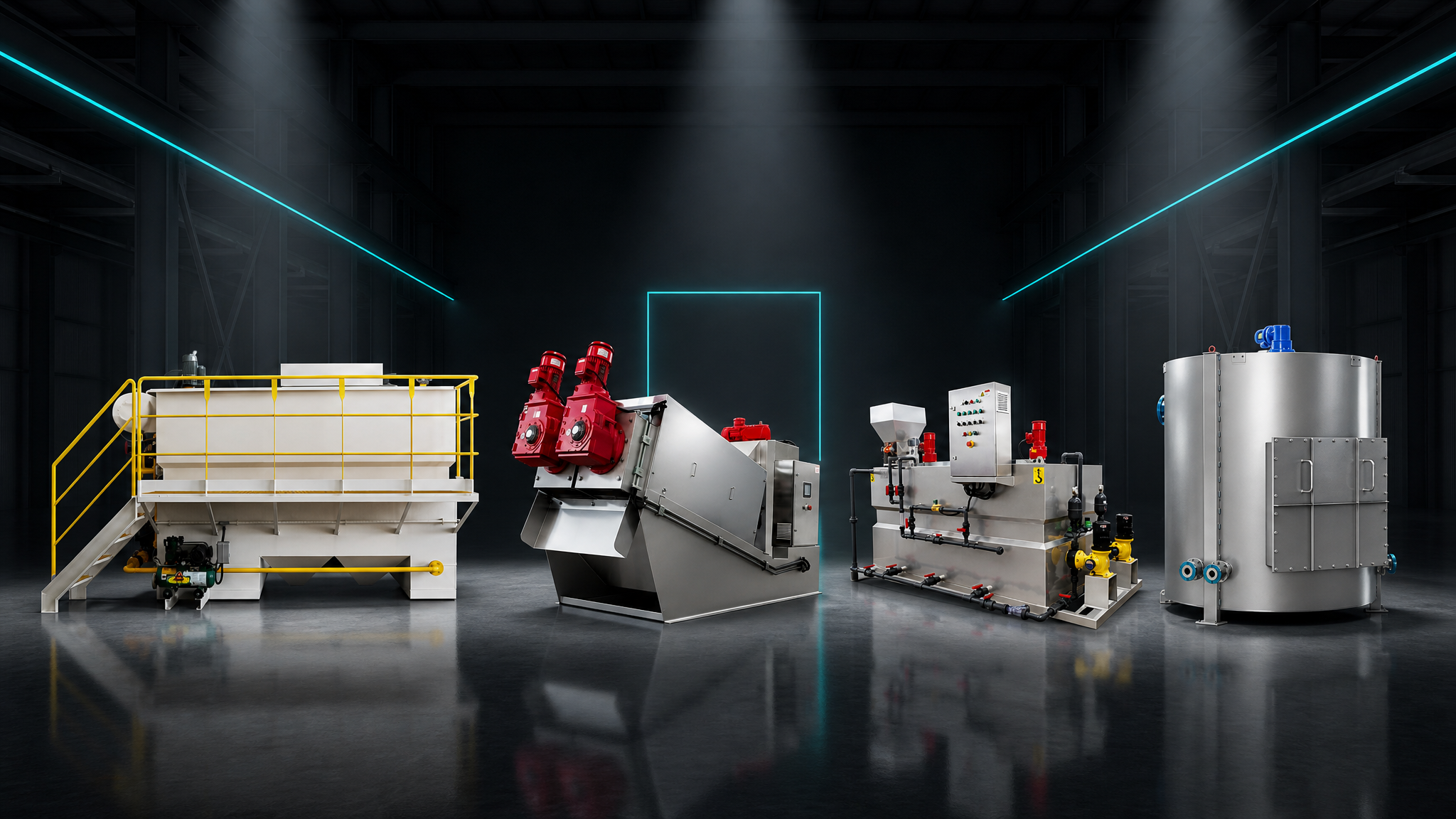
Screw-press dewatering that cuts disposal volume and runs unattended around the clock.
View equipmentDissolved air flotation
Flotation for fats, oils, low-density solids and sludge thickening — and to protect the biology.
View equipmentChemical dosing
Polymer preparation and dosing for reliable flocculation and lower reagent cost.
View equipmentLamella clarification
Compact plate settling and custom stainless-steel plant engineering.
View equipmentMBBR biology
Moving-bed biofilm capacity for COD and nitrogen removal in the same tank volume.
View equipmentWhat is achievable
Each technology has its own achievable ranges — the detailed solution pages give the figures. As a map of where each one fits:
| Parameter | Typical range |
|---|---|
| Fine solids & phosphorus polishing | tertiary cloth filtration |
| Fats, oils, low-density solids | dissolved air flotation |
| Sludge volume & disposal cost | screw-press dewatering |
| Reliable flocculation | polymer preparation & dosing |
| Compact clarification | lamella settling |
| Biological capacity & nitrogen | MBBR |
How we size it
Whatever the technology, sound sizing starts from the same data set. The inputs we need are:
Key sizing inputs
- Flow (average and peak)
- Inlet loads (TSS, FOG, phosphorus, COD, ammonia)
- Required effluent quality or discharge limit
- Site and space constraints
- Operating and staffing model
Rent or pilot first
For any of these technologies, a pilot or rental unit confirms performance on your own water before you invest — the most reliable way to de-risk the decision.
Rent or pilot firstRelated reading
Frequently asked questions
How do I choose between these technologies?
Start from what has to be removed and your site constraints. Light material and oils point to flotation; fine solids and phosphorus to cloth filtration; dense solids to lamella settling; organic and nitrogen load to biology. The solution pages and our comparisons go deeper.
Can technologies be combined?
Frequently. A DAF ahead of a biological stage, precipitation ahead of filtration, or thickening ahead of dewatering are common combinations that each stage makes work better.
How do I keep operating cost down?
By minimising the items that dominate it — energy, chemicals and sludge disposal. The right process choice and correct chemical preparation are usually where the savings are.
Where do I start?
Tell us the water, the load and the target. We map it to the right technology and confirm the sizing with a data set or a pilot.
Engineering Hub: get this sized for your plant
Describe your goal, effluent limit or sludge volume and receive a technology shortlist plus a sizing proposal – by email, no phone call required.