[title]
- Diagnosis focus
- Ageing time, concentration, mixing energy, sludge variability
- Most common root cause
- Incorrect make-up quality at the polymer preparation unit
- Typical symptom
- Higher dose with no improvement in cake dryness or centrate clarity
- Best first action
- Verify solution concentration and maturation time against the polymer supplier’s window
If polymer consumption is far above the design figure, the first mistake is usually to blame the sludge alone. In practice, excessive consumption often comes from an unstable make-up process: the polymer is not fully hydrated,
A useful diagnosis starts with one question: is the plant using more active polymer, or simply using it less efficiently? That distinction matters.
The most reliable method is to investigate the full chain: dry polymer storage, feed accuracy, wetting, ageing, solution concentration, transfer conditions, and final dosing response on the
Engineering Hub: get this sized for your plant
Describe your goal, effluent limit or sludge volume and receive a technology shortlist plus a sizing proposal – by email, no phone call required.
Why is polymer consumption higher than design
The design figure is normally based on a defined sludge type, solids concentration, temperature range, polymer grade, and preparation quality.
Typical causes include:
- insufficient ageing time, so the polymer has not fully hydrated
- incorrect make-up concentration, especially after seasonal water-quality changes
- excess shear from aggressive mixing, which can damage long-chain polymers
- poor feed consistency in the sludge line, causing unstable floc formation
- old or caked dry polymer, which dissolves more slowly and inconsistently
- dosing that follows habit rather than measured performance
Polymer make-up concentration effect on dewatering
Polymer concentration has a direct impact on both solution quality and dosing efficiency. If the solution is too dilute, you may inject more volume than necessary, increase tank turnover, and lose
In many plants, a practical operating window lies around 0.1% to 0.5% for anionic and cationic systems, but the correct value depends on the product, equipment, and sludge.
Polymer ageing time too short symptoms
When ageing time is too short, the polymer often looks “mixed” but behaves as if it is underperforming. Common symptoms are:
- higher dose required to reach the same cake dryness
- centrate or filtrate becomes cloudy after a short operating period
- unstable floc size at the feed point
- stringy or uneven flocs
- performance improves only after increasing the dwell time in the maturation tank
Many systems need roughly 20 to 60 minutes of proper ageing, but the exact requirement depends on polymer type, concentration, water quality, and the mixing concept. Very high molecular weight polymers are especially sensitive to insufficient hydration.
Systematic diagnostic sequence
- Confirm the actual dosage in kg active polymer per tonne of dry solids.
- Check powder feed accuracy and wetting performance.
- Measure make-up concentration at the preparation tank.
- Verify mixing energy: enough to disperse, not enough to shear.
- Confirm ageing/maturation time in real operating conditions.
- Review sludge variability: solids, temperature, load profile, and industrial inflow.
- Test one controlled correction at a time.
If consumption drops after correcting concentration or ageing, the issue is usually upstream of the dewatering machine. If not, the problem may be sludge variability, injection point design, or dosing control.
| Failure mode | Typical symptoms | Corrective action |
|---|---|---|
| Too short ageing time | Weak floc, cloudy centrate, unstable performance | Increase maturation time and verify tank hydraulics |
| Incorrect concentration | High chemical volume, poor hydration, lumpy solution | Reset make-up concentration and calibrate water feed |
| Excess mixing energy | Polymer appears dissolved but performs poorly | Reduce shear, revise mixer speed or impeller design |
| Sludge variability | Dose swings with feed changes | Stabilise upstream feed and use adaptive dosing logic |
| Poor dry polymer condition | Bridging, caking, slow dissolution | Improve storage, first-in first-out handling, and humidity control |
[title]
Do not compensate for poor make-up quality by simply increasing the dose. That often hides the root cause, raises operating cost, and can worsen dewatering by over-conditioning the sludge.
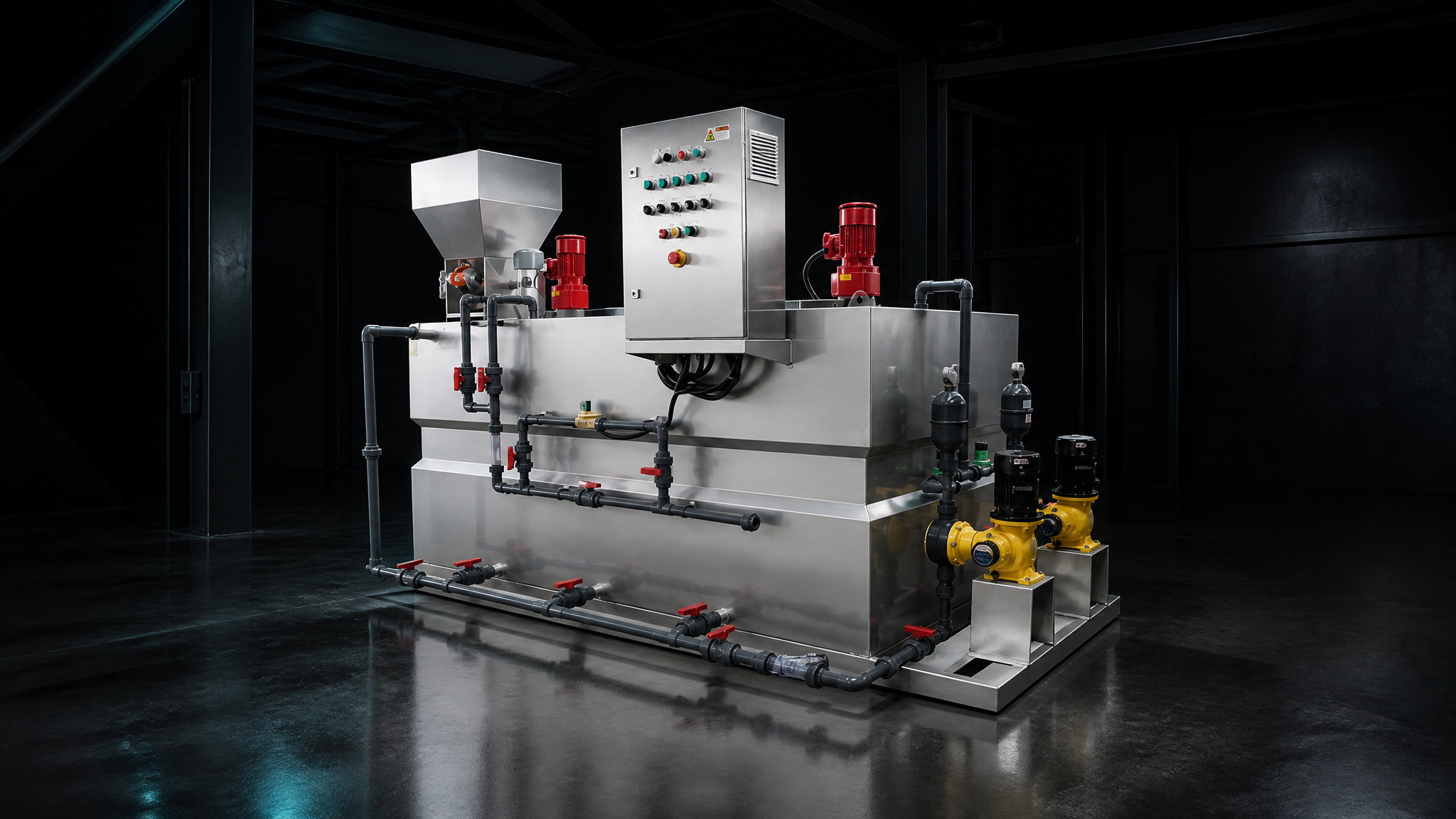
Polymer preparation unit troubleshooting
Start at the preparation unit, not at the dewatering machine. The unit should deliver a solution that is homogeneous, fully hydrated, and stable from batch to batch. Check water pressure, powder feed rate, wetting device condition, mixer speed, tank level control, and residence time. Inspect for deposits, scaling, dead zones, and air ingress.
Then verify the dosing station. Pulsation, blocked injection points, worn check valves, or unstable metering pumps can create false consumption signals. A poor dose distribution can force operators to increase setpoints even when the chemistry is acceptable.
Troubleshooting checklist
[title]
- Check actual kg active polymer per tonne dry solids
- Confirm make-up concentration with a calibrated sample
- Verify ageing time at normal throughput
- Inspect mixer speed and shear intensity
- Check powder storage for moisture, caking, and age
- Review sludge solids and process variability
- Inspect metering pumps, injectors, and non-return valves
- Compare performance before and after each correction
How to reduce polymer dosing in sludge dewatering
The answer is not a single setpoint change. Lower dosing comes from better preparation quality, more consistent sludge feed, and tighter feedback between the dewatering result and the dosing station. In many plants, the best gains come from stabilising the polymer solution first, then optimising dosage in small steps of 5% to 10% while watching centrate quality and cake dryness.
If the plant has a polymer preparation unit with variable batch quality, the dosing station will always be chasing instability. That is why the make-up system is often the fastest route to lower consumption.
why is polymer consumption higher than design+
The usual reasons are poor make-up quality, too little ageing time, the wrong concentration, excess mixing shear, or sludge variability that was not included in the original design basis. A stepwise diagnosis normally identifies the dominant cause within a few operating cycles.
polymer make-up concentration effect on dewatering+
Concentration affects hydration quality, solution stability, and the amount of liquid sent to the process. Too dilute can waste capacity and destabilise dosing; too concentrated can create incomplete wetting and reduce active polymer availability.
polymer ageing time too short symptoms+
Typical signs are weak floc formation, cloudy centrate, inconsistent cake dryness, and the need for higher dose to achieve the same result. If extending maturation time improves performance, hydration was probably incomplete.
Equipment we supply for this
Engineering Hub: get this sized for your plant
Describe your goal, effluent limit or sludge volume and receive a technology shortlist plus a sizing proposal – by email, no phone call required.