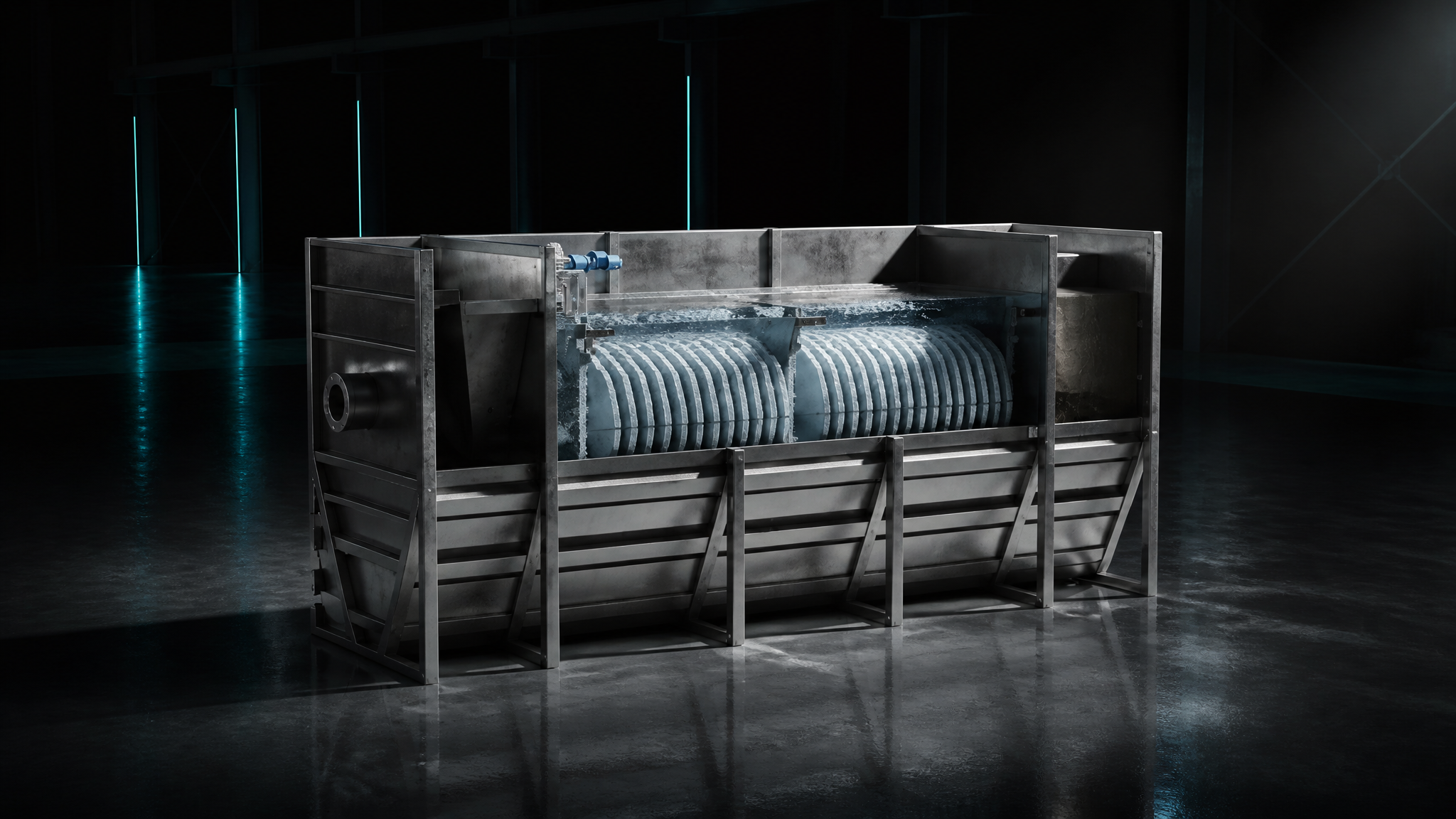
Engineering Hub: get this sized for your plant
Describe your goal, effluent limit or sludge volume and receive a technology shortlist plus a sizing proposal – by email, no phone call required.
Retrofit existing basin with disc filter
[Engineering decision at a glance]
- Label
- Value
- ---
- ---
- Typical use case
- Capacity increase where new civil structures are constrained by budget, footprint, or schedule
- Primary decision factors
- Structural reserve, hydraulic headloss, inlet/outlet geometry, access for maintenance
- Typical retrofit approach
- Reuse an existing basin as a filtration chamber or convert a clarifier compartment into a filter zone
- Main risk drivers
- Uneven flow distribution, inadequate freeboard, insufficient slab capacity, bypass complexity
- Common complementary equipment
- cloth-filter-horizontal, lamella-separators
Topic Typical engineering range
--- ---:
Structural assessment duration 1–4 weeks
Concept selection and hydraulic check 2–6 weeks
Retrofit installation window 1–8 weeks, depending on site access
Relative timeline versus new build Often shorter by several months
Practical retrofit footprint saving Can reuse most of the existing basin volume
Engineering question first: can the basin actually carry the retrofit?
Before a disc filter concept is chosen, the basin must be treated as an existing engineered asset, not.
A structural assessment typically reviews:
- Original design documents, if available
- Reinforcement details and concrete condition
- Load paths for static and dynamic equipment loads
- Water-tightness, cracks, and joint condition
- Corrosion exposure on embedded metal parts
For many retrofit projects, the answer is not a simple yes or no. It is a conditional yes,.
Hydraulic compatibility: will the basin work as a filter chamber?
A basin that functioned well as a clarifier or contact tank may still be hydraulically unsuitable for disc.
The hydraulic review should confirm:
- Available hydraulic grade line under peak and average flows
- Inlet distribution and short-circuiting risks
- Outlet elevation and downstream conveyance constraints
- Backwash or cleaning discharge routing
- Whether temporary bypass operation is needed during maintenance
For projects that must upgrade treatment capacity without new tanks, the most common challenge is not filter area.
Upgrade wastewater plant without new tanks
A retrofit works best when the basin is evaluated as part of the full plant hydraulics, not as a stand-alone vessel. The decision process normally compares three pathways:
- Keep the basin and install filtration equipment inside it.
- Reconfigure the basin hydraulically and add selective internal steelwork.
- Build a new treatment train and leave the existing basin in service as redundancy.
If civil works are out of budget, the first path is often the most realistic, but only if.
Project timeline: retrofit versus new build
A retrofit rarely eliminates engineering effort; it shifts it away from major civil works and toward careful integration. That is usually where the time advantage comes from.
A typical comparison looks like this:
- Retrofit concept, survey, and assessment: weeks
- Fabrication and delivery of modules: several weeks
- Installation during a planned shutdown: days to weeks
- Commissioning and process tuning: short staged period
A new build usually adds permitting complexity, excavation, reinforced concrete works, curing time, utility relocations, and a much.
A successful retrofit is usually decided by three questions: Is the basin structurally reusable? Can the hydraulic profile support the filter? Can the installation be completed within the available outage window? If any answer is uncertain, early site data collection is more valuable than conceptual design drawings alone.
capacity upgrade existing clarifier
An existing clarifier is one of the most common candidates for a capacity upgrade. In many plants, the.
Key engineering checks include:
- Confirming the clarifier can be dewatered and isolated safely
- Verifying sludge removal and bypass arrangements
- Ensuring the retrofit does not compromise upstream settling function if the tank remains partially in service
- Checking whether clarifier bridge, scraper, or launders interfere with the filter layout
In some applications, the clarifier is best kept as a settlement stage and followed by a dedicated filtration.
What a practical decision process looks like
A disciplined retrofit decision typically follows these steps:
- Site survey and dimensional verification
- Structural review and condition inspection
- Hydraulic model or mass balance check
- Concept layout for access, removal, and bypass
- CAPEX/OPEX comparison with new build alternatives
- Shutdown planning and commissioning sequence
The best concepts are the ones that can be installed, maintained, and eventually replaced without major demolition. That is especially important in plants with limited spare capacity or tight compliance margins.
in-basin cloth media filter installation
An in-basin cloth media filter installation can be attractive where footprint is highly constrained. The basin itself becomes part of the process envelope, but only if access, lifting routes, and maintenance clearances are designed in from the start.
Typical design points include:
- Filter module spacing for cleaning and inspection
- Support structure corrosion protection
- Safe access platforms and lifting points
- Drainage for washwater or maintenance events
- Instrumentation access for level, differential pressure, and flow measurement
For some retrofits, cloth-based filtration is combined with pre-separation equipment such as lamella-separators to reduce solids loading and.
Engineering assessment before retrofit
- Confirm basin dimensions and available water depth
- Assess structural load capacity for new equipment
- Check hydraulic head and inlet/outlet compatibility
- Identify access points for installation and maintenance
- Evaluate electrical supply and control integration options
- Review permit requirements for capacity change
What is the first step in a retrofit existing basin with disc filter project?+
Start with a structural and hydraulic feasibility review. That confirms whether the basin can safely carry the equipment and whether the flow profile can support filtration.
When is upgrade wastewater plant without new tanks realistic?+
It is realistic when the existing basin has enough structural reserve, the headloss budget is workable, and the site can accommodate installation and maintenance access.
Is in-basin cloth media filter installation always better than a new build?+
No. It is often faster and less invasive, but only if the basin geometry, hydraulics, and shutdown window match the retrofit concept.
Equipment we supply for this
Engineering Hub: get this sized for your plant
Describe your goal, effluent limit or sludge volume and receive a technology shortlist plus a sizing proposal – by email, no phone call required.