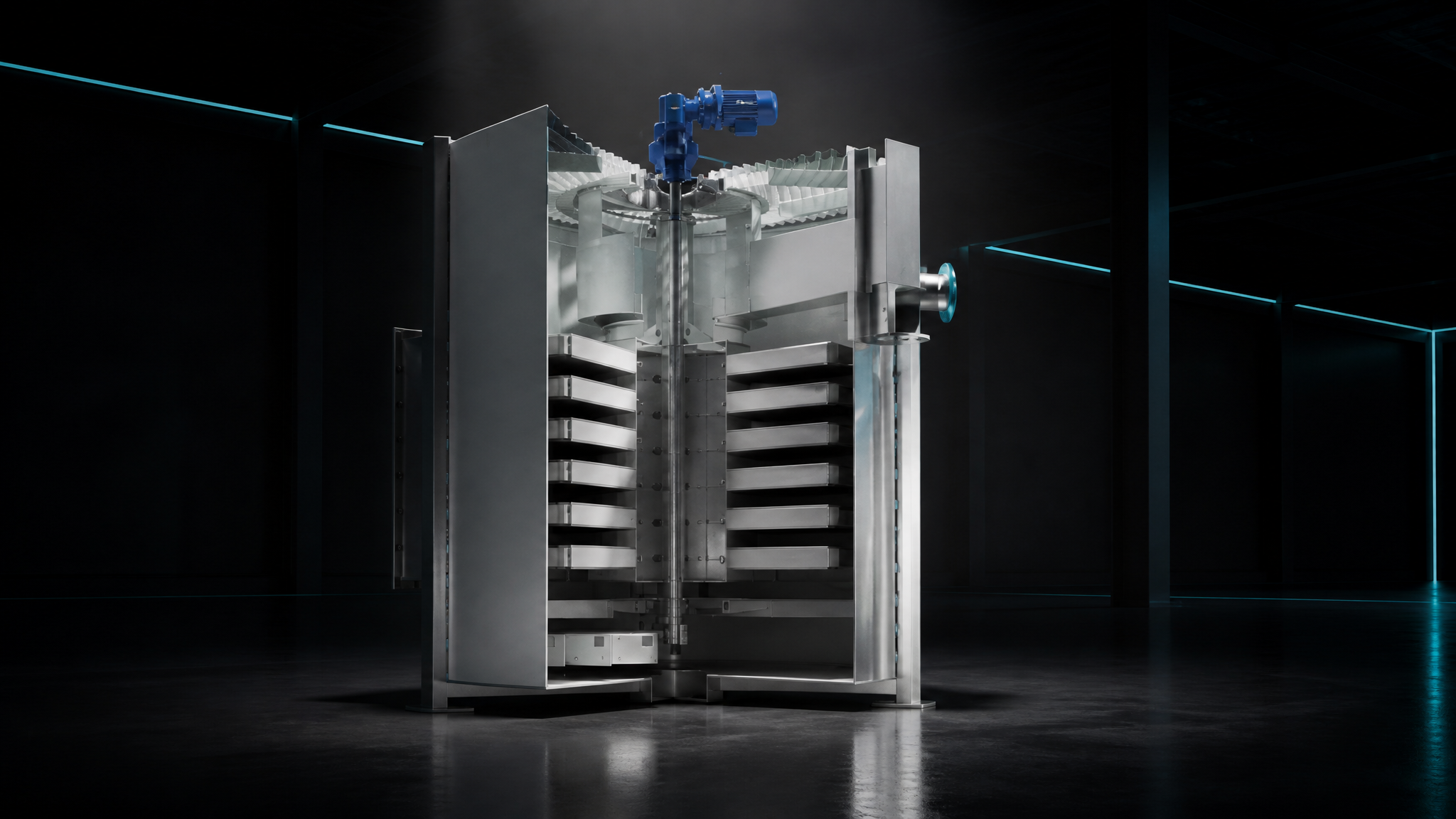
Pile cloth media filtration is widely used for tertiary filtration in wastewater and process water treatment, where reliable solids removal and compact design are required. Correct sizing of a pile cloth media filtration system is essential to achieve target effluent quality, manage solids loading, and ensure robust operation under varying hydraulic and solids loads.
This guide provides practical engineering principles for sizing pile cloth media filtration, including surface loading, solids load, filter area calculation, backwash requirements, and key process design decisions.
Engineering Hub: get this sized for your plant
Describe your goal, effluent limit or sludge volume and receive a technology shortlist plus a sizing proposal – by email, no phone call required.
Hydraulic Surface Loading: Typical Ranges
The primary sizing parameter for pile cloth media filtration is the hydraulic surface loading rate, defined as the volumetric flow per unit of filter area. This determines both the number and size of filter units required.
- Average hydraulic loading: For tertiary filtration of secondary effluent, typical design values range from 4 to 10 m³/(m²·h).
- Peak hydraulic loading: Systems are often designed for peak flows up to 12–18 m³/(m²·h), depending on influent quality and redundancy requirements.
- Feed method: Gravity-fed systems often operate at the lower end of the range, while pumped feed allows higher surface loading but requires careful control of headloss.
Typical Hydraulic Loading
- Average
- 4–10 m³/(m²·h)
- Peak
- 12–18 m³/(m²·h)
Solids Load and Effluent TSS Targets
The influent total suspended solids (TSS) load has a direct impact on filter performance and sizing. Pile cloth media filters are typically applied to flows with:
- Influent TSS: 5–40 mg/L, with higher values possible if upstream chemical dosing is used.
- Effluent TSS: Achievable filtrate quality is typically 1–5 mg/L for tertiary applications, with some variation based on influent quality and chemical conditioning.
- Filtrate quality: Consistent low TSS is a key advantage, supporting reuse, phosphorus removal, or sensitive discharge requirements.
Upstream coagulant or flocculant dosing can improve solids capture and reduce required filter area, but may increase backwash frequency.
Backwash Demand and Water Recycle
Effective cleaning of the pile cloth media is achieved by periodic backwashing, typically using filtered water. Key design considerations include:
- Backwash water fraction: Usually 0.5–2% of total filtrate flow, depending on solids load and cleaning frequency.
- Backwash frequency: Higher solids loads or chemical dosing increase cleaning demand.
- Water recycle: Backwash water is commonly returned to the inlet of the treatment process or to the head of the works.
| Operating Condition | Backwash Fraction | Typical Frequency |
|---|---|---|
| Low solids | 0.5–1% | 1–2 per hour |
| High solids/chemically enhanced | 1–2% | 2–4 per hour |
Filter Area, Disc/Segment Logic, and Redundancy
The total filter area required is calculated by dividing the maximum design flow by the selected surface loading rate. Pile cloth media filters are modular, with filter area provided by discs or segments (vertical or horizontal orientation):
- Number of discs/segments: Determined by total filter area, desired redundancy, and available tank footprint.
- Redundancy: Common practice is to provide n+1 redundancy (e.g., one additional disc or unit beyond minimum required) to allow for maintenance or unexpected loads.
- Filter area calculator: Engineering Hub tools can assist with rapid filter area estimation based on flow and loading inputs.
Gravity vs Pumped Feed: Implications for Design
- Gravity feed: Lower energy demand, simpler hydraulics, but may require larger filter area for a given flow.
- Pumped feed: Allows higher surface loading, but requires careful control of pressure, headloss, and backwash sequence.
- Headloss: Typical clean-bed headloss is 0.1–0.3 m, with maximum allowable headloss up to 1.0–1.5 m before backwash is triggered.
Chemical Dosing Effects
Adding coagulants or flocculants upstream of the filter can:
- Improve solids capture and effluent TSS
- Reduce required filter area
- Increase backwash frequency and solids loading to the filter
- Require dosing control linked to upstream turbidity or flow
Footprint Comparison: Pile Cloth vs Granular Media
Pile cloth media filtration systems offer a compact footprint compared to granular media (e.g., sand) filters:
- Filter area: Typically 2–4 times less area required for equivalent performance
- Installation: Modular disc or segment design supports flexible layouts and easy retrofitting
- Hydraulic profile: Low headloss minimizes civil works and pumping requirements
2–4x smaller
Typical footprint advantage vs granular media
Typical Sizing Workflow
Sizing Pile Cloth Media Filtration
- 1Define influent flow and TSS load
- 2Select target effluent TSS and surface loading
- 3Calculate required filter area
- 4Determine number of discs/segments and redundancy
- 5Estimate backwash water demand and recycle strategy
FAQ
Q: What is the typical surface loading rate for tertiary pile cloth media filtration?
A: Average design loading is 4–10 m³/(m²·h), with peak rates up to 12–18 m³/(m²·h) depending on influent quality and system configuration.
Q: How much backwash water is required?
A: Backwash water demand is typically 0.5–2% of filtrate flow, increasing with higher solids load or chemical dosing.
Q: How do I determine the number of discs or segments needed?
A: Divide the total required filter area by the area provided per disc or segment, then add redundancy as needed for reliability.
Q: Can pile cloth media filters handle chemically enhanced filtration?
A: Yes, but chemical dosing increases solids load and backwash frequency, which must be considered in sizing and operation.
Q: What is the typical effluent TSS from a pile cloth media filter?
A: Effluent TSS is typically 1–5 mg/L for tertiary applications, depending on influent quality and process control.
Q: How does the footprint compare to sand filters?
A: Pile cloth media filters require 2–4 times less area than granular media filters for similar performance.
:::
Equipment we supply for this
Pile Cloth Media Disc Filter
Vertical and horizontal cloth filters for tertiary filtration
Technical dataVertical Pile Cloth Disc Filter
Compact vertical disc filter for tertiary treatment and water reuse
Technical dataHorizontal Pile Cloth Disc Filter
Horizontal design for high flow rates and easy maintenance access
Technical dataFor rapid filter area estimation and design checks, consult the Engineering Hub filter-area calculator.