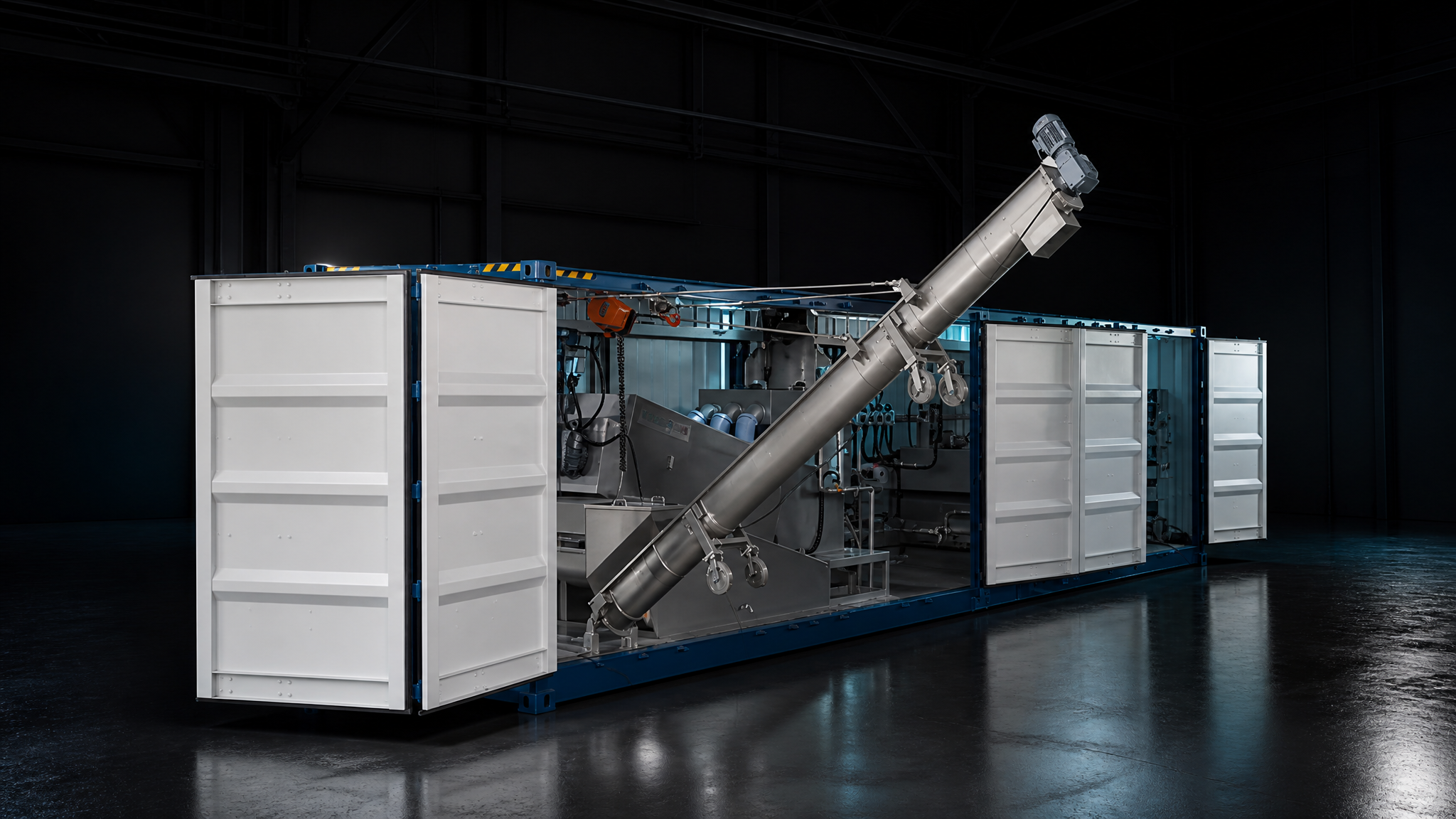
- Label
- Value
- Typical skid/container lead time
- 3–8 months from order to commissioning
- Typical site-built lead time
- 18–36 months including civil works
- Civil works share of site-built CAPEX
- 25–45 % of total project cost
- Useful service life (both approaches)
- 15–25 years with planned maintenance
- Scalability increment (modular)
- Add capacity in defined module steps
Engineering Hub: get this sized for your plant
Describe your goal, effluent limit or sludge volume and receive a technology shortlist plus a sizing proposal – by email, no phone call required.
Why lead time is the first decision criterion
Industrial operators facing a new discharge permit, a production ramp-up, or an acquisition integration rarely have two years to spare. A containerised wastewater treatment plant lead time of three to eight months is not a marketing claim — it reflects the reality that engineering, fabrication, and factory acceptance testing happen in parallel rather than sequentially. By the time a site-built project has completed ground investigation and obtained building permits, a skid-mounted unit can already be producing compliant effluent.
This time compression has a direct financial value. Every month of delayed compliance carries regulatory risk, potential production curtailment, and reputational exposure. Quantifying that risk in euros or dollars per month and comparing it against any CAPEX premium for prefabricated solutions is the correct starting point for the decision framework.
Skid mounted treatment unit advantages beyond speed
Speed is the headline, but the structural advantages of skid-mounted and containerised systems extend across the full project lifecycle:
- Factory quality assurance: Welding, pipework, instrumentation, and electrical terminations are completed under controlled workshop conditions, reducing field defects.
- Reduced civil works exposure: Foundations for a skid are typically a reinforced concrete pad rather than a full structural building, cutting civil works cost avoidance of 25–45 % of comparable site-built CAPEX.
- Predictable commissioning: Factory acceptance testing (FAT) resolves the majority of process and control issues before the unit leaves the workshop, compressing site commissioning to days rather than weeks.
- Relocatability: If production moves or the treatment requirement changes, a containerised unit can be transported and reinstalled at a new location — an option that does not exist for poured-concrete infrastructure.
- Financing clarity: A skid or container is a capital asset with a defined book value, simplifying asset financing and insurance.
Modular filtration systems industrial: scalability over time
One of the most underestimated advantages of modular filtration systems in industrial settings is the ability to scale incrementally. A site-built plant must be designed for peak future capacity on day one, locking capital into infrastructure that may sit underutilised for years. A modular approach allows operators to commission a first module sized for current flows, then add parallel modules as production grows — matching capital expenditure to actual throughput.
This staged investment profile materially improves net present value (NPV) calculations over a ten-year horizon, because capital deployed later is worth less in present-value terms than capital deployed today.
Prefabricated wastewater plant installation: what the site still needs
Prefabricated wastewater plant installation is not zero-civil-works. Operators should plan for:
- Reinforced concrete pad or steel frame foundation
- Electrical supply and earthing to the skid interface
- Inlet and outlet pipework connections
- Drainage and bunding for spill containment
- Access routes for delivery and future maintenance
These items are well-defined and can be tendered and constructed in parallel with factory fabrication, maintaining the compressed schedule.
| Criterion | Skid / Container | Site-Built |
|---|---|---|
| Lead time to commissioning | 3–8 months | 18–36 months |
| Civil works CAPEX share | 5–15 % | 25–45 % |
| Commissioning risk | Low (FAT completed) | Medium–High (field integration) |
| Scalability | Modular increments | Requires major redesign |
| Relocatability | Yes | No |
| 10-year OPEX profile | Predictable, vendor-supported | Variable, site-dependent |
| Permitting complexity | Lower (equipment, not building) | Higher (structural, planning) |
| Residual asset value | Defined book value | Embedded in property |
For flows below approximately 500 m³/day, skid-mounted and containerised solutions almost always deliver a lower ten-year total cost of ownership than equivalent site-built infrastructure, once civil works, extended commissioning, and delayed compliance costs are included in the model.
- ## Decision checklist: skid/container vs site-built
- [ ] Is the required commissioning date within 12 months?
- [ ] Is the treatment flow below 500 m³/day or likely to grow incrementally?
- [ ] Is the installation site temporary, leased, or subject to future relocation?
- [ ] Is civil works budget constrained or permitting timeline uncertain?
- [ ] Does the process require factory-proven performance before site deployment?
- [ ] Is asset financing or operating lease preferred over embedded infrastructure?
- [ ] Is a screw press or other mechanical dewatering step required within the same footprint?
What is a realistic containerised wastewater treatment plant lead time?+
For standard flow ranges up to approximately 200–500 m³/day, a containerised plant including process engineering, fabrication, factory acceptance testing, and delivery typically requires 3–8 months from order placement. Complex multi-stage systems or highly customised process trains may extend toward 10–12 months, still well within the 18–36 month range typical of site-built projects.
What are the main skid mounted treatment unit advantages for industrial operators?+
The primary advantages are compressed lead time, reduced civil works expenditure, lower commissioning risk through factory acceptance testing, incremental scalability, and relocatability. Over a ten-year ownership period, these factors combine to produce a total cost of ownership that is frequently lower than site-built alternatives, particularly when delayed compliance costs and financing costs on idle civil infrastructure are included.
How does prefabricated wastewater plant installation affect long-term OPEX?+
Prefabricated systems are designed and built as integrated packages, which simplifies spare parts management, remote monitoring integration, and planned maintenance scheduling. OPEX is generally more predictable than for site-built plants, where instrumentation, pipework, and electrical systems from multiple contractors must be maintained as a heterogeneous assembly. Vendor-supported service agreements are also more straightforward to structure for a defined equipment package.
Equipment we supply for this
Engineering Hub: get this sized for your plant
Describe your goal, effluent limit or sludge volume and receive a technology shortlist plus a sizing proposal – by email, no phone call required.