Engineering Hub: get this sized for your plant
Describe your goal, effluent limit or sludge volume and receive a technology shortlist plus a sizing proposal – by email, no phone call required.
The Time-Critical Challenge in Wastewater Treatment Deployment
Industrial facilities facing regulatory deadlines, production expansions, or environmental compliance requirements often encounter a critical constraint: time. Traditional site-built wastewater treatment infrastructure typically requires 18-24 months from design approval to commissioning. For operations that need treatment capacity within a few months, this timeline is simply unacceptable.
The choice between skid-mounted, containerised, and site-built construction fundamentally determines project delivery speed, capital expenditure patterns, and operational flexibility. Understanding these differences enables engineering teams to select the approach that aligns with both immediate operational needs and long-term strategic objectives.
- Typical Site-Built Timeline
- 18-24 months from approval to commissioning
- Skid-Mounted Delivery
- 3-6 months typical lead time
- Containerised Systems
- 2-4 months for standard configurations
- Installation Duration
- 1-2 weeks vs 6-12 months for site-built
Containerised Wastewater Treatment Plant Lead Time
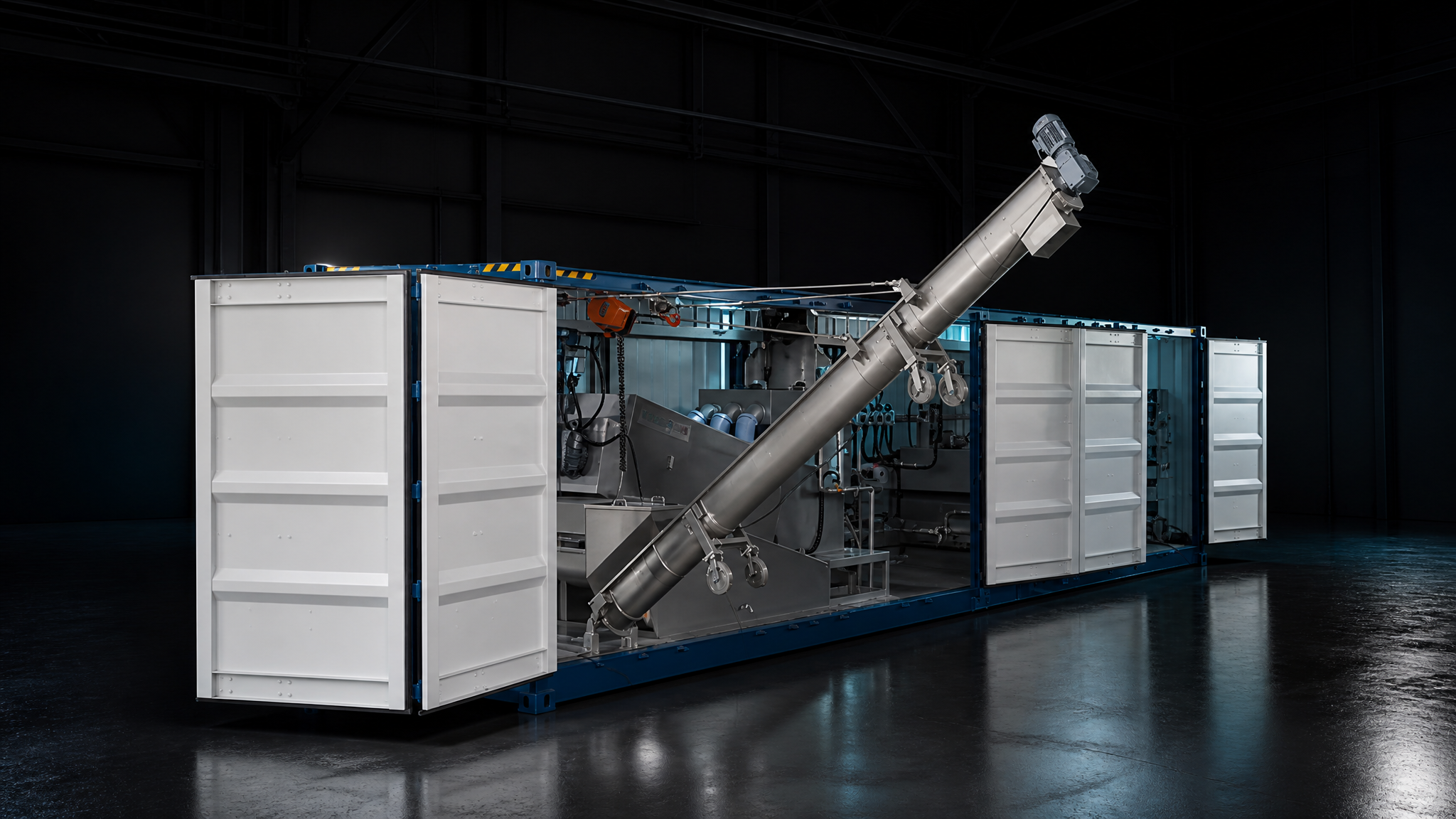
Containerised treatment systems represent the fastest deployment option for industrial wastewater applications. These fully enclosed units arrive at site with equipment pre-installed, pre-wired, and factory-tested.
Typical timeline breakdown:
- Engineering and customisation: 4-6 weeks
- Manufacturing and assembly: 6-10 weeks
- Factory acceptance testing: 1-2 weeks
- Shipping and site preparation: 2-4 weeks
- Installation and commissioning: 1-2 weeks
Total elapsed time from order to operation typically ranges from 2-4 months for standard configurations. Custom-engineered containerised systems may extend to 4-6 months, still representing a 70-80% reduction compared to equivalent site-built facilities.
Containerised units excel in applications requiring rapid deployment, temporary treatment capacity, or installations in remote locations where skilled construction labour is limited.
Skid-Mounted Treatment Unit Advantages
Skid-mounted systems offer a middle ground between fully containerised solutions and traditional site-built construction. These pre-assembled process units mount on structural steel frames, allowing factory fabrication and testing while providing greater flexibility in layout and integration.
Key advantages of skid-mounted configurations:
- Accelerated delivery: 3-6 month typical lead times versus 18-24 months for site-built equivalents
- Factory quality control: Assembly and testing in controlled environments ensures consistent quality and reduces field commissioning issues
- Reduced site work: Minimal civil construction requirements beyond foundations and utility connections
- Scalability: Multiple skids can be deployed in parallel or sequentially as capacity requirements evolve
- Relocatable assets: Equipment can be moved to different facilities or repurposed as operational needs change
- Predictable costs: Fixed-price procurement with minimal exposure to site construction variables
75%
Reduction in installation time vs site-built
40-60%
Lower civil construction costs
90%
Factory completion before shipping
Skid-mounted lamella clarification systems, for example, integrate settling plates, sludge collection mechanisms, and chemical dosing equipment on a single structural frame. This approach eliminates months of field installation while ensuring optimal component alignment and performance.
Modular Filtration Systems Industrial Applications
Modular filtration approaches extend the skid-mounted concept to create scalable, expandable treatment trains. Industrial facilities benefit from modular design through:
Phased capacity expansion: Deploy initial modules to meet immediate requirements, then add capacity incrementally as production increases without disrupting existing operations.
Process redundancy: Multiple parallel modules provide operational flexibility for maintenance and ensure continuous treatment during equipment servicing.
Technology upgrades: Individual modules can be replaced or upgraded as treatment requirements evolve or more efficient technologies become available.
Risk mitigation: Smaller modular investments reduce financial exposure compared to large-scale site-built projects, particularly valuable when future production volumes carry uncertainty.
Modular systems prove particularly effective for industries experiencing rapid growth or regulatory changes. The ability to deploy treatment capacity in 3-4 month increments rather than committing to multi-year construction projects provides strategic operational flexibility.
Prefabricated Wastewater Plant Installation Considerations
Successful prefabricated system deployment requires attention to several critical factors:
- Site preparation completed before equipment arrival including foundations, utility rough-ins, and access routes
- Electrical and control system integration planned for compatibility with existing facility infrastructure
- Operator training scheduled to coincide with commissioning activities
- Spare parts inventory established before system startup
- Maintenance access provisions verified in layout design
- Future expansion space allocated in initial site planning
When Site-Built Construction Remains Appropriate
Despite the compelling advantages of prefabricated approaches, site-built construction remains optimal for certain scenarios:
- Very large capacity requirements (>5,000 m³/day) where transportation constraints limit skid sizing
- Highly customised process configurations requiring extensive civil integration
- Permanent installations where long-term optimisation outweighs deployment speed
- Projects with extended timelines where construction scheduling flexibility provides value
Making the Strategic Selection
The decision framework should evaluate:
Timeline requirements: If operational treatment is needed within 6 months, prefabricated solutions become essential.
Capital availability: Skid-mounted and containerised systems typically require earlier payment compared to site-built projects with distributed construction draws.
Operational flexibility: Consider whether future relocation, expansion, or repurposing provides strategic value.
Site constraints: Limited construction access, ongoing operations, or remote locations favour prefabricated approaches.
What is the typical containerised wastewater treatment plant lead time?+
Containerised systems typically require 2-4 months from order to commissioning for standard configurations, and 4-6 months for custom-engineered solutions. This represents a 70-80% reduction compared to equivalent site-built facilities requiring 18-24 months.
What are the primary skid-mounted treatment unit advantages over site-built construction?+
Skid-mounted units offer 75% faster installation, 40-60% lower civil construction costs, factory quality control, relocatable assets, predictable fixed pricing, and the ability to achieve 90% completion before shipping. They reduce project risk while accelerating time to operation.
How do modular filtration systems benefit industrial applications?+
Modular industrial filtration systems enable phased capacity expansion, provide operational redundancy for maintenance, allow technology upgrades of individual modules, and reduce financial risk through smaller incremental investments rather than large-scale construction commitments.
Equipment we supply for this
Engineering Hub: get this sized for your plant
Describe your goal, effluent limit or sludge volume and receive a technology shortlist plus a sizing proposal – by email, no phone call required.
Conclusion
For industrial operations requiring wastewater treatment capacity in months rather than years, skid-mounted and containerised solutions provide proven alternatives to traditional site-built construction. While each approach offers distinct advantages, prefabricated systems deliver dramatic reductions in deployment time, predictable costs, and operational flexibility that align with modern industrial requirements. The strategic selection depends on balancing timeline urgency, capacity requirements, capital patterns, and long-term operational objectives.
Contact our engineering team at [email protected] to evaluate which approach optimises your specific wastewater treatment requirements.