Engineering Hub: get this sized for your plant
Describe your goal, effluent limit or sludge volume and receive a technology shortlist plus a sizing proposal – by email, no phone call required.
Sludge disposal cost: the financial case for higher dry solids content
For many wastewater plants, sludge disposal is not a minor line item; it is the.
The challenge is not proving that thicker sludge is better in principle. The real task.
sludge disposal cost per tonne dry solids
A robust calculation starts with a clear cost basis. Disposal costs are often quoted per.
A practical calculation framework includes:
- Wet sludge mass generated per day or per month
- Dry solids content, typically expressed as % DS
- Transport cost per truck or per tonne
- Gate fee or disposal fee per tonne
- Internal handling costs such as loading, decanting, or storage
To convert wet sludge into dry solids mass:
- Dry solids mass = wet sludge mass × dry solids fraction
To estimate disposal cost per tonne of dry solids:
- Total disposal cost ÷ dry solids tonnes disposed
This approach makes the economic effect of dewatering visible. If the dry solids content rises.
Key financial drivers
- Label Value
- --- ---:
- Main cost lever Reduced wet sludge mass
- Typical improvement range +3 to +10 percentage points DS
- Most relevant KPI Cost per tonne of dry solids
- Financial outcome Fewer truck movements and lower disposal fees
- Common decision metric Payback period
Scenario Dry solids content Relative hauled mass Indicative effect on disposal cost
--- ---: ---: ---:
Baseline 18% DS 100% Reference case
Improved dewatering 24% DS ~75% Lower transport and gate fees
Strong optimisation 28% DS ~64% Potentially substantial annual savings
High-performance range 30% DS ~60% Best suited to stable sludge conditions
How to increase dry solids content sludge
A higher dry solids content is usually achieved by improving the separation step before disposal..
Typical measures include:
- Optimising polymer selection and dosing
- Stabilising feed concentration and flow variations
- Improving sludge conditioning before dewatering
- Reducing excessive dilution from wash water or return streams
- Upgrading to a dewatering technology with better performance stability
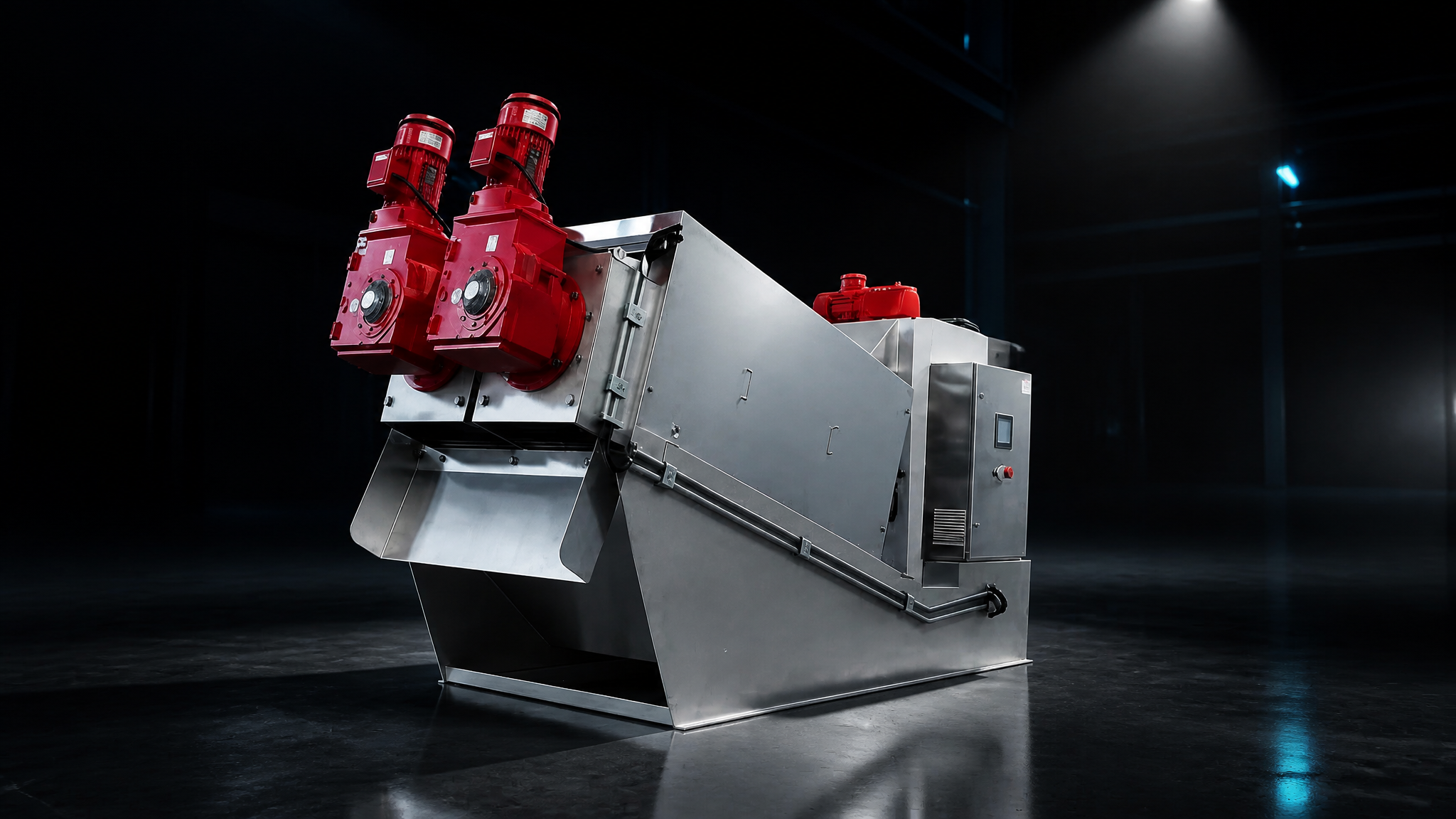
For many municipal and industrial applications, a screw-press can be an attractive option because it.
A stronger dewatering result does not have to mean a dramatic process overhaul. In many cases, the business case is built on incremental gains: one to two fewer truckloads per week, lower gate fees, and less time spent on sludge handling. Over a year, those savings can be material.
sludge dewatering payback calculation
Management usually wants a simple answer: how long until the investment pays back? The most.
Use this structure:
- Determine current annual sludge disposal cost.
- Estimate the reduction in wet sludge mass after dewatering improvement.
- Convert that reduction into annual transport and disposal savings.
- Subtract additional operating costs such as polymer, power, maintenance, and labour.
- Compare the net annual savings with the investment cost.
Formula:
- Payback period = Investment cost ÷ Net annual savings
Example framework for internal evaluation:
- Current disposal cost: transport + gate fee + handling
- Improvement effect: 10–25% less hauled wet mass, depending on baseline sludge condition
- Additional OPEX: polymer use and service costs may rise slightly
- Net result: savings should be measured after all incremental costs are included
A sound financial case should also include sensitivity analysis. Management is more likely to approve projects when the model shows.
reduce sludge volume before disposal
Reducing sludge volume before disposal is the most direct route to cutting operating cost. The principle is simple: if water.
A credible business case should show the following before and after figures:
- Average dry solids content
- Monthly wet sludge volume
- Number of trucks or containers required
- Annual disposal cost
- Payback period for the dewatering upgrade
For management, the recommendation should be expressed in financial language:
- annual savings
- avoided truck movements
- reduced disposal exposure
- resilience against future disposal price increases
Do not base the case only on equipment efficiency claims. A management proposal should always connect process performance to site-specific costs. If the savings are calculated from actual truck capacity, disposal invoices, and measured sludge solids, the case is much stronger.
How to present the business case to management
Decision-makers usually respond best to a concise, finance-led summary. Keep the message in three parts:
- Problem: sludge disposal is the largest operating cost and is trending upward.
- Solution: improve dewatering to raise dry solids content and reduce hauled mass.
- Result: quantified annual savings with a realistic payback period.
It helps to show a one-page summary with:
- baseline cost per tonne of dry solids
- proposed dry solids target range
- expected annual savings range
- investment cost
- simple payback range
- key risks and assumptions
This format allows management to compare the dewatering project against other capital priorities without needing to review the full process.
- Measure current sludge mass, dry solids content, and disposal invoices.
- Calculate the effective cost per tonne of dry solids.
- Estimate haulage reduction from higher dry solids content.
- Include polymer, energy, and maintenance changes in the model.
- Run conservative and expected payback scenarios.
- Present the result in annual savings, truck movements avoided, and payback period.
What is the best way to calculate sludge disposal cost per tonne dry solids?+
Divide the total annual disposal cost, including transport and gate fees, by the annual dry solids tonnes disposed. This gives a normalised cost basis for comparing scenarios.
What is a realistic way to increase dry solids content sludge?+
The most common route is to optimise polymer conditioning and upgrade the dewatering stage. Depending on sludge characteristics, a screw-press may improve solids capture and reduce wet mass for disposal.
What should be included in a sludge dewatering payback calculation?+
Include investment cost, annual savings from lower transport and disposal, and additional operating costs such as polymer, power, labour, and maintenance. A sensitivity range is advisable.
Equipment we supply for this
Engineering Hub: get this sized for your plant
Describe your goal, effluent limit or sludge volume and receive a technology shortlist plus a sizing proposal – by email, no phone call required.