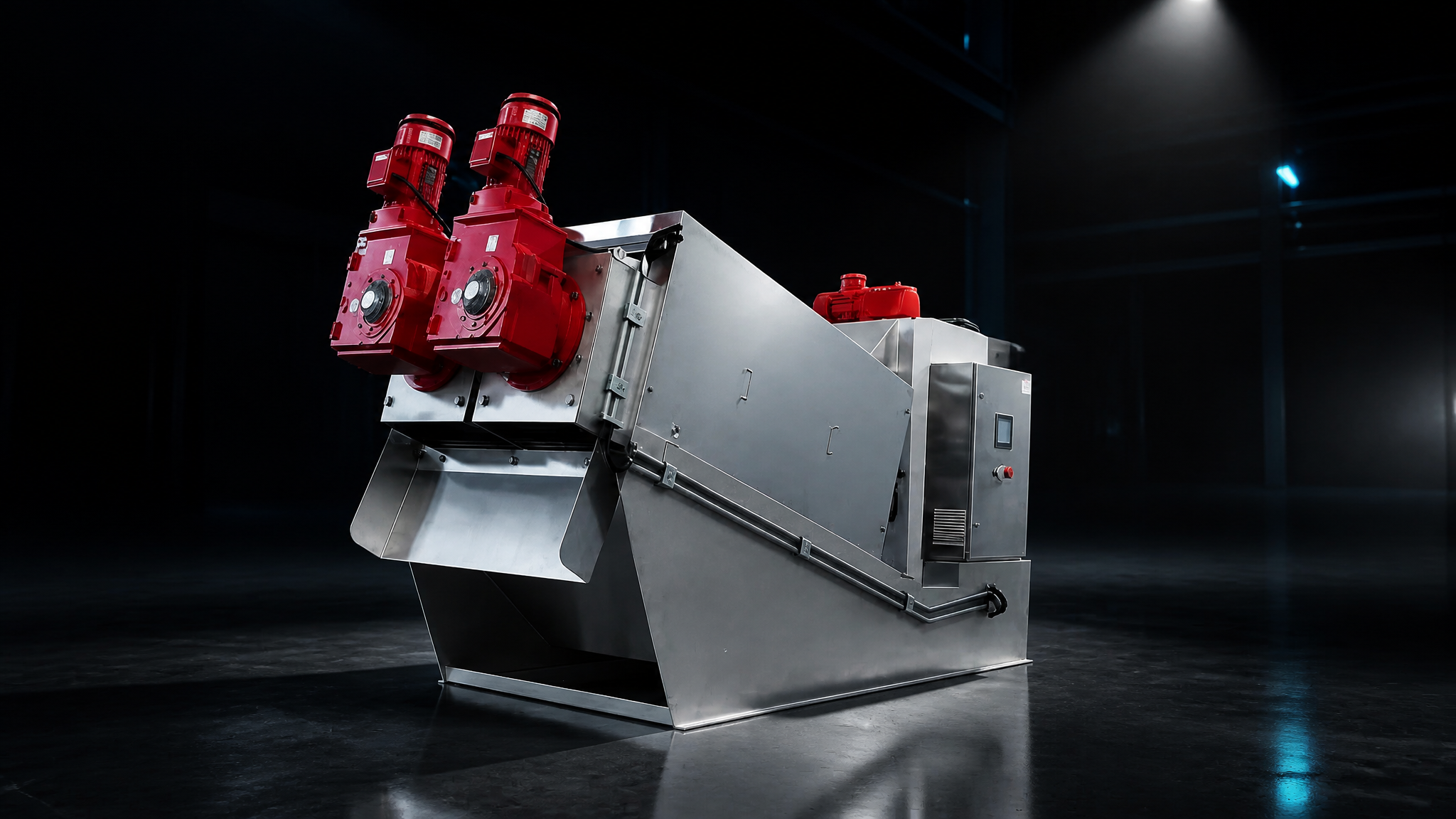
Key facts
- Metric
- Why it matters
- Torque trend
- Reveals rising mechanical resistance before a trip
- Cake dryness
- Early indicator of feed, wear, or polymer problems
- Filtrate quality
- Detects poor floc formation and carryover solids
- Run hours
- Supports service intervals based on actual load
- Alarm history
- Helps separate process faults from equipment faults
Engineering Hub: get this sized for your plant
Describe your goal, effluent limit or sludge volume and receive a technology shortlist plus a sizing proposal – by email, no phone call required.
Predictive maintenance starts with the signals your dewatering line already generates
Automated screw press dewatering is designed to run with minimal supervision. That is a major advantage, but it also creates a blind spot: the first visible sign of trouble may be an off-spec cake, an overloaded press, or a shutdown alarm. Predictive maintenance closes that gap by turning operating data into early warnings.
The objective is to understand what changes in torque, throughput, cake moisture, filtrate clarity, and polymer demand mean in combination. A rising torque trend may point to increasing internal friction, sludge feed variability, or build-up on the screw. A sudden change in cake dryness can indicate polymer underdosing, poor mixing in the polymer-preparation stage, or a feed pump issue. Used together, these signals help operators distinguish a process drift from a genuine mechanical fault.
From reactive response to condition-based intervention
In a reactive setup, maintenance starts after the press trips or the sludge cake fails quality checks. In a predictive setup, operators define acceptable operating bands and watch for deviations over time. This can be done with simple trend analysis or PLC-linked data logging. The key is consistency: a fault that develops slowly over days is often visible long before a shutdown occurs.
If torque increases while feed rate remains stable, the press may be experiencing higher solids loading, wear on conveying elements, or partial blockage. If filtrate solids rise while torque stays normal, the issue is more likely chemical or hydraulic — poor polymer activation or inconsistent sludge conditioning. This is where polymer-preparation performance becomes critical, because unstable floc formation can look like a mechanical fault unless the upstream chemistry is monitored properly.
What to monitor in an unattended dewatering system
Predictive maintenance works best when monitoring points reflect both process and asset health. The most useful indicators include:
- torque or motor current trend
- screw speed and feed rate stability
- cake dryness and discharge consistency
- filtrate turbidity or suspended solids
- polymer consumption per tonne of dry solids
- alarm frequency and duration
These values should be reviewed as trends, not isolated readings. A single high torque event may not matter; a sustained rise over several cycles often does.
Fault diagnostics: matching symptoms to likely causes
A well-instrumented screw press supports faster diagnosis. The table below shows typical signal patterns and their interpretation.
| Signal | Normal range | Fault indicator | Action |
|---|---|---|---|
| Torque | Baseline with minor fluctuations | Sustained increase above established trend | Inspect screw wear, cake buildup, and inlet loading |
| Cake dryness | Stable within process target | Noticeable reduction over several batches | Check polymer dose, mixing, and feed consistency |
| Filtrate clarity | Low and steady solids carryover | Rising turbidity or visible solids | Review floc formation and screens |
| Motor current | Correlates with throughput | Unexplained rise at constant load | Check bearings, gearbox, or mechanical resistance |
| Polymer use | Stable against sludge type | Increased demand without better cake quality | Verify polymer aging, preparation, and dilution |
Why polymer-preparation is part of predictive maintenance
Many dewatering problems begin upstream, where polymer is prepared, diluted, and aged. If concentration drifts, mixing energy is too low, or maturation time changes, the resulting floc structure becomes unstable. The press may then compensate with higher torque, poorer drainage, or reduced cake dryness.
That is why polymer-preparation should be treated as an asset in the predictive maintenance model. Stable solution quality makes dewatering performance more repeatable and diagnostics more reliable. When polymer preparation is automated and monitored, operators can see whether a fault is chemistry-related or truly mechanical — reducing unnecessary interventions and improving confidence in unmanned operation.
A practical approach to early fault detection
A strong program does not require complex tools on day one. It starts with defining baselines for normal operation, then setting alert levels for deviation. The next step is to connect those alerts to response rules:
- rising torque plus stable polymer use may trigger a mechanical inspection
- falling cake dryness plus rising polymer demand may trigger a chemistry review
- repeated short alarms may indicate unstable feed or sensor drift
- changing filtrate quality after maintenance may suggest incorrect settings
Over time, these patterns support planned service windows and spare parts ordering before production is affected — especially valuable where dewatering runs overnight or at remote sites.
Predictive maintenance is not about replacing operator judgment. It is about giving the maintenance team earlier, clearer evidence so they can act before the press trips or cake quality becomes an issue.
Diagnosis caution
Do not treat a single fault alarm as the full diagnosis. In unattended dewatering, the root cause is often a combination of sludge variability, polymer drift, and gradual mechanical wear.
Early-warning checklist for unattended screw press operation
- Compare torque and motor current against a rolling baseline, not a fixed daily value
- Track cake dryness and filtrate quality together to separate process from mechanical faults
- Verify polymer concentration, mixing, and maturation time at every shift change
- Review alarm history for repeated short events that suggest instability
- Inspect wear parts on a condition basis rather than only by calendar interval
- Document sludge type changes, because feed variability can mimic equipment failure
- Confirm sensor calibration so predictive trends are based on trustworthy data
Can predictive maintenance work without advanced analytics?+
Yes. Even simple trend monitoring of torque, cake dryness, filtrate quality, and polymer use can reveal developing faults before downtime occurs.
Why does polymer-preparation matter so much in screw press dewatering?+
Because unstable polymer solution quality leads to poor floc formation, which reduces drainage performance and can be mistaken for a mechanical issue.
What is the most useful early warning sign in unattended operation?+
A sustained deviation from the normal operating trend, especially when torque, cake quality, and filtrate clarity change together.
Equipment we supply for this
Engineering Hub: get this sized for your plant
Describe your goal, effluent limit or sludge volume and receive a technology shortlist plus a sizing proposal – by email, no phone call required.