Engineering Hub: get this sized for your plant
Describe your goal, effluent limit or sludge volume and receive a technology shortlist plus a sizing proposal – by email, no phone call required.
[Sludge Disposal Economics]
- Disposal cost range
- €40–€180 per tonne wet sludge
- Typical dry solids
- 18–24% from belt press; 22–28% from screw press
- Mass reduction per 1% TS gain
- ~4% less sludge to dispose
- Payback period
- 18–36 months for dewatering upgrade
For many wastewater treatment facilities, sludge disposal represents the single largest variable operating expense, often exceeding energy and chemical costs combined. Disposal tariffs vary widely depending on regional infrastructure, regulatory requirements, and disposal method—landfill, incineration, or agricultural application—but all share one characteristic: cost is calculated per tonne of wet cake delivered. This pricing structure creates a direct financial incentive to maximise dry solids content, as every kilogram of water removed before transport is a kilogram you do not pay to dispose of. Facilities that achieve even modest improvements in dewatering performance realise substantial, recurring savings that compound year after year.
The arithmetic of dry solids improvement is straightforward but often underappreciated. Consider a facility producing 2,000 tonnes of dry solids annually, currently dewatering to 22% dry solids content. The wet cake mass is 9,091 tonnes per year (2,000 ÷ 0.22). Improving dewatering performance to 23% dry solids reduces wet cake mass to 8,696 tonnes—a reduction of 395 tonnes, or 4.3%. At a disposal cost of €80 per tonne, this single percentage point improvement saves €31,600 annually. Scale this to larger facilities or higher disposal tariffs, and the financial impact becomes impossible to ignore. The relationship is non-linear: each additional percentage point of dry solids removes proportionally more water from a smaller remaining mass.
€8,000–€25,000
Annual saving per 1% TS gain at 1,000 m³/day throughput
21%
Mass reduction from 22% to 26% dry solids
4:1
Typical ratio of disposal cost saving to dewatering energy increase
Polymer conditioning is the primary operational lever for dewatering performance, yet it remains poorly optimised at many facilities. The polymer dose rate, make-up concentration, and mixing energy must all be calibrated to sludge characteristics that change with season, influent load, and upstream process conditions. Underdosing produces weak floc structure that releases water during pressing, while overdosing creates viscous, sticky cake that blinds filter media without improving dry solids. Jar testing should be conducted monthly—or more frequently when sludge characteristics change—to establish the optimal dose rate, typically 4–10 kg active polymer per tonne dry solids. Automated polymer preparation systems that maintain consistent active concentration deliver more reliable performance than manual batch systems, where concentration drift and incomplete dissolution compromise flocculation quality.
[The Hidden Cost of Wet Sludge]
Facilities that report sludge disposal cost per tonne of wet cake are systematically underestimating the true cost. A 22% dry solids cake contains 78% water you are paying to transport and dispose of. Every percentage point of dry solids improvement reduces that water fraction and the associated cost.
Identifying whether your dewatering equipment is underperforming requires systematic measurement and comparison against realistic benchmarks. Record dry solids content daily using a calibrated moisture analyser, not visual assessment or operator experience. Compare your results against typical performance ranges for your sludge type: biological sludge from activated sludge processes should achieve 18–22% dry solids; mixed primary and secondary sludge should reach 22–26%; digested sludge can achieve 24–28% with proper conditioning. If your facility consistently operates at the lower end of these ranges, investigate polymer conditioning quality first—verify make-up concentration, check mixing energy, and conduct jar tests. If polymer optimisation does not improve performance, examine press throughput rate relative to design capacity, filter cloth condition, and wear on press elements. Dewatering equipment operates as a system; weak performance in one component limits overall results.
[Factors That Determine Achievable Dry Solids]
- Sludge type and conditioning history (biological vs. primary vs. mixed)
- Polymer type, make-up concentration, and dosing rate
- Press throughput rate relative to design capacity
- Feed sludge consistency and temperature
- Equipment maintenance status (wear on press elements, filter cloth condition)
The financial case for dewatering optimisation is compelling even when capital investment is required. Upgrading from a belt press to a screw press, or replacing an undersized or worn-out unit, typically delivers payback periods of 18–36 months through disposal cost savings alone. Additional benefits—reduced odour, smaller equipment footprint, lower wash water consumption—strengthen the business case but are secondary to the disposal cost reduction. Facilities that defer dewatering upgrades to prioritise other capital projects are often making a costly mistake: every year of delay represents tens of thousands of euros in avoidable disposal costs. The question is not whether to optimise dewatering performance, but how quickly you can implement improvements and begin capturing the savings.
How do I calculate the financial value of improving dry solids content by 1%?+
Multiply your annual sludge production in tonnes dry solids by the wet cake mass at current dry solids, then recalculate at the improved dry solids. The difference in wet tonnes multiplied by your disposal cost per tonne gives the annual saving. At 1,000 m³/day throughput producing 2 kg DS/m³, improving from 22% to 23% DS reduces wet cake by approximately 4%, saving €8,000–€25,000 annually depending on disposal tariff.
What dry solids content can a screw press realistically achieve?+
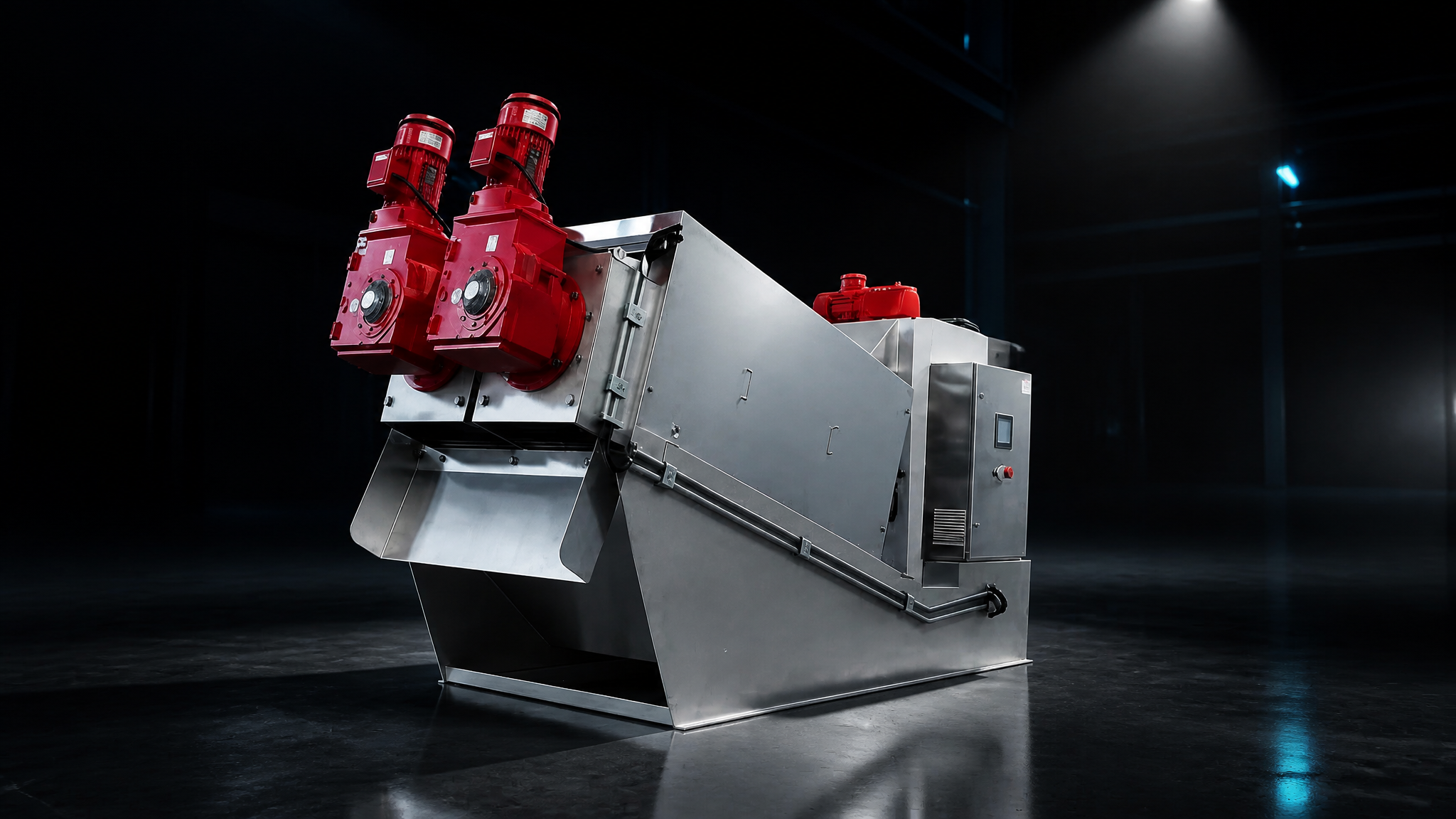
Screw presses typically achieve 18–28% dry solids depending on sludge type. Biological sludge from activated sludge processes typically dewaters to 18–22%; mixed primary and secondary sludge reaches 22–26%; digested sludge can achieve 24–28% with optimised polymer conditioning. These are realistic operating ranges, not guaranteed values—actual performance depends on sludge characteristics and conditioning quality.
How does polymer dosing affect dry solids and disposal cost?+
Polymer conditioning is the primary lever for dewatering performance. Underdosing produces wet, poorly structured cake; overdosing wastes chemical cost without proportional performance gain. The optimal dose rate—typically 4–10 kg active polymer per tonne dry solids—must be established by jar testing and adjusted as sludge characteristics change. Automated polymer preparation systems maintain consistent active concentration, which is as important as dose rate for achieving target dry solids.
Equipment we supply for this
Engineering Hub: get this sized for your plant
Describe your goal, effluent limit or sludge volume and receive a technology shortlist plus a sizing proposal – by email, no phone call required.