Chemical treatment & dosing
Polymer preparation & dosing
Polymer is the quiet cost driver behind every dewatering and clarification process. Get the make-up and dosing right and the whole plant works better on less reagent; get it wrong and consumption drifts up while performance drifts down.
The key is proper preparation: correct dilution, adequate maturation time and clean make-up water, so that every polymer chain is activated before it reaches the process. A well-designed preparation and dosing station is usually the fastest route to lower chemical bills.
In brief
Polymer preparation is the automatic dilution, maturation and dosing of flocculant so that it is fully activated at the point of use — the basis for reliable flocculation in dewatering and clarification.
The challenges this solves
Excessive polymer consumption
Under-matured or poorly diluted polymer never reaches its full activity, so operators compensate with more dose. Correct preparation typically recovers a significant part of the reagent cost.
Unstable flocculation
Variable make-up quality and manual dosing lead to flocs that change from shift to shift. Automatic preparation and dosing hold the chemistry stable across the day.
Powder vs. emulsion handling
Each polymer form has different storage, make-up and layout implications. The right choice depends on plant size, handling and available space — not on habit.
Technologies we apply
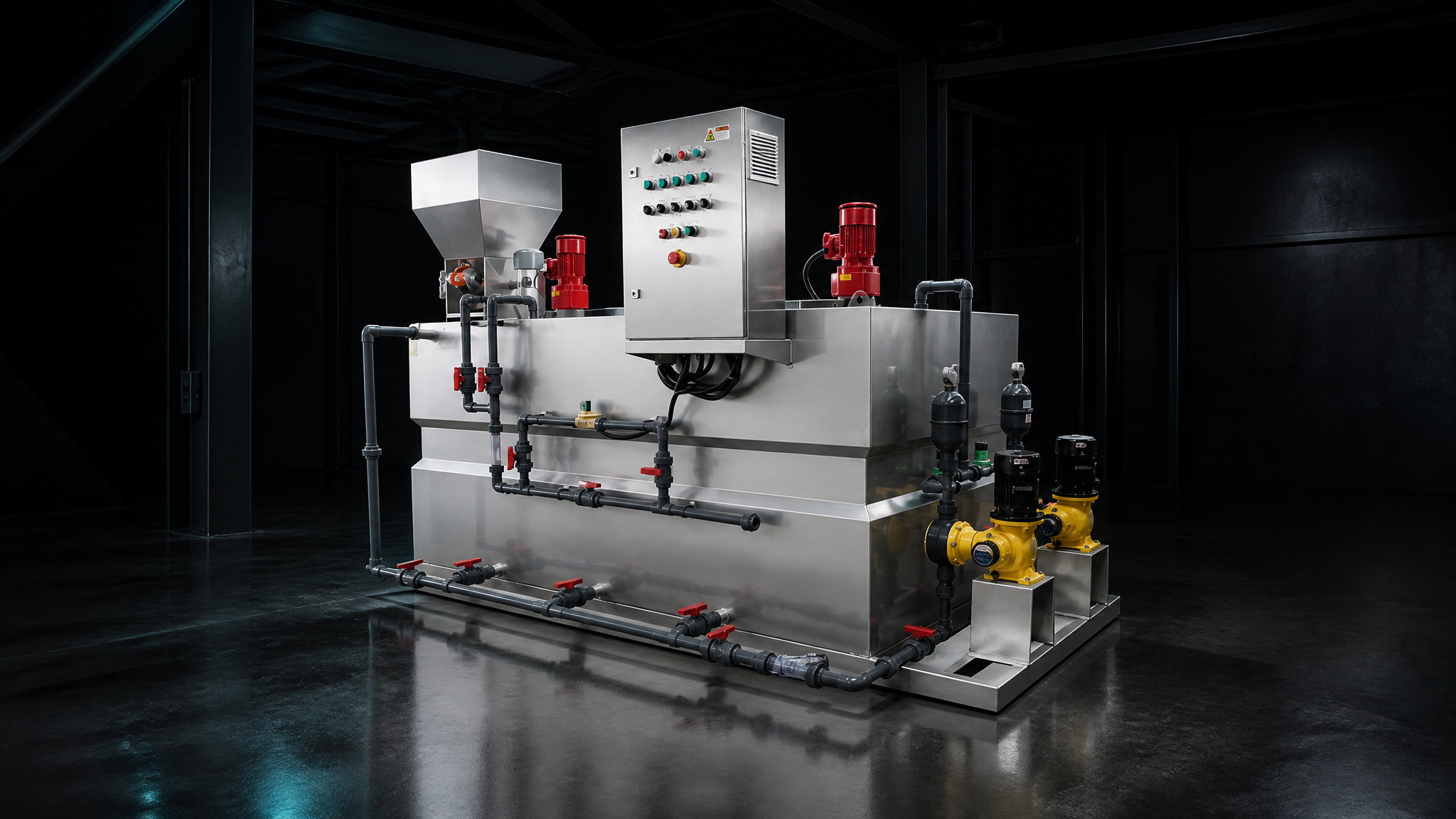
Polymer preparation unit
Automatic make-up of powder or emulsion polymer with controlled dilution and maturation, delivering fully activated solution to the dosing point. Consistent quality, lower consumption.
View equipmentDosing stations
Metering of coagulant, flocculant and precipitant matched to the process signal, so the dose follows the load instead of a fixed setpoint.
View equipmentWhat is achievable
Polymer demand is highly application-specific. The ranges below are indicative for sludge conditioning and are confirmed by trials on your sludge.
| Parameter | Typical range |
|---|---|
| Polymer dose (dewatering) | ~2–12 kg active/t DS (sludge-dependent) |
| Make-up concentration | ~0.1–0.5 % typical working solution |
| Maturation time | ~30–60 min for full activation |
| Consumption reduction potential | often substantial with correct preparation |
How we size it
A preparation and dosing station is sized on reagent throughput and the process it serves. The inputs we need are:
Key sizing inputs
- Polymer form (powder or emulsion)
- Downstream process and its solids load
- Required working-solution flow
- Make-up water quality
- Degree of automation and control signal
Rent or pilot first
Where the goal is to prove a consumption saving, a trial with a properly configured preparation unit on your own sludge is the most direct evidence — and can be combined with a dewatering trial.
Rent or pilot firstRelated reading
Frequently asked questions
Why is my polymer consumption so high?
Most often because the polymer is not fully activated — too little maturation time, wrong dilution or poor make-up water. Correcting preparation usually brings consumption down markedly.
Powder or emulsion — which should I use?
It depends on plant size, handling and layout. Powder is cheaper per active kilogram but needs more make-up equipment; emulsion is simpler to handle. We help you weigh both.
Can dosing follow the load automatically?
Yes. A dosing station driven by a process signal adjusts the dose to the actual load, which stabilises flocculation and avoids over-dosing.
How long does polymer need to mature?
Typically half an hour to an hour for full chain activation. Skipping maturation is a common and expensive mistake.
Engineering Hub: get this sized for your plant
Describe your goal, effluent limit or sludge volume and receive a technology shortlist plus a sizing proposal – by email, no phone call required.