Sludge management
Sludge management & dewatering
Sludge is the single largest operating cost item on many treatment plants, and almost all of that cost is water being trucked away. Every percentage point of dry solids you add before disposal is tonnage you never pay to transport or incinerate.
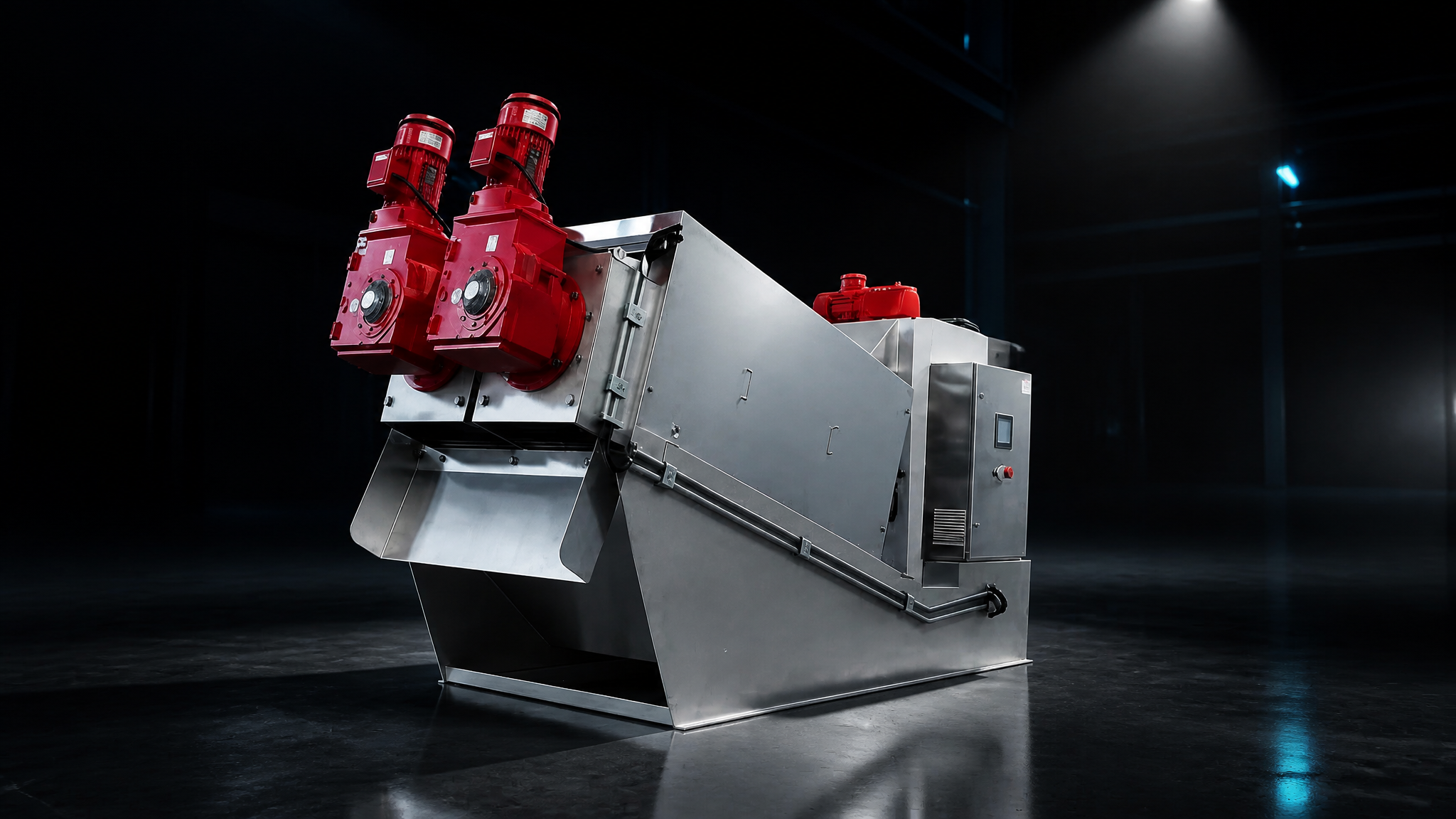
Modern sludge management is about removing that water reliably, automatically and with the least possible operator attention. The screw press has become the workhorse for this because it runs unattended around the clock, uses very little energy and almost no wash water.
In brief
Sludge management is the conditioning, thickening and dewatering of the solids a treatment plant produces, with the goal of minimising disposal volume and cost while keeping the process reliable and unattended.
The challenges this solves
Disposal volume and cost
Disposal is usually billed per tonne of wet cake. Because the cake is mostly water, small gains in dry solids translate directly into lower haulage and disposal bills — often the fastest payback on the whole plant.
24/7 unattended operation
Few plants can staff a dewatering hall at night or at weekends. Equipment that starts, runs and stops on its own — and shuts down safely on an alarm — is essential for continuous operation.
Variable sludge characteristics
Sludge concentration and composition change with the season and the process. The dewatering line and its polymer dosing have to hold performance across that variability without constant re-tuning.
Technologies we apply
Screw press
A slowly rotating screw dewaters conditioned sludge against an adjustable counter-pressure. Very low energy, almost no wash water, low noise and designed for fully unattended 24/7 operation with automatic start-stop.
View equipmentPolymer conditioning
Dewatering performance stands or falls on flocculation. A correctly prepared and dosed polymer builds strong flocs that release water — the difference between a wet and a transportable cake.
View equipmentFlotation thickening
Where sludge has to be thickened before dewatering, dissolved air flotation lifts the solids to the surface for concentration — an efficient pre-step that reduces the load on the dewatering machine.
View equipmentWhat is achievable
The ranges below are typical for screw-press dewatering of municipal and industrial sludge. Achievable dry solids depend heavily on sludge type and polymer conditioning and are confirmed by a dewatering trial.
| Parameter | Typical range |
|---|---|
| Cake dry solids (surplus activated sludge) | ~15–20 % DS |
| Cake dry solids (primary/mixed) | ~20–25 % DS |
| Solids capture | ~95–98 % |
| Wash water demand | very low, intermittent |
| Attendance | fully unattended, automatic start-stop |
How we size it
Sludge dewatering is sized on daily solids load, not on volumetric flow. The inputs we need to size a line are:
Key sizing inputs
- Daily dry solids load (kg DS/d)
- Feed sludge concentration (% DS)
- Sludge type (primary, surplus, mixed, industrial)
- Target cake dryness and disposal route
- Operating hours per day and staffing model
Rent or pilot first
A rental screw press bridges a dewatering outage or lets you run a trial on your own sludge before you invest. It is also the fastest way to establish achievable cake dryness and polymer demand under real conditions.
Rent or pilot firstRelated reading
Frequently asked questions
How much can I reduce sludge volume?
Because the cake is mostly water, moving from a thin sludge to a transportable cake can cut disposal tonnage substantially. The exact reduction depends on your starting concentration and target dryness — our sludge disposal calculator estimates it for your figures.
Can a screw press really run unattended overnight?
Yes. It is designed for automatic start-stop and safe shutdown on alarm, which is why it is the preferred machine for plants without night staffing.
What determines polymer consumption?
Sludge type, make-up water quality and dosing control. Poorly prepared polymer is the most common reason for excessive consumption — correct preparation usually recovers a large part of the cost.
How is a dewatering line sized?
On daily dry solids load and operating hours, not on flow. Give us the load and sludge type and we size the machine and the polymer station together.
Engineering Hub: get this sized for your plant
Describe your goal, effluent limit or sludge volume and receive a technology shortlist plus a sizing proposal – by email, no phone call required.