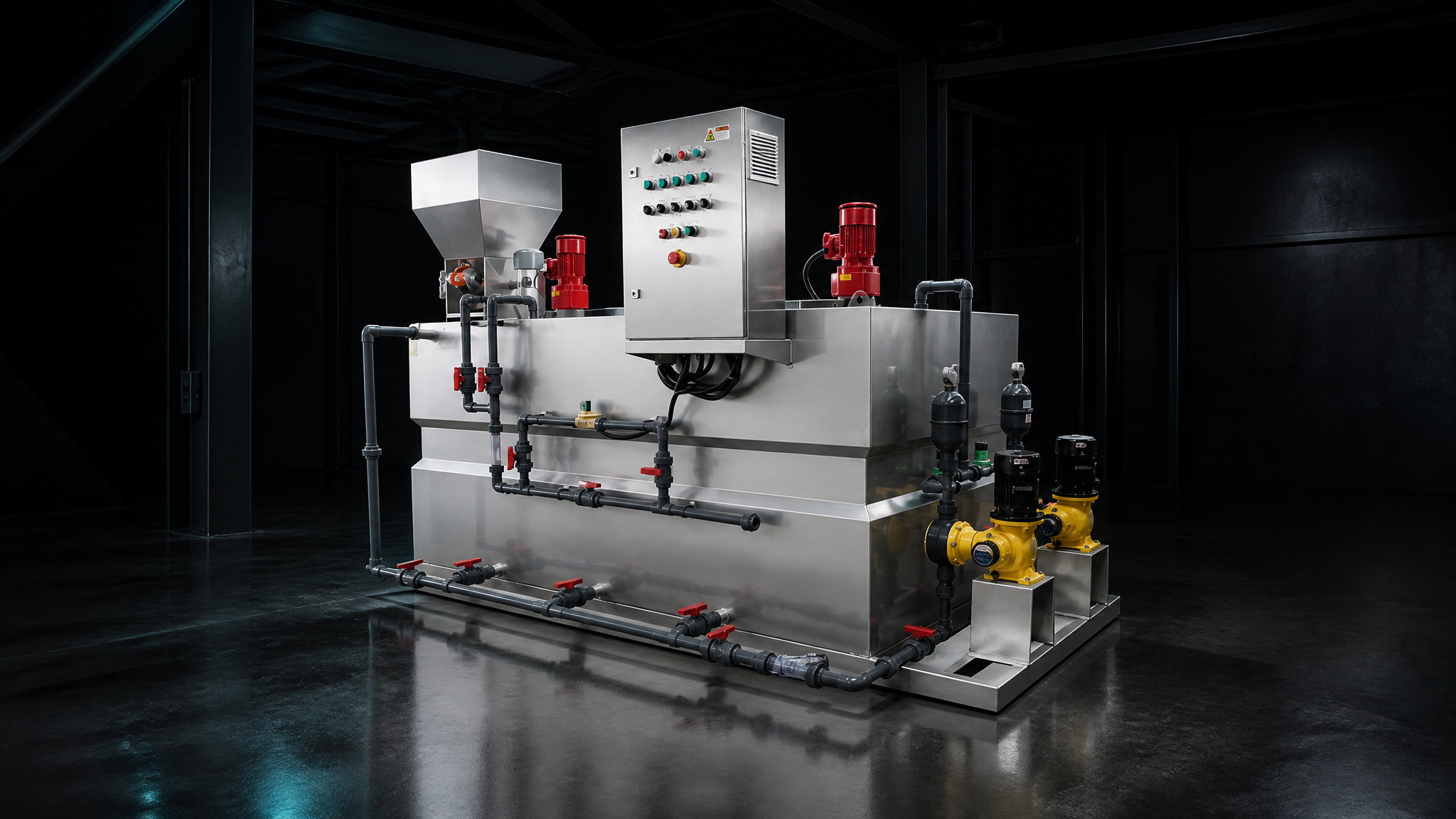
Key Parameters for Polymer Consumption Analysis
- Parameter
- Typical Range Critical Threshold
- Make-up concentration
- 0.2–0.5% ±0.05% deviation
- Ageing time
- 30–60 min <20 min problematic
- Dilution water quality
- <100 NTU, <500 mg/l TDS >200 NTU critical
- Dosing point residence time
- 15–45 sec <10 sec insufficient
- Polymer age in tank
- <24 hours >48 hours degraded
When polymer consumption climbs significantly above design figures—sometimes by 30% or more—operators face both budget pressure and operational uncertainty. The challenge.
This guide provides a step-by-step troubleshooting protocol that addresses the most common root causes of excessive.
Engineering Hub: get this sized for your plant
Describe your goal, effluent limit or sludge volume and receive a technology shortlist plus a sizing proposal – by email, no phone call required.
The Systematic Diagnostic Protocol
Step 1: Verify Make-up Concentration
Begin at the source. Incorrect make-up concentration is the most frequent culprit behind elevated consumption..
Check the preparation unit calibration. Verify that the polymer powder feeder or liquid metering pump delivers the specified mass flow. A.
Measure actual concentration. Don't rely solely on setpoints. Take samples and verify concentration through viscosity measurement or dry-weight analysis. Concentrations below design.
Step 2: Assess Ageing and Dissolution Quality
Poorly dissolved or insufficiently aged polymer performs weakly, requiring higher doses to achieve the same effect.
Inspect the ageing tank. Verify that residence time matches design specifications. Shortened ageing time—often caused by increased throughput or.
Examine mixing energy. Both under-mixing (incomplete dissolution) and over-mixing (chain degradation) reduce polymer performance. Check.
| Symptom | Probable Cause | Verification Method | Correction |
|---|---|---|---|
| Gel particles visible | Insufficient mixing | Visual inspection, screen test | Increase mixing intensity |
| Low viscosity despite correct concentration | Polymer degradation | Viscosity measurement | Reduce mixing energy, check age |
| Inconsistent floc formation | Concentration fluctuation | Continuous monitoring | Calibrate feeders, check controls |
| Rapid performance decline | Excessive polymer age | Time-stamped sampling | Reduce batch size, increase turnover |
Step 3: Evaluate Dilution Water Quality
Dilution water quality directly affects polymer performance. Contaminants can neutralize active sites or interfere with chain extension.
Test for suspended solids. Turbidity above 100 NTU indicates particulates that consume polymer before it.
Measure dissolved salts. Total dissolved solids above 500 mg/l can affect ionic polymers, particularly cationic types.
Check pH. Extreme pH values (below 5 or above 9) can alter polymer charge density and chain conformation, reducing effectiveness.
Water Quality Impact
Using process water or filtrate for polymer dilution without quality verification is a common cause of unexplained consumption increases. Even small changes in water chemistry—such as seasonal variations in source water or process upsets—can significantly impact polymer performance. Always establish baseline water quality parameters and monitor regularly.
Step 4: Analyze Dosing Point and Mixing Conditions
Even perfectly prepared polymer fails if dosed incorrectly.
Verify dosing point location. The polymer must contact sludge particles with sufficient mixing energy to promote flocculation, but excessive.
Measure residence time. From dosing point to separation (centrifuge, belt press, or DAF), verify that contact time falls within the.
Assess mixing intensity. Calculate velocity gradients at the dosing point. Values below 200 s⁻¹ may.
Systematic Troubleshooting Sequence
- 11. Document baseline conditions — Record current consumption, sludge characteristics, and all operational parameters before making changes
- 22. Verify make-up concentration — Calibrate feeders and confirm actual concentration through laboratory analysis
- 33. Check ageing time and quality — Ensure polymer receives full hydration time without degradation from over-mixing or excessive age
- 44. Test dilution water — Analyze turbidity, TDS, hardness, and pH; compare against baseline values
- 55. Evaluate dosing conditions — Verify dosing point location, mixing intensity, and residence time to separation
- 66. Optimize dose rate — With all parameters corrected, conduct jar tests to establish minimum effective dose
- 77. Monitor and validate — Track consumption over 7–14 days to confirm sustainable improvement
Step 5: Optimize Through Testing
Once mechanical and operational issues are addressed, optimize the dose rate itself.
Conduct systematic jar tests. Using sludge samples, test a range of polymer doses to identify the minimum effective concentration..
Validate at full scale. Jar test results provide guidance, but full-scale validation is essential. Implement.
Process Integration Considerations
Polymer consumption optimization cannot be isolated from overall process performance. Changes in upstream processes—thickening efficiency, digestion performance, or mixing intensity—directly affect polymer requirements. Establish regular communication between process areas to identify changes that may impact chemical conditioning needs. A 1% increase in feed solids concentration, for example, may allow a 5–10% reduction in polymer dose.
Sustaining Optimal Performance
Diagnosing and correcting excessive polymer consumption is only half the challenge. Sustaining optimal performance requires ongoing monitoring and periodic re-verification.
Establish key performance indicators: polymer consumption per ton of dry solids, cake solids percentage, and filtrate.
Schedule regular calibration of preparation and dosing equipment. Quarterly verification prevents gradual drift that operators may not notice day-to-day.
Document all changes to process conditions, sludge characteristics, or polymer specifications. When consumption increases, this record helps identify correlations quickly.
What is the most common cause of excessive polymer consumption?+
Incorrect make-up concentration or insufficient ageing time are the most frequent root causes. Even small calibration drifts in powder feeders or liquid metering pumps can increase consumption by 15–30%. Always verify actual concentration through laboratory analysis rather than relying solely on equipment setpoints.
How does dilution water quality affect polymer performance?+
Poor dilution water quality—high turbidity, excessive dissolved salts, or extreme pH—can reduce polymer effectiveness by 20–40%. Suspended solids consume polymer before it reaches the sludge, while high hardness interferes with ionic polymer function. Using filtrate or process water without quality verification is a common oversight that drives up consumption.
Can dosing point location really make a significant difference?+
Absolutely. Dosing location determines mixing intensity and contact time, both critical for flocculation. Dosing too early exposes polymer to excessive shear that breaks flocs; dosing too late provides insufficient contact time. Optimizing dosing point location alone can reduce consumption by 10–25% while improving dewatering performance.
Equipment we supply for this
Engineering Hub: get this sized for your plant
Describe your goal, effluent limit or sludge volume and receive a technology shortlist plus a sizing proposal – by email, no phone call required.