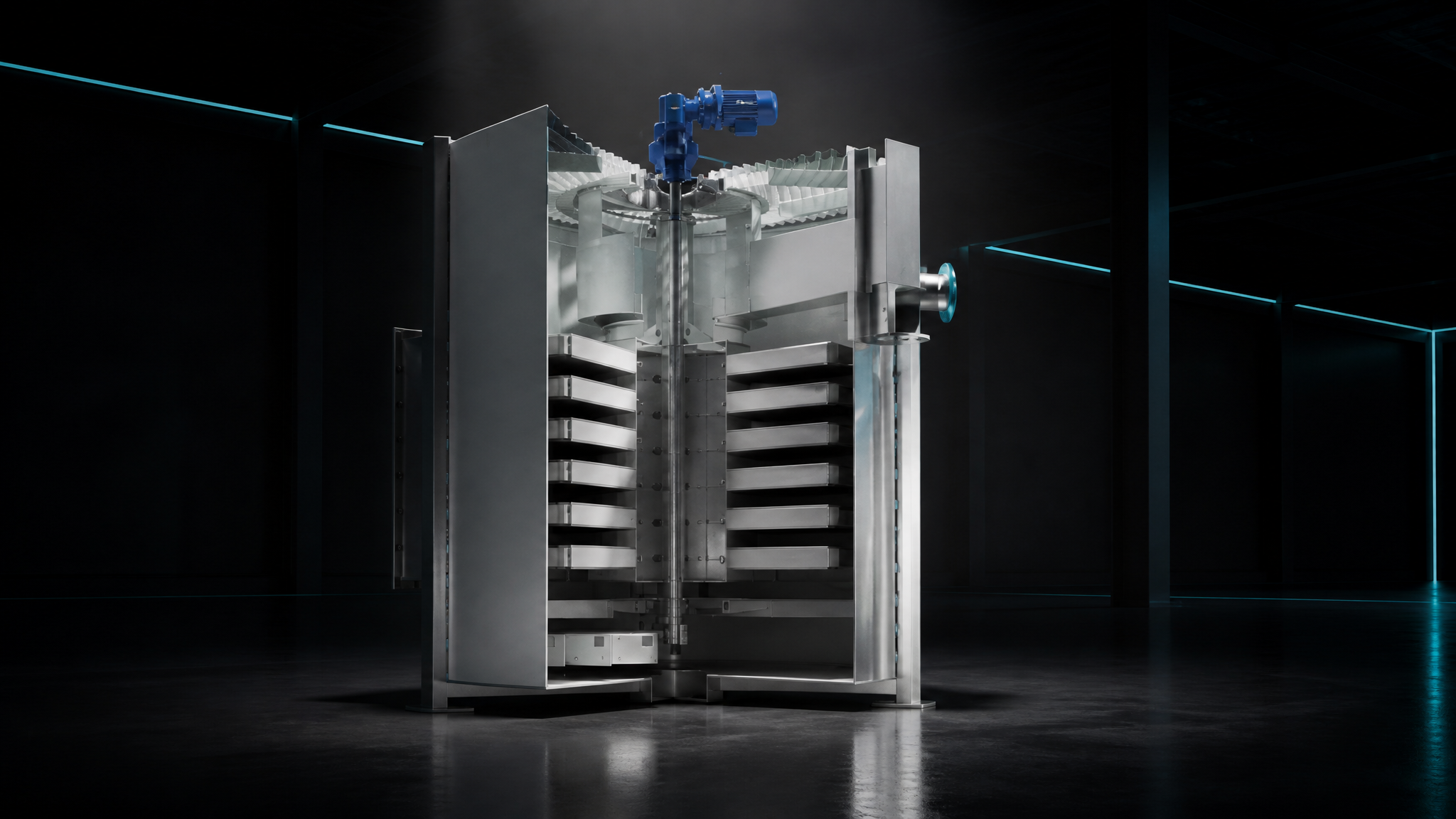
Engineering Hub: get this sized for your plant
Describe your goal, effluent limit or sludge volume and receive a technology shortlist plus a sizing proposal – by email, no phone call required.
Replacing Sand Filters with Pile Cloth Media: A Financial and Engineering Decision
When sand filters become a recurring maintenance burden, the question is whether they still make economic sense. Aging sand filters often consume too much wash water, require frequent backwashing, and occupy footprint that cannot easily be expanded. For facilities facing tighter discharge limits and limited space, pile cloth media disc filters offer a retrofit path that can reduce operating effort while improving filtration consistency — provided the decision is based on a structured TCO evaluation.
What TCO Should Include
A meaningful TCO model compares the full lifecycle cost over a 10- to 20-year planning horizon:
- Capital cost: equipment, installation, piping, civil modifications, controls, commissioning
- Energy cost: pumping, backwash systems, air scour, and auxiliary loads
- Water loss cost: backwash volume and associated disposal cost
- Maintenance cost: media replacement, service visits, parts, labor, and unplanned downtime
- Risk cost: regulatory exceedance risk, bypass events, and production interruption
In many plants, the biggest surprise is the operating cost profile. Sand filters can remain mechanically robust while still being financially inefficient.
[title]
- Label
- Value
- ---
- ---
- Typical retrofit driver
- Excessive backwash, high energy use, limited footprint
- Planning horizon for TCO
- 10–20 years
- Common retrofit scope
- Mechanical replacement, piping adaption, controls integration
- Typical footprint challenge
- No space for filter expansion
- Decision focus
- Lifecycle cost, maintainability, and hydraulic compatibility
How Pile Cloth Media Disc Filters Change the Cost Profile
Pile cloth media filtration is designed to provide fine solids capture with lower hydraulic and operational penalties than conventional sand filtration. In retrofit applications, the main economic value often comes from fewer cleaning cycles, lower wash-water losses, and simpler operation.
Typical operational advantages
- Lower backwash intensity and reduced wash-water consumption in many applications
- Compact footprint — important where basin expansion is impossible
- Modular configuration that fits into existing process layouts
- Stable effluent quality when influent solids loading varies within design limits
| Factor | Sand Filters | Pile Cloth Media Disc Filters |
|---|---|---|
| Footprint | Often larger and difficult to expand | Compact retrofit-friendly layout |
| Cleaning demand | Frequent backwashing in many older systems | Lower operating burden in suitable applications |
| Energy use | Higher due to backwash and hydraulics | Typically lower, depending on duty |
| Water loss | Can be significant over a year | Usually reduced compared with sand systems |
| Maintenance focus | Media condition, backwash equipment, valves | Cloth integrity, drives, spray systems, instrumentation |
Retrofit Decision Framework
A sound retrofit decision should proceed in four steps.
1. Define the process objective
Start with the discharge target. Is the plant trying to improve suspended solids removal, reduce turbidity, or provide a buffer for tighter seasonal limits? The target determines whether the retrofit must be a like-for-like replacement or a performance upgrade.
2. Confirm hydraulic compatibility
Check available head, influent flow variation, solids loading, and downstream constraints. A pile cloth media disc filter may be an excellent technical fit, but only if the site can support the hydraulic profile and control strategy.
3. Quantify TCO over the planning horizon
Compare annual energy, wash water, labor, spare parts, and shutdown impacts. A realistic TCO model usually shows the highest value in plants that currently spend a large share of effort on filter cleaning and corrective maintenance.
4. Evaluate implementation risk
Retrofit success depends on layout, access, tie-in windows, and control integration. Plants with limited shutdown windows should prioritize solutions with predictable installation scope and standardized interfaces.
Key decision criteria
- Existing sand filters require frequent intervention
- Backwash water has become a significant operating cost
- Site footprint cannot be expanded
- Effluent quality must improve or become more stable
- Maintenance staffing is limited
- A retrofit can be completed within available outage windows
[title]
A lower purchase price does not mean lower lifecycle cost. If a sand filter continues to consume excessive energy, wash water, and labor, apparent savings can disappear within a few years. Always evaluate retrofit options using a full TCO model.
Retrofit Checklist for Plant Teams
Process and hydraulic data
- Peak, average, and minimum flow rates
- Influent solids concentration and particle characteristics
- Current effluent quality and regulatory target
- Available inlet and outlet head
- Bypass, standby, and redundancy requirements
Mechanical and layout data
- Existing footprint dimensions
- Basin access, lifting routes, and demolition limits
- Structural conditions and anchoring constraints
- Pipe sizes, valve locations, and drain arrangements
- Electrical supply and controls integration requirements
Economic data
- Annual energy consumption of current filters
- Backwash volume and disposal cost
- Labor hours spent on operation and maintenance
- Spare part expenditure and unplanned downtime
- Budget limits and internal payback criteria
Implementation data
- Shutdown window availability
- Temporary treatment needs during retrofit
- Commissioning and training requirements
- Ongoing service expectations
[title]
- Collect 12 months of operating data before comparing options
- Include energy, water, labor, and downtime in the TCO model
- Verify available head and hydraulic losses early
- Measure the true footprint available for retrofit
- Confirm access for installation and future maintenance
- Define performance acceptance criteria before procurement
- Review integration with existing controls and alarms
When a Sand Filter Replacement Makes the Most Sense
Replacement is often justified when the current system has reached an operational ceiling: persistent backwashing, rising operating costs, unstable effluent quality, and no room for expansion. In those cases, a pile cloth media disc filter is a financially rational choice, particularly when the retrofit must fit inside an existing facility envelope.
How do I know if a sand filter should be replaced instead of repaired?+
If maintenance frequency, energy consumption, and wash-water losses remain high after normal servicing, replacement is often worth evaluating through a TCO model.
Are pile cloth media disc filters always cheaper to operate?+
Not always. They are often more efficient in retrofit-friendly tertiary filtration, but the final result depends on hydraulic conditions, solids loading, and maintenance strategy.
What is the most important retrofit risk?+
Hydraulic mismatch and poor layout integration are the main risks, so available head, footprint, and controls compatibility should be reviewed early.
Equipment we supply for this
Engineering Hub: get this sized for your plant
Describe your goal, effluent limit or sludge volume and receive a technology shortlist plus a sizing proposal – by email, no phone call required.