Engineering Hub: get this sized for your plant
Describe your goal, effluent limit or sludge volume and receive a technology shortlist plus a sizing proposal – by email, no phone call required.
Why polymer consumption drifts – and how make-up quality fixes it
When your polymer consumption sits 40% above the design figure month after month, the instinct is to blame sludge characteristics or process upsets. Yet in most cases, the root cause lies much closer to home: in the polymer preparation station itself.
This article focuses on the preparation side of the polymer story—where small errors multiply into major cost overruns—and provides a systematic troubleshooting path to bring consumption back on target.
Why polymer consumption drifts
- Typical drift range
- 30–60% above design
- Primary root cause
- Make-up quality and concentration error
- Payback period
- 2–6 months after correction
- Most overlooked factor
- Ageing time consistency
The hidden cost of preparation errors
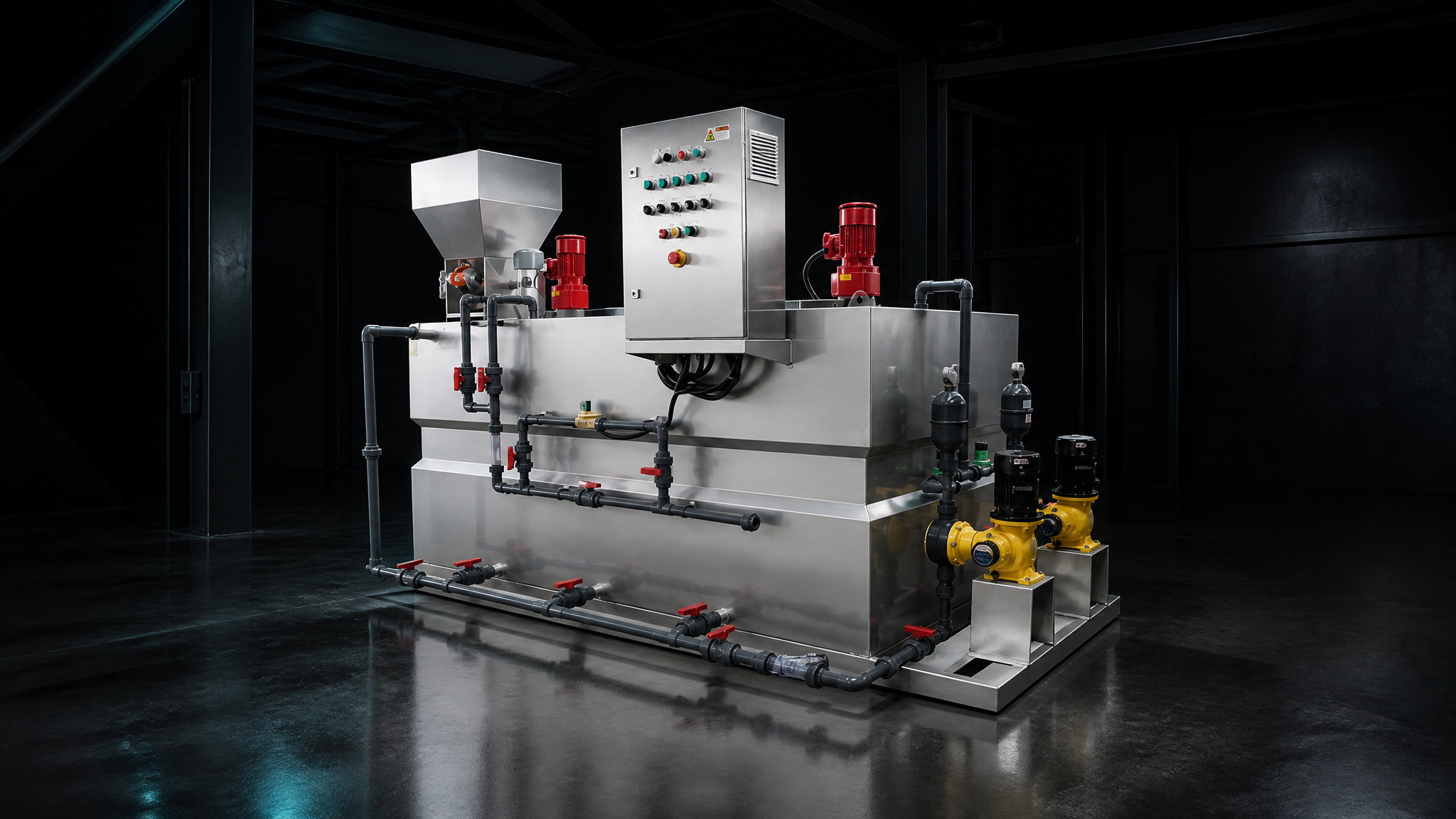
Polymer preparation seems straightforward: dilute powder or emulsion to working concentration, allow time for chain uncoiling, then dose. But each step harbours failure modes that degrade active polymer availability.
The insidious part: jar tests performed with fresh, correctly prepared polymer still show good results at design dose. The gap between lab and reality widens, and troubleshooting focuses everywhere except the preparation station.
Three preparation factors that drive consumption drift
1. Make-up water quality and wetting
Polymer powder must disperse into individual particles before hydration begins. Clumping—caused by too-rapid addition, poor mixing energy, or hard water—creates "fish eyes" that never fully dissolve.
Correction: Verify make-up water hardness stays below 150 mg/L CaCO₃. Check eductor vacuum and powder feed rate. Inspect the wetting funnel for bridging or uneven flow. A simple turbidity test of aged solution (should be crystal-clear at 0.1–0.2% active) reveals incomplete dissolution.
2. Ageing time consistency
Polymer chains require 45–90 minutes to fully uncoil after wetting, depending on molecular weight and chemistry. Batch systems often short-cut this when demand spikes; continuous systems suffer when flow rates change without adjusting residence time. Under-aged polymer delivers 20–40% less floc strength, forcing higher doses.
Correction: Install level switches or timers that enforce minimum ageing before transfer to day tanks. For continuous systems, calculate actual residence time at current flow (tank volume ÷ flow rate) and compare to supplier specification. If residence drops below 60 minutes during peak demand, you've found your culprit.
3. Concentration drift and verification
Most sites set concentration once during commissioning and assume it holds. But powder feeders wear, emulsion pumps drift, and dilution water flow varies with supply pressure. A target of 0.2% that drifts to 0.15% requires 33% more volume to deliver the same active dose—and that's exactly what operators dial in.
Correction: Implement weekly concentration verification. The simplest method: weigh a known volume of aged solution and compare to water density. A 1000 mL sample of 0.2% solution should weigh 1002 g; 0.15% weighs 1001.5 g. Precision scales (±0.1 g) make this a five-minute check.
| Target (%) | Actual (%) | Volume increase | Annual cost impact (1,000 kg/yr) |
|---|---|---|---|
| 0.20 | 0.15 | +33% | +€8k–12k |
| 0.25 | 0.20 | +25% | +€6k–9k |
| 0.30 | 0.25 | +20% | +€5k–7.5k |
Systematic troubleshooting approach
When consumption exceeds design, work through this sequence before adjusting process parameters:
Polymer consumption troubleshooting
- 11. Verify concentration – Weigh aged solution samples from day tank; compare to target density
- 22. Check ageing time – Calculate actual residence time in maturation tanks under current flow
- 33. Inspect make-up quality – Sample aged solution for clarity; test hardness of dilution water
- 44. Review dosing calibration – Confirm pump output matches controller signal across flow range
- 55. Validate with jar test – Use plant-prepared polymer (not lab stock) at design dose on fresh sludge
- 66. Document baseline – Record corrected consumption for 2–3 weeks before declaring success
This sequence isolates preparation issues before diving into sludge variability or mixing energy—factors that matter, but rarely explain sustained 30–50% overruns.
Degradation in day tanks
Aged polymer solution degrades through shear and biological activity. Day tanks should turn over every 24–48 hours maximum. Stagnant solution loses 15–30% activity within 72 hours, even with biocide addition. If your day tank holds a week's supply, you're dosing progressively weaker solution all week.
Practical correction steps
Once you've identified the preparation weak point, corrections are usually straightforward:
- For concentration drift: Recalibrate powder feeders or emulsion pumps quarterly. Install flow meters on dilution water lines if not present.
- For ageing issues: Resize maturation tanks or add a second tank in series to guarantee residence time during peak flow.
- For make-up quality: Install a water softener if hardness exceeds 200 mg/L, or switch to pre-treated water. Upgrade eductor nozzles if vacuum is weak.
The investment is modest—often under €5,000 for instrumentation or minor piping changes—and payback comes within months through reduced polymer purchase.
How quickly will I see consumption drop after fixing preparation issues?+
Typically within 3–7 days once corrected polymer reaches the dosing point and operators re-optimize dose rates. Document the baseline carefully so savings are measurable.
Can I use the same troubleshooting approach for emulsion and powder polymers?+
Yes, though emulsion systems are more sensitive to dilution water quality and less prone to fish-eye formation. Ageing time and concentration verification apply equally to both.
What if consumption is still high after preparation corrections?+
Then shift focus to process factors: mixing energy, sludge residence time before conditioning, or polymer selection. But fix preparation first—it's the low-hanging fruit in 70% of cases.
Bringing consumption back on target
Polymer consumption drift is rarely a mystery when you audit the preparation station with the same rigor applied to process equipment. Make-up quality, ageing consistency, and concentration accuracy are the three levers that determine how much active polymer reaches your sludge. Get these right, and design figures become achievable again—without changing a single process parameter.
The next time consumption creeps up, start at the preparation skid. The answer is usually there, waiting to be measured.
Equipment we supply for this
Engineering Hub: get this sized for your plant
Describe your goal, effluent limit or sludge volume and receive a technology shortlist plus a sizing proposal – by email, no phone call required.