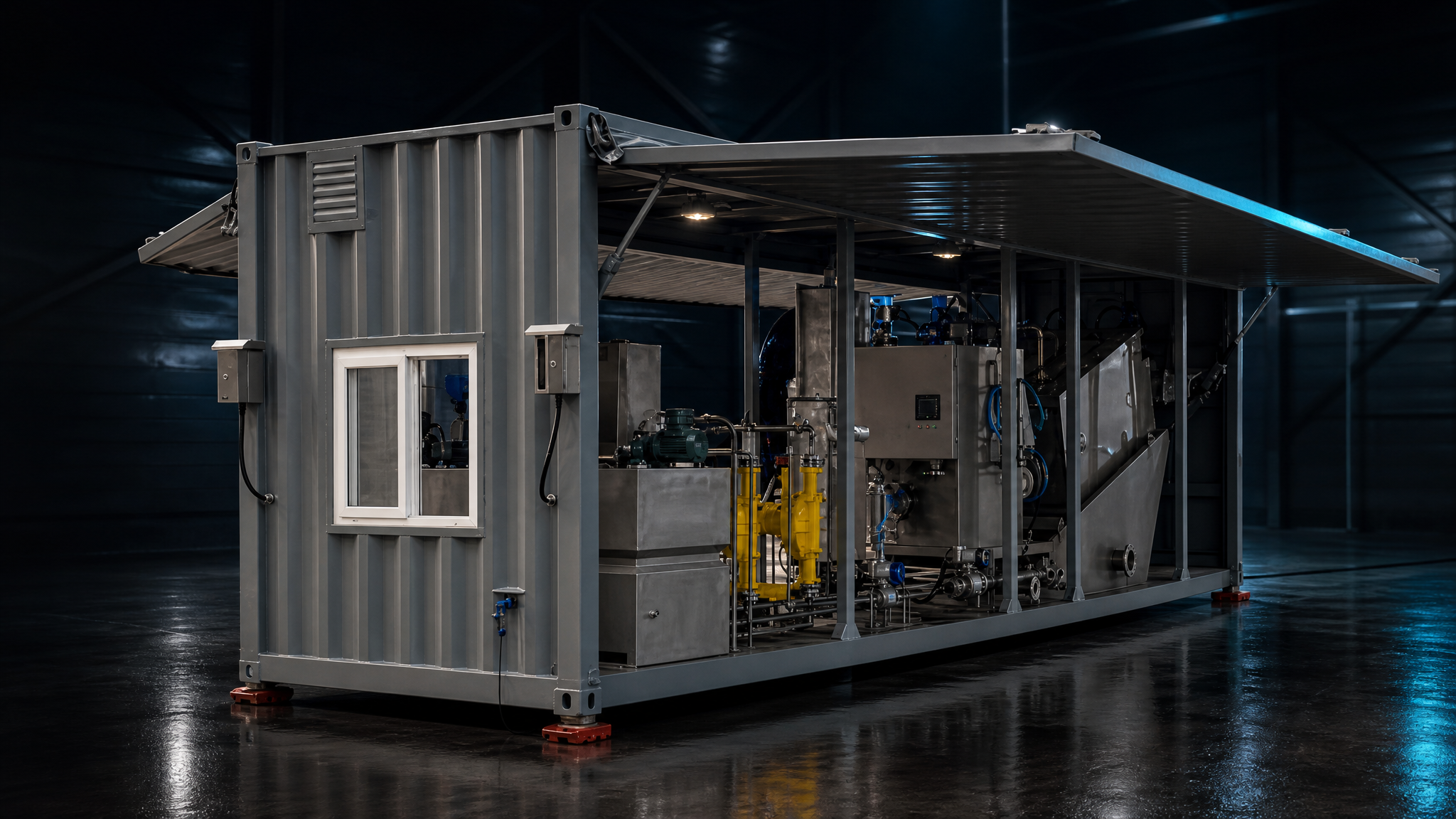
Sludge handling is often the single largest operating cost item of an industrial or municipal wastewater treatment plant. Every cubic metre of water that leaves the plant with the sludge has to be transported and disposed of, so the performance of conditioning, thickening and dewatering directly determines disposal volumes and costs.
This engineering guide covers the complete sludge treatment chain: sludge types and their dewaterability, polymer conditioning, thickening, the main dewatering technologies including the screw press, achievable dry-solids contents, disposal economics, automation and temporary rental solutions. All values are typical ranges and must be confirmed with tests on the actual sludge.
Sludge Dewatering at a Glance
- Typical feed solids (thickened)
- 2–6 % DS
- Typical cake after mechanical dewatering
- 18–35 % DS, depending on sludge and technology
- Typical polymer demand
- 3–12 kg active polymer per tonne DS
- Main cost driver
- Wet cake mass to disposal
Engineering Hub: get this sized for your plant
Describe your goal, effluent limit or sludge volume and receive a technology shortlist plus a sizing proposal – by email, no phone call required.
Sludge Types and Their Dewaterability
The achievable cake dryness depends far more on the sludge than on the machine. Key influencing factors are the ratio of organic to inorganic solids, the content of fibres, fats and extracellular polymers, and the degree of stabilisation.
| Sludge type | Characteristics | Typical cake DS (mechanical dewatering) |
|---|---|---|
| Primary sludge | Coarse, fibrous, readily dewaterable | 25–35 % |
| Waste activated sludge (non-digested) | Fine flocs, high bound water | 16–22 % |
| Digested sludge | Stabilised, medium dewaterability | 20–30 % |
| Chemical / precipitation sludge | Inorganic, metal hydroxides | 20–40 % |
| Flotation sludge (food industry) | High fat and protein content | 15–25 % |
Mixed industrial sludges can deviate significantly from these ranges. Laboratory tests (capillary suction time, filtration and centrifuge tests) and pilot trials with the original sludge are the most reliable basis for design.
Conditioning with Polymer
Polymer conditioning binds fine particles into stable flocs that release water under mechanical pressure. It is the step with the greatest leverage on cake dryness, filtrate quality and operating costs.
- Polymer type: cationic polyacrylamides are standard for organic sludges; charge density and molecular weight are selected in jar and dewatering tests.
- Make-up quality: sufficient ageing time and correct concentration (typically 0.1–0.5 % for the dosing solution) are decisive; poorly dissolved polymer leads to high consumption.
- Dosing point and mixing: short, intensive mixing before the dewatering unit; dosing control based on sludge flow and solids content.
The causes of increasing polymer demand are explained in why polymer consumption drifts; the choice between powder and liquid products is covered in powder vs. emulsion polymer.
Thickening Before Dewatering
Thickening reduces the sludge volume before dewatering and stabilises the feed to the dewatering unit. Common processes are gravity thickeners, flotation thickeners, drum and belt thickeners. Thickened sludge typically reaches 4–8 % DS, depending on sludge type and process.
A stable feed concentration is important for the dewatering stage: strong fluctuations make polymer dosing difficult and reduce the average cake dryness.
Mechanical Dewatering Technologies
The three most common technologies are the screw press, the decanter centrifuge and the belt filter press. Each has a typical operating window:
| Criterion | Screw press | Decanter centrifuge | Belt filter press |
|---|---|---|---|
| Cake DS (digested sludge) | 18–28 % | 20–30 % | 16–24 % |
| Specific energy demand | Very low | High | Low |
| Rotational speed / wear | Very low speed, low wear | High speed, wear on scroll | Belt and roller wear |
| Noise and vibration | Very low | High | Low |
| Wash water demand | Low, intermittent | Low | High, continuous |
| Operator attention | Low, suitable for unattended operation | Medium | High |
A detailed comparison including life-cycle cost considerations is available on the page screw press vs. centrifuge vs. belt press.
Screw Press Basics
The screw press dewaters conditioned sludge between a slowly rotating screw and a cylindrical screen basket. The volume between the screw flights decreases towards the discharge, so the pressure on the sludge increases gradually while filtrate escapes through the screen.
- Dewatering zones: an inlet and drainage zone for free water, followed by a pressing zone in which the cake is compacted; a back-pressure cone at the outlet controls the residence time.
- Speed: typically below a few revolutions per minute, which results in very low energy demand, low noise and minimal wear.
- Screen cleaning: spray nozzles clean the screen intermittently, so wash water consumption remains low.
- Application: municipal and industrial sludges, especially where low operating costs, enclosed design and unattended operation are priorities.
How a Screw Press Works
- 1Sludge and polymer are mixed in a flocculation tank upstream of the press.
- 2Flocculated sludge enters the inlet zone, where free water drains through the screen.
- 3The decreasing flight pitch increases pressure in the pressing zone.
- 4The back-pressure cone at the outlet regulates the compaction and cake dryness.
- 5Filtrate is collected and returned to the treatment plant; the cake is discharged by conveyor or into containers.
Dry-Solids Targets and Disposal Costs
The disposal route determines the required cake dryness: incineration, co-incineration, agricultural use or landfill each have their own requirements. Because disposal is usually charged per tonne of wet cake, every percentage point of additional dry solids reduces the mass to be removed.
| Cake DS | Wet cake mass | Change vs. 20 % DS |
|---|---|---|
| 18 % | approx. 556 t | +11 % |
| 20 % | 500 t | reference |
| 22 % | approx. 455 t | −9 % |
| 25 % | 400 t | −20 % |
The calculation of these savings in practice is described in what one extra percent of dry solids is worth. Filtrate and centrate also create an internal return load that should be considered in the overall balance, see filtrate and reject water loops.
Automation and Unattended Operation
Modern dewatering systems can run largely unattended if the critical functions are automated:
- Feed control: sludge flow and solids measurement as basis for flow-proportional polymer dosing.
- Polymer make-up: automatic preparation unit with level control and concentration monitoring.
- Cake quality: monitoring of torque, back pressure or cake dryness to adjust the dewatering unit.
- Safety functions: blockage detection, dry-run protection and controlled shutdown with flushing.
- Remote access: alarms and operating data on the control system or via remote monitoring.
Which functions are essential is covered in unattended 24/7 sludge dewatering.
Rental Solutions for Outages and Trials
Mobile dewatering units in containers or on skids bridge planned maintenance, unexpected failures or seasonal peaks, and allow trials with the original sludge before an investment. Important points to clarify before delivery are electrical connection, sludge and filtrate connections, polymer supply, cake discharge and permits. Details are summarised in bridging a dewatering outage with rental equipment.
Data Needed for Dewatering Design
- Sludge type and origin, degree of stabilisation
- Sludge volume per day and operating hours
- Solids content of the feed (average and range)
- Organic content (loss on ignition)
- Target cake dryness and disposal route
- Available space, power supply and staffing
- Results of laboratory or pilot tests, if available
Which dry-solids content can a screw press achieve?+
For digested municipal sludge, typically 18–28 % DS; for primary or mineral-rich sludges higher values are possible. The result depends primarily on sludge type and conditioning.
How much polymer is needed for dewatering?+
Typical values are 3–12 kg active polymer per tonne of dry solids. Biological and fat-rich sludges tend to need more, primary and inorganic sludges less.
When is a screw press preferable to a centrifuge?+
When low energy demand, low noise, little wear and unattended operation are priorities. Centrifuges can reach slightly higher cake dryness for some sludges but require more energy and maintenance.
Is thickening always necessary before dewatering?+
Not always. Many screw presses can process sludge from about 0.5–1 % DS with an upstream flocculation stage, but thickening reduces the hydraulic load and stabilises the feed.
How quickly can a rental dewatering unit be deployed?+
This depends on availability and site preparation. Clarifying connections, polymer supply and cake discharge in advance significantly shortens commissioning.
What determines the disposal cost of sludge?+
Mainly the wet cake mass, the disposal route and transport distances. Increasing cake dryness is usually the most effective lever.
Equipment we supply for this
Screw Press
Energy-efficient sludge dewatering
Technical dataPolymer Preparation Unit
Fully automatic polymer make-up and dosing station
Technical dataDosing Stations
Precise dosing of coagulants, flocculants and pH correction chemicals
Technical dataStainless Steel Tanks
Process, buffer and storage tanks built to your specification
Technical data