Engineering Hub: get this sized for your plant
Describe your goal, effluent limit or sludge volume and receive a technology shortlist plus a sizing proposal – by email, no phone call required.
Retrofit existing basin with disc filter: The engineering assessment workflow
Constructing new basins is often prohibitively expensive. Retrofitting existing infrastructure with modern tertiary filtration technology can deliver comparable performance at a fraction of the capital cost—but success depends on a rigorous pre-retrofit assessment that validates structural capacity, hydraulic compatibility, and civil integration before any equipment is ordered.
Key Facts
- Typical footprint saving
- 60–80 % vs. new construction
- Structural load assessment duration
- 2–4 weeks with existing drawings
- Hydraulic modeling complexity
- Medium (CFD optional for complex geometries)
- Permit modification timeline
- 3–8 months depending on jurisdiction
- Typical ROI vs. new basin construction
- 18–36 months
Why upgrade wastewater plant without new tanks?
The decision to retrofit rather than build new infrastructure stems from multiple converging pressures:
- Capital budget constraints: New basin construction typically costs €800–€2,400 per cubic meter of volume, excluding site preparation and pipework
- Site footprint limitations: Urban plants often have no available land for expansion
- Accelerated compliance timelines: Regulatory deadlines may not allow 24–36 month construction schedules
- Operational continuity: Retrofits can often be staged to maintain treatment capacity during installation
Yet the engineering question remains: can your specific existing basin safely and effectively house modern filtration equipment?
The pre-retrofit engineering assessment process
Phase 1: Document collection and desktop review
Gather complete documentation before any site visits: structural drawings, as-built civil plans, hydraulic profiles, soil investigation reports, maintenance records, and process flow diagrams. Missing documentation significantly extends assessment timelines.
Phase 2: Structural capacity evaluation
This phase determines whether existing basin walls, floors, and support structures can accommodate additional loads from filtration equipment.
Dead load assessment: Filter units typically add 180–420 kg/m² of filter area; include support frames, backwash piping, and instrumentation. Live loads cover backwash surge, maintenance access, snow, wind, and seismic loads per local codes.
Concrete condition survey: Core sampling verifies compressive strength (target ≥25 MPa); chloride penetration testing, rebar cover assessment, and crack mapping complete the picture.
| Condition Finding | Retrofit Feasibility | Typical Remediation |
|---|---|---|
| Concrete strength >25 MPa, no significant cracking | Proceed with standard design | None required |
| Concrete strength 20–25 MPa, minor surface cracks | Conditional approval | Surface sealing, load distribution plates |
| Concrete strength <20 MPa or structural cracks | Requires reinforcement | Carbon fiber wrapping, post-tensioning, or reject |
| Foundation settlement evidence | Detailed geotechnical review | Underpinning, load redistribution |
Phase 3: Hydraulic compatibility verification
Even structurally sound basins may fail hydraulic integration requirements.
Flow distribution analysis: Evaluate inlet baffle configuration, approach velocity profiles (target <0.15 m/s), dead zones, and turbulence intensity at filter inlet zones.
Hydraulic head budget: Total head requirement is typically 1,200–1,800 mm (clean filter 150–300 mm, dirty filter 600–1,200 mm, backwash 800–1,500 mm, safety margin 200 mm). Insufficient head may require pump stations.
Retention time: Minimum 15–20 minutes for flocculation-filtration; account for 8–15 % volume displaced by equipment.
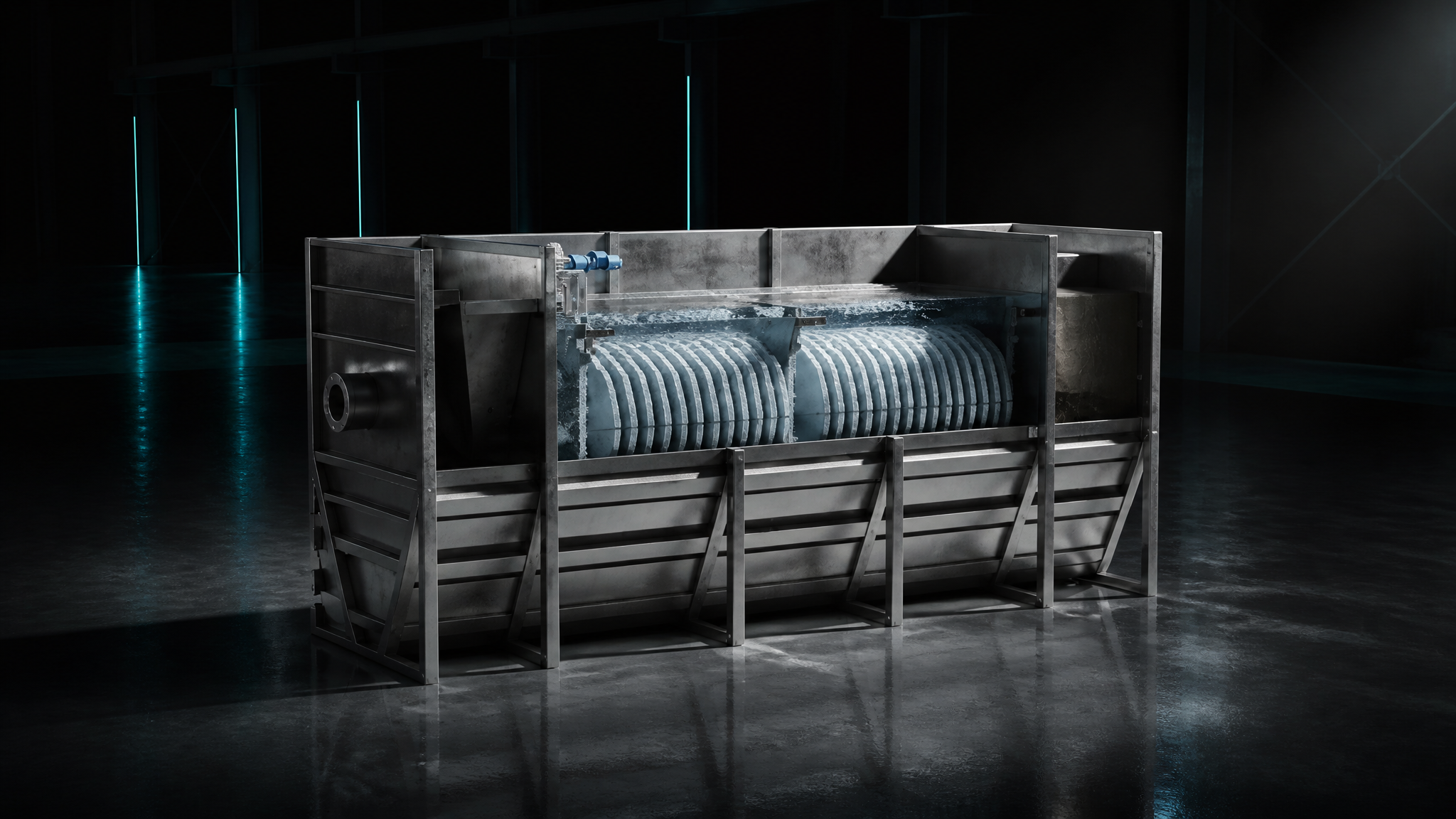
In-basin cloth media filter installation: civil integration requirements
Access and maintenance provisions
Plan for personnel walkways and fall protection, crane access for major maintenance, electrical conduit routing, and backwash waste discharge piping with air scour blowers.
Existing basin modifications
Even "retrofit" projects typically require inlet channel modifications, outlet weir adjustments, penetrations for new piping, anchor bolt installation, and protective coating application.
Important
Never assume existing basin drawings reflect actual as-built conditions. Field verification surveys identifying discrepancies between design and reality are essential. Dimensional errors of 50–150 mm are common in structures over 20 years old, which can prevent proper equipment fit and create costly delays.
Capacity upgrade existing clarifier: realistic performance expectations
When retrofitting tertiary filtration into existing secondary clarifiers or contact basins, establish realistic performance targets:
TSS reduction from 15–25 mg/L to 5–10 mg/L is typical; turbidity below 2 NTU is achievable with proper pretreatment. With coagulation, total phosphorus can reach 0.3–0.5 mg/L. Performance depends critically on upstream process stability—retrofitted filters cannot compensate for poorly performing biological treatment.
Pre-Retrofit Feasibility Checklist
- Complete as-built structural and civil drawings obtained
- Structural load capacity verified by licensed engineer
- Concrete condition assessed (cores, strength testing)
- Hydraulic head budget calculated and verified adequate
- Flow distribution uniformity evaluated (CFD or tracer study)
- Retention time post-installation confirmed sufficient
- Backwash waste handling capacity confirmed
- Electrical service capacity and routing verified
- Permit modification requirements identified
- Maintenance access and safety provisions designed
- Equipment removal/replacement strategy documented
- Project staging plan developed to maintain treatment during construction
The decision framework: proceed, modify, or reject
After completing the assessment, projects fall into three categories:
Proceed with standard retrofit (60–70 %): structure meets load requirements, hydraulics need only minor adjustments, ROI strongly favors retrofit.
Proceed with modifications (20–30 %): structural reinforcement or hydraulic changes required but economically justified; civil scope still less costly than new basin.
Reject retrofit approach (5–10 %): deficiencies too severe, total project cost approaches new construction.
How long does a complete pre-retrofit engineering assessment take?+
Typical timelines range from 6–12 weeks depending on documentation availability and site complexity. Projects with complete as-built drawings and accessible basins can be assessed in 4–6 weeks, while those requiring extensive field investigation, concrete coring, or hydraulic modeling may extend to 12–16 weeks. Budget adequate time before equipment procurement deadlines.
What is the most common reason retrofit projects fail feasibility assessment?+
Insufficient hydraulic head is the leading cause of retrofit rejection, accounting for approximately 40 % of failed assessments. Many existing basins were designed with minimal freeboard, and the 1,200–1,800 mm total head requirement for filtration and backwash systems cannot be accommodated without costly pump stations. Structural deficiencies account for another 30 %, while flow distribution issues represent 20 % of rejections.
Can we retrofit filters into a basin that is still in active service?+
Yes, staged installation is common and often preferred to maintain treatment capacity. Typical approaches include installing filters in one-half of a basin while the other half continues operation, then switching. Alternatively, temporary bypass filtration or peak flow storage can maintain compliance during short installation outages. The staging strategy must be defined during the assessment phase and reflected in the hydraulic modeling to ensure each stage meets discharge limits.
Equipment we supply for this
Conclusion: Engineering rigor enables cost-effective upgrades
Retrofitting existing basins with modern tertiary filtration technology offers compelling economic and schedule advantages over new construction—but only when preceded by thorough engineering assessment. A 6–12 week feasibility study gives plant owners confidence that the retrofit will perform as designed and deliver the expected return on investment.
Engineering Hub: get this sized for your plant
Describe your goal, effluent limit or sludge volume and receive a technology shortlist plus a sizing proposal – by email, no phone call required.